Your pump shaft seal is leaking. Maybe it has been dripping for weeks and you have been adjusting the gland nut. Maybe a mechanical seal has just failed for the third time in two years. Either way, you are here because the seal you have is not working well enough — and you need to know whether you have the right type of seal for the application, or whether you should switch.
This guide answers that question directly. We cover what each sealing method actually does, where each one performs best in Australian industrial conditions, the real cost difference over 3–5 years of operation, and the six most common reasons mechanical seals fail prematurely — so you can stop replacing them on the same interval and fix the root cause.
Pump Power Australia has been specifying and supplying pump shaft seals to Australian mining, water treatment, food processing, and chemical operations for over 35 years. The guidance in this article reflects real application experience across those industries — not generic theory.
If your mechanical seal is leaking beyond an acceptable rate or your gland packing requires adjustment more than weekly — the seal system needs attention now, not at the next scheduled shutdown. Pump Power Australia stocks mechanical seals and gland packing for fast same-day dispatch from our Brooklyn, VIC warehouse. Call +61 3 9933 7400 with your pump model and we will confirm the correct replacement seal specification and availability within the hour. Or visit our Mechanical Seals product page to enquire online.
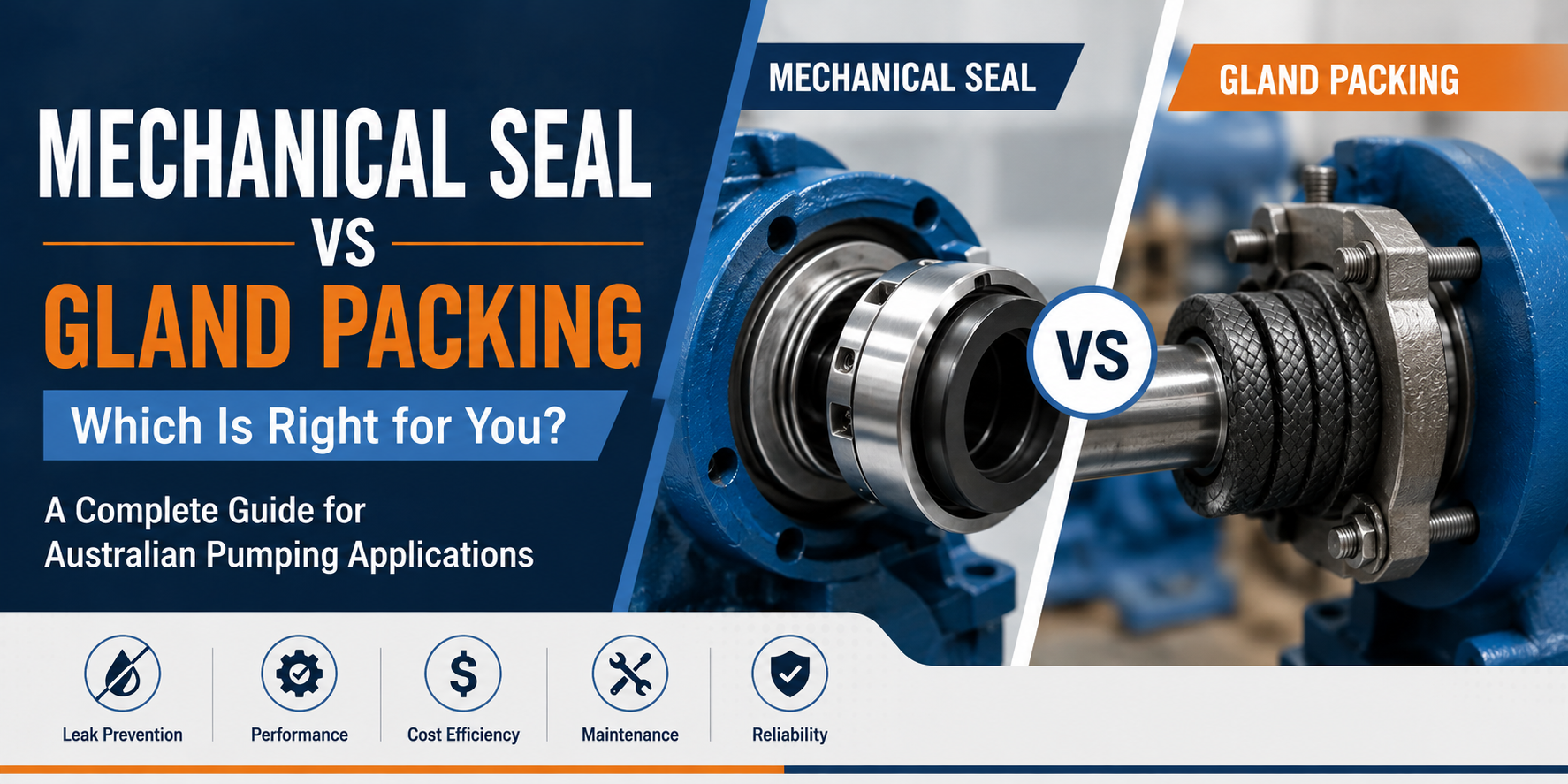
Mechanical seal: Two precision-lapped flat faces — one rotating with the pump shaft, one stationary in the gland plate — pressed together by a spring to create near-zero leakage. The seal faces are lubricated by a thin film of process fluid. Designed for minimal leakage, lower energy consumption, and long service intervals.
Gland packing: Braided rope-like rings compressed around the rotating pump shaft in a stuffing box by a gland follower and gland nuts. Must always allow a controlled leak of 2–60 drops per minute to lubricate and cool the packing material. Lower upfront cost, tolerates misalignment and abrasive fluids, but requires regular adjustment and generates continuous shaft wear.
1. How Gland Packing Works — and Why It Must Leak
Gland packing is the oldest and simplest form of pump shaft sealing, and it is still widely used — particularly in mining slurry pumps, large agricultural pumps, and older industrial installations across Australia. Understanding how it works explains why it behaves the way it does, and why some of its apparent weaknesses are actually features in the right application.
A gland packing installation consists of a stuffing box — a cylindrical chamber built into the pump casing around the shaft — filled with multiple rings of braided packing material. Common packing materials used in Australian industrial applications include PTFE (Teflon) for chemical service, graphite for high-temperature service, aramid fibre for abrasive service, and braided flax for low-pressure water applications. A gland follower plate compresses the packing rings axially into the stuffing box. Two gland bolts (or a gland nut) control the compression level.
The packing rings press radially against the rotating shaft under the gland compression load. This creates a seal — but critically, it is not a zero-leakage seal. The packing-to-shaft interface requires a continuous thin film of process fluid to lubricate and cool the contact zone. Without this fluid film, the packing generates heat from friction, the shaft sleeve overheats, the packing chars, and both shaft sleeve and packing are destroyed rapidly. This is why the correct gland adjustment allows 2–60 drops per minute of leakage at all times — and why overtightening gland packing causes more damage than loose packing.
Gland Packing — Operating Rules for Australian Conditions
- Leakage rate: 2–10 drops/min for clean water; up to 60 drops/min for hot or slightly abrasive fluids. Above 60 drops/min: adjust gland nuts one-quarter turn at a time, wait 20 minutes before re-checking. Never tighten past the point where leakage stops
- Gland adjustment frequency: New packing requires daily adjustment for the first 2 weeks as the packing beds in. Thereafter, weekly check and adjustment is typical for continuously running pumps
- Shaft sleeve inspection: Gland packing causes progressive shaft sleeve wear — a grooved shaft sleeve accelerates leakage and makes consistent gland adjustment impossible. Inspect shaft sleeve at each repacking and replace when groove depth exceeds 0.5mm
- Packing material selection: Always match packing material to the fluid chemistry, temperature, and pressure. PTFE packing used in high-temperature service above its rating will extrude and fail. Graphite packing in mild acid service may corrode. Confirm material compatibility before installation
- Flushing water: Some applications — particularly hot service and abrasive fluids — require an external clean-water flush injected into the lantern ring (gland bushing) within the stuffing box to keep abrasives away from the packing rings and dilute the leakage. If a lantern ring is present in the stuffing box, confirm the flush water connection is active before starting the pump
2. How Mechanical Seals Work — The Physics of Near-Zero Leakage
A mechanical seal creates a seal between two precision-ground, lapped flat faces — one rotating with the pump shaft, one stationary in the gland plate — pressed together by spring force and hydraulic pressure from the process fluid. The sealing interface is at the faces, not at the shaft surface, which is why mechanical seals do not wear the shaft.
The two faces are made from dissimilar materials to prevent welding (galling) under contact — typically one face is carbon-graphite (the softer face) and the other is a harder material such as silicon carbide, tungsten carbide, or ceramic. The softer carbon face wears gradually over time; the harder face maintains its lapped surface for the life of the seal. The faces are lapped to a flatness of 3 helium light bands (approximately 0.0009mm) — an extraordinarily precise surface finish that enables near-zero leakage.
The faces are not perfectly in contact — a thin hydrodynamic fluid film (typically 0.25 microns thick) separates them during operation, providing lubrication and cooling. This film generates a small amount of vapour leakage to atmosphere — typically measured in millilitres per hour, not drops per minute. This is what distinguishes a mechanical seal from a zero-leakage sealless pump design (magnetic drive pumps) — mechanical seals have extremely low leakage, not zero leakage.
The Four Components Every Mechanical Seal Has
The rotating and stationary faces — the core sealing element. Typically carbon vs silicon carbide or tungsten carbide. Face condition determines seal performance and life.
O-rings, V-rings, or wedge rings that seal between the rotating face and the shaft, and between the stationary face and the gland plate. Material must be chemically compatible with the process fluid.
Single coil spring, multiple small springs, or wave spring — provides the closing force that holds the rotating and stationary faces together. Spring compression must be set to the manufacturer’s dimension at installation.
The housing that holds the stationary face components and bolts to the pump casing. The gland plate contains the flush ports (inlet and outlet) that connect to the seal flush piping system.
3. Mechanical Seal vs Gland Packing — Complete Head-to-Head Comparison
This table covers every factor an Australian engineer or maintenance manager needs to compare when deciding between mechanical seal and gland packing for a specific pump application.
| Factor | Mechanical Seal | Gland Packing |
|---|---|---|
| Leakage | Near-zero — vapour only (mL/hr). Acceptable for hazardous, toxic, or valuable fluids. Compliant with modern environmental regulations | Must leak 2–60 drops/min by design. Continuous fluid loss — significant cost for valuable fluids. Not suitable for hazardous or toxic fluids without containment |
| Maintenance frequency | Low — seal replacement every 2–5 years in correct application. No routine adjustment required between replacements | High — weekly gland adjustment; full repacking every 3–12 months; shaft sleeve inspection at each repacking |
| Energy consumption | Minimal — seal face friction adds 0.1–0.5 kW to motor load | Significant — packing friction adds 2–3 kW. At SA electricity rate of 42c/kWh: AUD $7,400/yr per pump |
| Shaft wear | None — seal faces contact each other, not the shaft. Shaft sleeve remains undamaged | Progressive — packing causes continuous shaft sleeve wear. Replacement of shaft sleeve required periodically — additional cost and downtime |
| Upfront cost | Higher — AUD $150–$2,000+ depending on type and size | Lower — AUD $20–$150 per set of packing rings |
| Total 5-year cost | Usually lower once fluid loss, energy, labour, and shaft wear are included — particularly for valuable or hazardous fluids | Usually higher due to: continuous leakage cost, energy waste, maintenance labour, shaft sleeve replacement |
| Misalignment tolerance | Low — misalignment causes face separation and chipping. Requires correct shaft alignment before installation | High — packing tolerates shaft deflection and runout. Suitable for pumps with inherent shaft movement (large slurry pumps) |
| Abrasive fluid suitability | Moderate — special materials (tungsten carbide faces, external flush Plan 32) required. Double seal with external barrier fluid preferred for high-solids slurry | Good — packing tolerates abrasive particles better in standard configuration. Used on most slurry pumps in Australian mining |
| Hazardous fluid compliance | Excellent — near-zero leakage complies with Australian environmental and WHS regulations for toxic, flammable, and carcinogenic fluids. Double seal with pressurised barrier: zero process leakage to atmosphere | Not suitable — continuous leakage to atmosphere of hazardous fluid creates WHS and environmental compliance risks. Not acceptable in chemical, oil and gas, pharmaceutical applications |
| Installation skill required | Moderate (component seal) to low (cartridge seal). Incorrect spring setting is main failure cause — cartridge seal eliminates this risk | Low — packing replacement requires no specialist tools or measurements. Gland adjustment requires only a spanner and judgement |
| Food and pharmaceutical | Required — food-grade elastomers (FDA-approved EPDM, PTFE), clean hygienic seal designs, CIP/SIP-compatible. Standard for food and beverage pump applications | Not suitable — packing cannot meet food safety or pharmaceutical cleanliness requirements. Prohibited in GMP and HACCP environments |
4. Mechanical Seal Types — Which One Is Right for Your Application?
Not all mechanical seals are the same. Selecting the correct seal type for the application is as important as selecting the correct face materials and elastomers. These are the five mechanical seal configurations most commonly used in Australian industrial pump applications.
Single Mechanical Seal — the standard choice
One set of seal faces, one spring mechanism, one set of secondary seals. Fluid from the pump seals the rotating and stationary faces; a small vapour leakage to atmosphere is the only external emission. Suitable for the majority of clean, non-hazardous process fluids — water, clean chemicals, food products, light oils, water treatment applications. Not suitable for toxic, carcinogenic, or flammable fluids where atmospheric leakage cannot be accepted.
Used on: centrifugal pumps, water and wastewater applications, food manufacturing, general industrial service
Double Mechanical Seal — zero process leakage to atmosphere
Two sets of seal faces — an inner (primary) seal containing the process fluid, and an outer (secondary) seal providing a second line of containment. Between the two sets of faces, a barrier or buffer fluid is maintained under controlled conditions. In a pressurised double seal (Arrangement 3, API Plan 53), barrier fluid pressure exceeds process pressure — ensuring zero process fluid can reach atmosphere even if the primary seal fails completely. Required for toxic, carcinogenic, or flammable process fluids in Australian chemical and oil and gas applications.
Used on: chemical transfer pumps, oil and gas applications, pharmaceutical, solvent service
Tandem (Unpressurised Double) Seal — early warning of primary seal failure
Two sets of seal faces with an unpressurised buffer fluid between them, held at a pressure below process pressure. If the primary (inner) seal fails, the buffer fluid pressure rises — this can be detected by a pressure transmitter on the buffer reservoir, giving advance warning of primary seal failure before any process fluid reaches atmosphere. The secondary (outer) seal contains the leakage while the primary seal is replaced. Used when early warning of seal failure is important for process continuity but the process fluid is not hazardous enough to require a pressurised double seal.
Used on: Critical continuously-running process pumps where unplanned seal failure would cause significant downtime cost — mine dewatering, major process transfer
Cartridge Seal — the preferred specification for Australian field conditions
A cartridge seal is not a different seal type — it is a packaging concept. The seal faces, springs, gland plate, and all secondary sealing elements are pre-assembled into a single self-contained unit, factory-set to the correct spring compression dimension. The cartridge slides onto the shaft and bolts to the pump casing with no measurements or adjustments required. Setting clips hold the spring compression during installation and are released after the gland plate is bolted down. The major benefit: eliminates incorrect spring setting — the most common cause of premature mechanical seal failure in field conditions. Strongly recommended for any maintenance team without specialist seal-fitting experience.
Used on: Any application where fast, reliable seal replacement without specialist fitting experience is required. Ideal for remote Australian mine sites and plants with limited seal fitting expertise
Split Seal — in-place replacement without pump disassembly
A split seal has all components split along the shaft centreline, allowing installation and removal without removing the shaft, impeller, or motor. The performance is somewhat lower than a conventional cartridge seal due to the split joint faces — split seals are not suitable for high-pressure or aggressive chemical applications. But for large horizontal pumps in water utilities, irrigation systems, and power generation cooling water service — where full pump disassembly requires heavy lifting equipment and extended downtime — a split seal reduces maintenance time from days to hours.
Used on: Large horizontal split case pumps, water treatment pump stations, power station cooling water pumps, large horizontal split case pump installations
5. API Seal Flush Plans — Plain English Explanation for Australian Engineers
An API seal flush plan is a defined piping arrangement that controls the environment at the mechanical seal faces — providing cooling, lubrication, and protection from the process fluid conditions. Flush plans are standardised by API 682 (now also adopted as ISO 21049). Understanding flush plans is essential when specifying mechanical seals for Australian industrial applications — the wrong flush plan is a common cause of premature seal failure.
Plan 11 is the default flush plan for most single mechanical seals. It uses fluid from the pump discharge, routed through a small orifice into the seal chamber, which cools and lubricates the seal faces and removes heat from the seal chamber. Most single seals on clean water, clean chemical, and general industrial service in Australian plants operate on Plan 11 without any special piping beyond what comes standard with the seal gland plate.
| API Plan | How it works | Best for — Australian application |
|---|---|---|
| Plan 11 | Discharge bypass through orifice into seal chamber — process fluid recirculates and cools the seal faces. Default for single seals | Clean water, clean chemicals, food products, general industrial single-seal service. Water and wastewater applications |
| Plan 23 | Seal chamber fluid recirculates through a heat exchanger (cooler) then back to seal chamber via an integral pumping ring. Significantly cools the seal environment | Hot water and high-temperature process service — boiler feed pumps, hot oil, condensate return. Essential where process fluid above 80°C |
| Plan 32 | Clean external fluid (water, solvent) injected from an external source into the seal chamber at controlled pressure — dilutes the process fluid and flushes abrasives away from the seal faces | Abrasive, polymerising, or process fluids unsuitable as seal lubricant — mine dewatering with suspended solids, paper pulp, abrasive slurries where mechanical seal is specified over gland packing |
| Plan 52 | Unpressurised buffer fluid reservoir circulates between two seal faces in a tandem (dual unpressurised) arrangement. If inner seal fails, buffer pressure rises — early warning without process leakage to atmosphere | Critical continuously-running pump circuits requiring early warning of inner seal failure. Process monitoring and predictive maintenance applications |
| Plan 53A | Pressurised barrier fluid (pressure above process pressure) in a dual pressurised seal arrangement using a pressurised reservoir — ensures zero process fluid can reach atmosphere under any conditions | Toxic, carcinogenic, or flammable fluids — chemical transfer, oil and gas produced water, API 610 compliant applications |
The most common seal system specification error in Australian industrial plants is running a single mechanical seal on Plan 11 in a hot-fluid application where Plan 23 is required. Process fluid above 80°C has reduced vapour pressure — the thin film between the seal faces approaches flash point, the seal faces run partially dry, and the carbon face overheats and cracks. If your seal has been failing repeatedly in hot service, check whether the flush plan is cooling the seal environment adequately. Contact our engineering team — we can review your seal and flush plan specification at no charge.
6. Total Cost of Ownership — Mechanical Seal vs Gland Packing in Australian Conditions
The upfront cost of a mechanical seal is always higher than gland packing. The 5-year total cost of ownership almost always favours the mechanical seal — particularly in South Australia (42c/kWh), Western Australia, and Queensland where electricity costs are elevated. Here is the calculation across three representative Australian pump applications.
Case 1 — 15 kW Centrifugal Pump, Clean Water Service, Melbourne Food Manufacturer
Shaft sleeve replacements (2×): AUD $800
Gland adjustment labour (52 wks × 15 min × $80/hr): AUD $2,600
Energy waste (2 kW × 6,000 hrs × $0.28/kWh): AUD $3,360
Water loss (10 drops/min × 5 yrs continuous): AUD $180
Installation labour (2× at 1 hr × $80/hr): AUD $160
Energy (negligible seal friction): AUD $0
No shaft sleeve wear: AUD $0
No leakage loss: AUD $0
Case 2 — Chemical Transfer Pump, $3/Litre Solvent, Adelaide (42c/kWh) — 8,000 hrs/yr
Packing replacement labour: AUD $1,000
Energy waste (2 kW × 8,000 hrs × $0.42/kWh × 5 yrs): AUD $33,600
Shaft sleeve (2× replacements): AUD $1,200
Product loss (0.1 L/hr × 8,000 × 5 × $3): AUD $12,000
Barrier fluid (Plan 53A): AUD $2,500
Installation labour (2× at 2 hr × $80/hr): AUD $320
7. Why Mechanical Seals Fail Prematurely — The 6 Real Causes
If your mechanical seals are failing more frequently than every 2 years — or if a new seal has failed within weeks of installation — one of these six root causes is responsible. Replacing the seal without fixing the root cause will produce exactly the same result on the same interval.
The thin fluid film between the seal faces is the only lubrication and cooling the faces receive. Running a pump dry — even briefly during priming attempts, low-level trips, or process upsets — generates extreme heat at the seal face interface. The carbon face chars, blisters, and cracks within seconds. The harder mating face may survive but the carbon face is destroyed. Fix: install and commission a dry-run protection device (level switch, flow switch, or pressure switch on the suction line) before start-up. Never commission a pump without confirming fluid is present at the seal. This is particularly critical on progressive cavity pumps and gear pumps which are also sealed and equally vulnerable to dry running.
Incorrect spring setting is the single most common root cause of seal failure in field installation. A component seal requires the installer to set the spring compression to the manufacturer’s specified dimension (typically 2–4mm, measured from the shaft shoulder to the gland face). Over-compression: excessive face load generates heat, the thin fluid film breaks down, and the faces run dry. Under-compression: insufficient face load allows faces to separate under dynamic conditions, causing face chipping and rapid wear. The fix is a cartridge seal — spring compression is pre-set at the factory and cannot be altered during installation. For all pumps where installation is performed by non-specialist maintenance staff, specify cartridge seals.
A misaligned pump-motor coupling causes the shaft to deflect cyclically with each revolution. This cyclic deflection causes the rotating seal face to lift away from the stationary face at one point in each revolution — the faces separate momentarily, the fluid film breaks down at that point, and the faces re-contact without lubrication. Over time this causes face chipping and heat damage at the specific contact zone. Misalignment also increases radial load on bearings, accelerating bearing wear simultaneously. Fix: laser-align pump and motor at installation and re-check alignment quarterly — or whenever vibration or seal leakage increases. See our pump maintenance checklist for alignment check guidance.
The secondary seals (O-rings and V-rings) in a mechanical seal must be chemically compatible with the process fluid, operating temperature, and pressure. An incompatible O-ring material will swell (blocking shaft movement), harden and crack (creating a direct leakage path), or extrude under pressure. The most common elastomer materials — NBR (Buna-N), EPDM, Viton (FKM), and PTFE — each have specific compatibility profiles. NBR is incompatible with many ketones, esters, and aromatic hydrocarbons. EPDM is incompatible with most petroleum-based oils. Viton is the most chemically resistant but cannot be used above its temperature limit with steam or high-temperature water. Always confirm elastomer compatibility with the specific process fluid before specifying a seal — contact our team for a compatibility check.
Hard particles in the process fluid that enter the gap between the seal faces act as abrasives — grinding the seal faces in a mechanism analogous to grinding wheel on metal. Even a small amount of abrasive contamination (sand, scale, mineral fines) can significantly reduce seal face life. The lapped surface finish that enables near-zero leakage is destroyed by abrasive wear in a fraction of the normal service life. Solutions: API Plan 32 external flush (clean external water flushes abrasives away from the seal faces); cyclone separator on the flush line to remove particles from the process flush (Plan 31); or selection of harder seal face materials (tungsten carbide vs silicon carbide) if abrasive contamination cannot be eliminated. For very high-solids applications, consider whether gland packing or a double seal with clean barrier fluid is more appropriate.
Every mechanical seal is designed for a specific range of operating pressure, temperature, shaft speed, and fluid properties. Operating outside this envelope — even temporarily — causes disproportionate damage. Common examples in Australian industrial operations: process temperature spikes above seal design temperature during upset conditions; pressure surges above the seal’s rated pressure during system changes; pump operating far from Best Efficiency Point (causing cavitation or recirculation that increases shaft vibration and seal chamber turbulence). Always confirm the selected seal’s design envelope covers the full range of operating conditions — including upset and start-up conditions — not just steady-state design conditions. See our pump cavitation guide for how operating off-BEP affects pump and seal performance.
8. When Gland Packing Is Still the Right Choice
This guide should not leave the impression that gland packing is obsolete or inferior in all applications. Gland packing remains the correct choice in three specific situations: pumps running fewer than 500 hours per year, applications where a small controlled leakage is acceptable, and sites with extremely limited maintenance budgets and no access to clean flush water. In Australian mining, there are additional contexts where packing is preferred.
Slurry pumps on Bowen Basin coal circuits, Pilbara iron ore tailings, and Goldfields hard-rock gold operations handle extremely abrasive high-density slurries. The large shaft movements from operation in highly abrasive duty, combined with the cost and complexity of maintaining clean flush water at remote sites, often makes gland packing the preferred sealing choice — even though it leaks more. Specialist slurry packing compounds in aramid and graphite are specifically designed for this service.
Pumps that run fewer than 500 hours per year — seasonal irrigation pumps, emergency fire pumps, standby water supply — do not accumulate the operating hours that justify the higher capital cost of a mechanical seal. Gland packing’s lower upfront cost and simpler maintenance are practical advantages for infrequently used pumps. Confirm the pump is properly primed before each start, and inspect packing condition annually.
Some large horizontal split case pumps and large-diameter vertical turbine pumps have stuffing boxes that are too large for standard mechanical seal designs, or the shaft deflection characteristics of the pump design make mechanical seal application technically challenging. In these cases, packing with lantern ring flushing remains the standard approach. Confirm with the pump manufacturer before specifying seal type on pumps above 200mm shaft diameter.
API Plan 32 mechanical seals require a continuous supply of clean external flush water at controlled flow and pressure. At remote WA and QLD mine sites where clean water supply infrastructure is limited and expensive, maintaining a Plan 32 flush system for a mechanical seal on a clean-water application may be more complex than gland packing with the same service life outcome. Evaluate on a site-by-site basis.
9. Converting From Gland Packing to Mechanical Seal — What Is Involved
Many Australian industrial plants still run centrifugal pumps originally fitted with gland packing that could be running more efficiently and reliably with a mechanical seal. Converting from packing to mechanical seal is often straightforward and cost-effective — but requires assessment of three factors before proceeding.
| Assessment factor | What to check | Outcome |
|---|---|---|
| Stuffing box dimensions | Measure stuffing box bore diameter, depth, and shaft shoulder dimension. Compare to standard cartridge seal dimensional requirements. Most standard pump stuffing boxes accept a cartridge seal without machining | If dimensions match: direct cartridge seal installation. If bore too small: adaptor sleeve may be available. If fundamentally wrong dimensions: review pump suitability for conversion |
| Shaft sleeve condition | Inspect shaft sleeve for grooving from packing wear. A groove deeper than 0.3mm will damage new mechanical seal O-rings during installation and cause premature leakage | If grooved: replace shaft sleeve before fitting mechanical seal. Do not install a mechanical seal on a grooved sleeve — the conversion will fail. |
| Flush plan provision | Confirm the gland plate has flush ports (¼” or ⅜” BSP/NPT connections) for the required API flush plan. For Plan 11, confirm the discharge bypass orifice connection is accessible. For Plan 32, confirm external water supply is available | Flush plan piping is rarely an obstacle for Plan 11. Plan 32 may require additional piping infrastructure. |
Pump Power Australia can assess whether your gland packing pumps are suitable for mechanical seal conversion and recommend the correct seal specification. Provide us with the pump make, model, and service details — and shaft sleeve photos if possible — and our engineering team will advise on seal selection, flush plan requirements, and estimated conversion cost. Contact us on +61 3 9933 7400 or via our enquiry form. This assessment is provided at no charge to all customers.
10. Reddit, Quora, and Forum Questions on Pump Seals — Answered
These are the most frequently asked pump seal questions across Reddit r/ChemicalEngineering, r/mechanical_engineering, Quora, and Australian industrial maintenance communities — with direct, practical answers.
If the same seal keeps failing on the same interval, the root cause is not the seal — it is the system. Check: (1) Is the spring compression set correctly? Use a cartridge seal to eliminate this. (2) Is the pump aligned? Misalignment is the most common cause of short and consistent seal life. (3) Is the flush plan working? Remove the flush outlet line and confirm there is flow — a blocked orifice (Plan 11) means the seal runs hot and dry. (4) Is the elastomer material compatible with the fluid? Have the O-rings been inspected after each failure — swelling or cracking reveals chemical incompatibility. (5) Are there abrasive particles in the fluid? Inspect failed seal faces — grooving or random scratching on the faces confirms abrasive contamination. Address the root cause — do not just replace the seal again.
It depends on the specific slurry, the pump size, and the maintenance capability on site. For high-density, high-abrasivity slurry pumps in Australian mining — particularly where shaft diameter is large, shaft deflection is significant, and clean flush water supply is limited — gland packing with aramid or graphite/PTFE packing compound is often the better practical choice. For lower-solids slurries, or where the slurry pump is handling chemically aggressive fluid alongside abrasives, a double mechanical seal with Plan 32 external flush (clean water) can significantly extend seal life. Evaluate both options on total cost including flush water infrastructure and labour cost for your specific site conditions.
No — overtightening is the most common error in gland packing management and causes more damage than leakage. Gland packing must leak to lubricate and cool itself. If leakage is above 60 drops/minute, tighten the gland nuts one quarter turn, then wait 20–30 minutes before checking again — the packing will bed in under heat. If leakage does not reduce to acceptable levels, the packing needs to be replaced — not just compressed harder. A packing that has been overtightened will rapidly damage the shaft sleeve (expensive), generate heat in the stuffing box, and fail catastrophically rather than gradually. If the current packing will not seal within normal gland adjustment, replace the packing rings entirely.
A component seal supplies the rotating assembly, stationary seat, and secondary seals as separate components that the installer assembles on the pump. The critical step is setting the spring compression correctly — measure from the shaft shoulder to the gland face and set the seal to the manufacturer’s dimension before tightening. Incorrect setting is the most common cause of new seal failure. A cartridge seal comes pre-assembled and pre-set from the factory — it slides on and bolts up with no measurement required. For most Australian industrial maintenance teams, the cartridge seal’s elimination of installation error is worth the 30–50% cost premium — particularly on remote sites where a failed seal means another shutdown before the next maintenance rotation.
A 6-month seal failure on a new pump almost always indicates a system or installation problem, not a faulty seal. The most likely causes in order of probability: (1) incorrect spring setting during installation — the seal was over or under-compressed; (2) shaft misalignment — not checked or corrected at commissioning; (3) pump started dry at least once during commissioning before fluid was confirmed present; (4) flush plan not functioning — check that the flush line is connected and that flow is present. Inspect the failed seal faces — the failure mode tells the story: chipped faces indicate mechanical shock (dry run or particle impact), glazed or heat-damaged faces indicate thermal failure (dry running or hot flush), radial score marks on faces indicate abrasive contamination. Provide the failed seal to Pump Power Australia’s service team for failure mode analysis if you need a definitive root cause.
Key Takeaways — Mechanical Seal vs Gland Packing
- Gland packing must always leak 2–60 drops per minute — if it is not leaking, it is overheating and damaging the shaft sleeve
- Mechanical seals provide near-zero leakage, lower energy consumption, no shaft wear, and longer service intervals — but require correct installation, correct flush plan, and correct materials selection
- Total 5-year cost almost always favours mechanical seals for continuously-running pumps, particularly where fluid is valuable, hazardous, or where electricity costs are high (SA, WA)
- Specify cartridge seals over component seals wherever possible — incorrect spring setting is the most common cause of premature mechanical seal failure and cartridge seals eliminate this completely
- If a mechanical seal is failing on a consistent short interval, the root cause is the system — not the seal. The six causes: dry running, wrong spring setting, misalignment, wrong elastomer, abrasives, operating outside design envelope
- Gland packing remains the correct choice for: abrasive slurry mining pumps, intermittent-duty pumps (<500 hrs/yr), and remote sites where clean flush water for Plan 32 is unavailable
- Food, pharmaceutical, chemical, and oil and gas applications require mechanical seals — gland packing is not compliant with food safety, GMP, or environmental regulations in these sectors
- Converting a gland packing pump to mechanical seal is usually straightforward — assess stuffing box dimensions, shaft sleeve condition, and flush plan provision before proceeding
- Pump Power Australia stocks mechanical seals and gland packing for fast dispatch to all Australian states — contact our team for seal specification and cross-reference support
Frequently Asked Questions
Structured for Google People Also Ask, ChatGPT, Gemini, Claude, and Perplexity direct answer extraction.
A mechanical seal uses two precision-lapped flat faces — one rotating with the pump shaft, one stationary — pressed together by spring force to create near-zero leakage. Gland packing uses braided rope-like rings compressed around the rotating shaft in a stuffing box; it always leaks a controlled 2–60 drops per minute to lubricate and cool the packing material. Mechanical seals are the preferred choice for most modern industrial pump applications due to lower leakage, lower energy consumption, longer service life, and compliance with environmental regulations. Gland packing remains suitable for abrasive slurry service, intermittent pumps, and budget-constrained applications. For seal supply, see our Mechanical Seals page.
Gland packing must leak a controlled amount — typically 2 to 60 drops per minute — because the leakage provides the lubrication and cooling that prevents the packing material from overheating and burning against the rotating shaft. If gland packing is tightened to zero leakage, the packing rapidly overheats, glazes the shaft sleeve, and fails catastrophically. The acceptable leakage rate for clean water is 2–10 drops/min; for higher-temperature or slightly abrasive fluids, up to 60 drops/min may be acceptable. Above 60 drops/min, adjust the gland one quarter turn at a time and wait before re-checking. If leakage cannot be controlled within range, replace the packing rings — do not overtighten.
The six most common causes in Australian industrial pumps: (1) dry running — destroys carbon faces in under 60 seconds; (2) incorrect installation — wrong spring setting in component seals; (3) shaft misalignment — cyclic face separation; (4) wrong elastomer material — chemical incompatibility causing O-ring swelling or cracking; (5) abrasive particles between the seal faces; (6) operating outside design conditions — temperature spikes, pressure surges, cavitation. Every repeated short-interval seal failure has one of these root causes. Fix the root cause — replacing the seal without fixing the system will produce the same result. See our detailed maintenance guide at Pump Maintenance Checklist.
Gland packing is preferred for: (1) abrasive slurry service in Australian mining — where large shaft movement, coarse abrasives, and remote site constraints make gland packing the practical choice on most slurry pump applications; (2) intermittent pumps running fewer than 500 hours/year — lower capital cost outweighs efficiency benefits; (3) sites with very limited maintenance capability or no clean flush water supply for Plan 32 mechanical seal service. For all continuously-running pumps handling non-abrasive, non-hazardous fluids, mechanical seals are the better long-term investment on total cost of ownership.
A cartridge mechanical seal is a pre-assembled self-contained unit where all components — rotating face, stationary seat, springs, gland plate, and secondary seals — are factory-set to the correct spring compression dimension. No measurement or adjustment is required on site. Component seals require the installer to set spring compression correctly — incorrect setting is the most common cause of premature seal failure in field conditions. Cartridge seals eliminate this source of error, reduce installation time significantly, and consistently deliver longer service life. The 30–50% higher cost of a cartridge seal is almost always justified for any Australian industrial pump operated by a maintenance team without specialist seal-fitting experience.
API Plan 11 is the default flush plan for most single mechanical seals. It uses fluid from the pump discharge through an orifice and directs it to the seal chamber through the flush port, increasing lubricity to the seal faces and reducing heat in the seal chamber. Plan 11 is suitable for clean, non-polymerising, non-abrasive process fluids — water, clean chemicals, and light oils in standard Australian industrial service. For hot service above 80°C, use Plan 23 (with heat exchanger) instead. For abrasive fluids, use Plan 32 (external clean flush). Always confirm the orifice (minimum 3.2mm) is clear and that flow is reaching the seal chamber — a blocked Plan 11 orifice causes seal failure from heat buildup.
In most cases yes. Assess three things first: (1) stuffing box dimensions — most standard pumps accept a cartridge seal without machining; (2) shaft sleeve condition — replace if grooved from packing wear; (3) flush plan provision — confirm flush ports are available on the gland plate for the required API plan. Cartridge seals simplify conversion significantly — many are available to fit common stuffing box dimensions without modification. Contact Pump Power Australia’s engineering team for a conversion feasibility assessment on your specific pump model — provided at no charge to all customers.
Correctly selected and installed mechanical seals in Australian industrial service typically achieve 2–5 years before replacement. In clean water service, seals may run 8+ years. In abrasive, high-temperature, or chemically aggressive service, seal life may be 6–18 months. The most significant factor reducing seal life is incorrect installation — specifically incorrect spring compression in component seals. Cartridge seals consistently deliver longer service life in field conditions. Operating conditions that cause premature failure — dry running, misalignment, off-BEP operation — are covered in Section 7 of this guide and in our pump cavitation and operating conditions guide.
Gland packing upfront cost: AUD $20–$150 per set of rings. Component mechanical seal: AUD $150–$600. Cartridge mechanical seal: AUD $400–$2,000+. However, total 5-year cost typically favours mechanical seals — particularly for continuously-running pumps handling valuable or hazardous fluids. The Case 1 and Case 2 calculations in Section 6 of this guide show mechanical seal savings of AUD $5,820 (clean water, Melbourne) and AUD $376,980 (chemical solvent, Adelaide) over 5 years. The ROI calculation changes dramatically based on fluid value, electricity cost, and maintenance labour cost — contact our team for a cost analysis specific to your application.
Yes. Pump Power Australia supplies mechanical seals across a wide range of configurations — single, double, cartridge, and component seals — and gland packing in PTFE, graphite, and aramid compounds from our Brooklyn, Victoria warehouse, with fast dispatch to all Australian states. For seal cross-referencing and selection support — confirm the correct replacement specification for your pump make and model — call +61 3 9933 7400 or enquire via our Spares & Services page. We also provide pump refurbishment and seal replacement services at our Brooklyn workshop, including failure mode analysis of returned failed seals.
Conclusion — The Right Seal for Your Application
For most continuously-running Australian industrial pumps handling clean or moderately clean fluids — water, food products, light chemicals, oils — the mechanical seal is the correct specification and the lower total cost option over a 3–5 year horizon. The upfront cost premium is recovered within the first 12–24 months through reduced maintenance labour, eliminated shaft sleeve wear, and lower energy consumption.
For abrasive slurry mining applications, intermittent-duty pumps, and remote sites with specific constraints, gland packing remains a viable and sometimes preferred choice. The decision should be made on application-specific engineering criteria — not habit or upfront cost alone.
If your mechanical seals are failing repeatedly, the answer is not a different seal brand — it is a root cause investigation. The six causes in Section 7 cover the vast majority of premature mechanical seal failures in Australian industrial operations. Fix the system first, then replace the seal.
References
- Select Seals Australia — “Mechanical Seals vs Gland Packing” (2026): mechanicalsealsinternational.com.au
- BBP Pump — “Mechanical Seal vs Gland Packing: Which Seal Should You Choose?” (Oct 2025): bbppump.com
- DynaPro — “Mechanical Seal vs Packing: Cost, Leakage, Reliability” (Nov 2025): dynaproco.com
- Dehuike Pump — “Pump Sealing Technologies for Harsh Fluids: The 2026 Industrial Pump Guide” (Jun 2026): dhkpump.com
- Unique Seals — “What is a Mechanical Seal? A Complete Guide for 2026” (Jun 2026): uniqueseals.com
- Fabrico — “Mechanical Seal Types in Pumps: A Practical Guide” (Jul 2026): fabrico.io
- Pump Industry Magazine — “Mechanical seals vs gland packing: which should you choose?” (2021): pumpindustry.com.au
- API Standard 682 / ISO 21049 — Pumps: Shaft Sealing Systems for Centrifugal and Rotary Pumps
- SEPCO — “API Flush Plans for Mechanical Seals”: sepco.com
- Hydraulic Institute (HI) — Pump Standards and shaft sealing guidance: pumps.org
Pump Seal Enquiry — Mechanical Seal or Gland Packing?
Tell us your pump make, model, the fluid being pumped, and whether you have gland packing or a mechanical seal currently fitted — and our engineering team will recommend the correct seal specification and confirm parts availability. Repeated seal failures? We provide failure mode analysis on returned seals at no charge.
Mechanical seals and gland packing dispatched same business day from our Brooklyn, VIC warehouse to all Australian states.
📞 +61 3 9933 7400
✉ info@pumppower.com.au
9 Export Drive, Brooklyn VIC 3012 | Mon–Fri 8:00am–5:00pm AEST
This guide was prepared by the engineering team at Pump Power Australia, a specialist industrial pump and seal supplier based in Brooklyn, Victoria, with over 35 years of experience specifying, supplying, and supporting pump shaft seals across Australian mining, water treatment, food processing, chemical, and marine industries.
Related guides: Pump Maintenance Checklist | Pump Cavitation Guide | VSD Energy Savings | Centrifugal vs PD Pumps | Mechanical Seals