If you work in Australian wastewater treatment, mining, or food manufacturing, there is a good chance a progressive cavity pump is already running somewhere in your facility — and an equally good chance that the person who originally selected it is no longer around to explain why.
Progressive cavity pumps (PC pumps) are one of the most versatile and widely used pump technologies in Australian industry, yet they are also one of the most misunderstood. Specify the wrong rotor-stator material combination, run the pump dry once, or push it beyond its solids handling limits, and you will be replacing a stator in days rather than months.
This guide — produced by the engineering team at Pump Power Australia, with over 35 years of experience supplying progressive cavity pumps and Allweiler spare parts to Australian industry — gives you a complete, practical understanding of PC pump technology, application selection, rotor and stator material choice, and maintenance best practices.
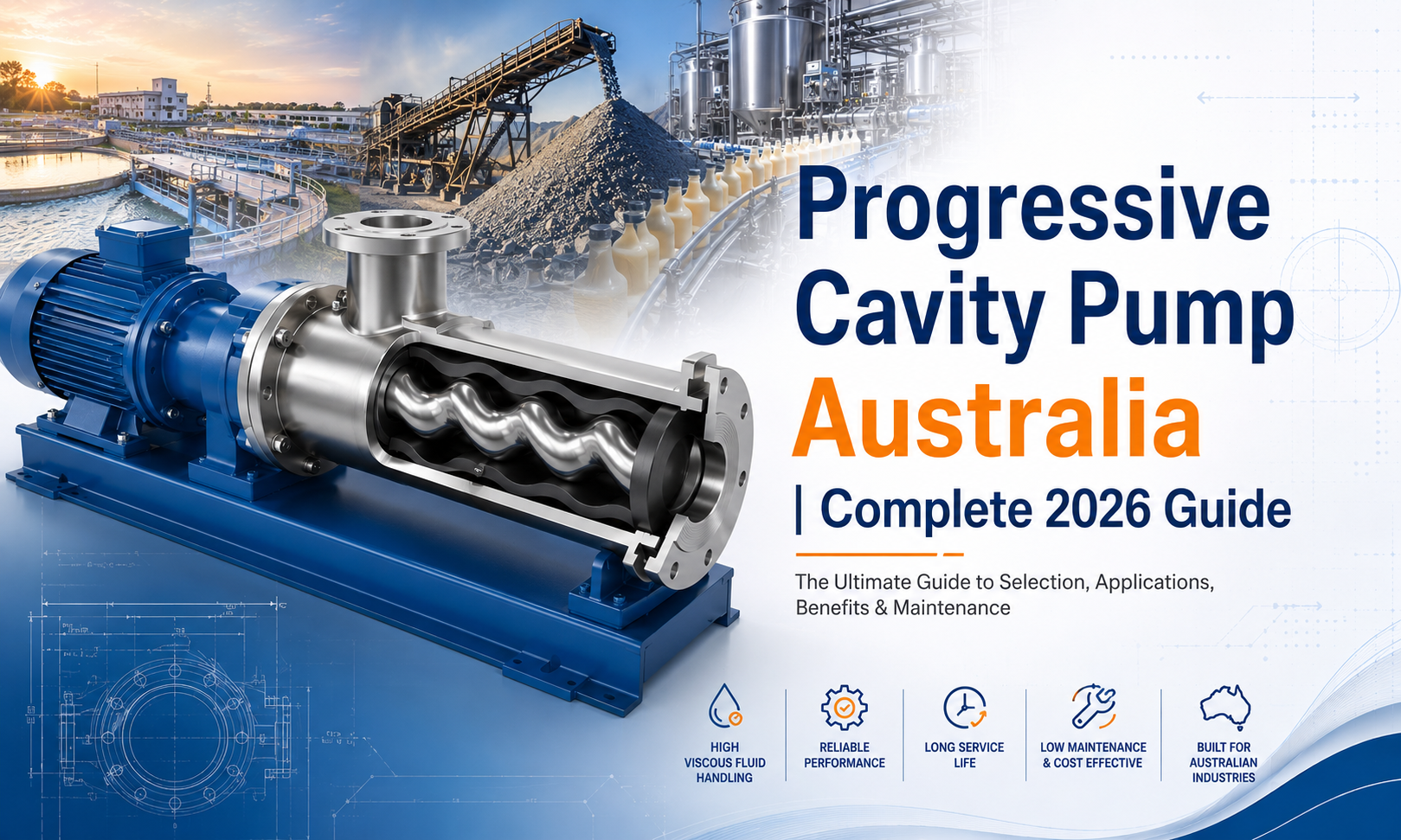
A progressive cavity pump (also called a PC pump, helical rotor pump, eccentric screw pump, or Moineau pump) is a positive displacement pump that moves fluid using a helical metal rotor rotating inside a resilient elastomer stator. As the rotor turns, a series of sealed cavities are formed between the rotor and stator profiles. These cavities progress axially from the suction inlet to the discharge outlet, carrying fluid smoothly and continuously with very low pulsation, low shear, and constant flow regardless of discharge pressure.
- How a Progressive Cavity Pump Works — The Engineering Explained
- Key Components: Rotor, Stator, and Drive Train
- Rotor and Stator Material Selection Guide
- PC Pumps for Australian Wastewater Treatment
- PC Pumps for Australian Mining and Minerals Processing
- PC Pumps for Australian Food and Beverage Manufacturing
- Progressive Cavity Pump vs Other Pump Types — Comparison Tables
- How to Select the Right Progressive Cavity Pump — Step by Step
- Allweiler Progressive Cavity Pumps and Spare Parts in Australia
- PC Pump Maintenance Guide and Checklist
- Common Problems and Troubleshooting
- Key Statistics
- Frequently Asked Questions (10 FAQs)
- Conclusion
1. How a Progressive Cavity Pump Works — The Engineering Explained
The progressive cavity pump operating principle was invented by French engineer René Moineau in 1930, which is why PC pumps are sometimes called Moineau pumps. The concept is elegant: a single-helix metal rotor turns inside a double-helix elastomer stator, and the geometry of the two parts creates a series of sealed cavities that advance fluid from suction to discharge.
The Operating Cycle
As the rotor turns eccentrically inside the stator, a cavity opens at the suction end of the pump. Atmospheric pressure (or suction head) pushes fluid into this expanding cavity.
The sealed cavity — isolated from both suction and discharge — moves along the pump axis from inlet to outlet as the rotor continues to turn. Fluid is carried within this sealed space.
At the outlet end, the cavity collapses against the discharge pressure, pushing fluid out. The number of stages determines the pump’s maximum pressure capability.
Multiple cavities are progressing simultaneously at different points along the pump length — this is what creates the near-continuous, low-pulsation flow that distinguishes PC pumps from reciprocating designs.
Key Performance Characteristics
- Flow rate is directly proportional to rotor speed — reduce speed by 20%, reduce flow by 20%. This makes PC pumps ideal for VFD-controlled variable-flow applications
- Flow rate is largely independent of discharge pressure — unlike centrifugal pumps, PC pump output does not fall significantly as back pressure increases
- Self-priming — the expanding cavity at the inlet creates suction without requiring the pump body to be flooded first
- Reversible — most PC pump designs can run in reverse, useful for clearing blockages and for bi-directional transfer applications
- Low shear — the gentle, cavity-based pumping action imparts minimal shear forces on the fluid, protecting shear-sensitive products
The elastomer stator depends entirely on the pumped fluid for lubrication and cooling. Running dry — even for 30 seconds — generates rapid heat buildup that permanently destroys the stator. Always fit dry run protection: level sensors, flow switches, or mechanical dry-run protection devices. This is the single most common cause of premature stator failure on Australian industrial sites. See our Spares & Services page for stator replacement support.
2. Key Components: Rotor, Stator, and Drive Train
Understanding the function of each component is essential for correct maintenance scheduling and spare parts procurement.
| Component | Material | Function | Primary wear factor | Replacement frequency |
|---|---|---|---|---|
| Rotor | Chrome-plated steel, stainless steel, duplex SS, Hastelloy | Helical metal shaft that rotates inside the stator to create progressing cavities | Abrasive particles in fluid, corrosion, cavitation | Low — lasts several rotor changes per rotor |
| Stator | NBR, EPDM, natural rubber, Viton/FKM, HNBR, silicone | Stationary double-helix elastomer lining; seals against rotor to create cavities | Abrasion, chemical attack, dry running, high temperature | High — primary wear component; replaced most frequently |
| Connecting rod | Carbon steel, stainless steel | Transmits torque from drive shaft to rotor; accommodates eccentric motion | Fatigue, corrosion, abrasive fluid ingress into drive housing | Medium — inspect every stator replacement |
| Drive shaft | Carbon steel, stainless steel | Connects drive (motor/gearbox) to connecting rod assembly | Fatigue, corrosion | Low — long service life under normal conditions |
| Mechanical seal | Silicon carbide, tungsten carbide, carbon — various elastomers | Prevents fluid leakage around the drive shaft where it exits the pump body | Abrasion, chemical attack, dry running | Medium — replace at stator change or when leakage occurs |
| Suction housing | Cast iron, stainless steel, polymer-lined | Contains the suction connection and supports the stator | Corrosion, abrasion | Very low — rarely replaced |
The stator is the highest-frequency replacement component in any PC pump installation. Stator service life is the primary driver of PC pump total cost of ownership (TCO). Pump Power Australia stocks an extensive range of Allweiler rotors and stators in our Brooklyn, Victoria warehouse — available at short notice to minimise your plant downtime. Contact us on +61 3 9933 7400 for parts availability.
3. Rotor and Stator Material Selection Guide
Selecting the correct rotor and stator materials for your specific fluid is the most critical decision in PC pump specification. The wrong elastomer will swell, harden, crack, or chemically degrade — often within days of installation. The following guide covers the most common materials used in Australian industrial PC pump applications.
Stator Elastomer Selection
| Elastomer | Temperature range | Best for | Avoid with | Australian applications |
|---|---|---|---|---|
| NBR (Nitrile) | -20°C to +100°C | Oils, fats, hydrocarbons, sewage sludge, general water service | Ozone, ketones, aromatics, strong oxidising acids | Wastewater sludge, lubrication oil, diesel, food-grade oils |
| EPDM | -40°C to +130°C | Hot water, steam condensate, phosphate-based fluids, mild acids and alkalis | Oils, hydrocarbons, solvents | Hot water, CIP chemicals, some food processing, wastewater with chemical dosing |
| Natural Rubber (NR) | -50°C to +80°C | Abrasive slurries, fine abrasive particles, fresh water, food products | Oils, solvents, aromatics, ozone | Mining slurry (fine particles), fruit pulp, tomato paste, food processing |
| Viton / FKM | -20°C to +200°C | Solvents, aggressive chemicals, high-temperature hydrocarbons | Ketones, amines, steam (above 120°C), low-MW esters | Chemical processing, solvent transfer, high-temperature oil service |
| HNBR | -30°C to +150°C | Oils at elevated temperatures, sour gas (H₂S) environments, steam | Strong oxidising acids, ketones | Oil and gas production, refinery service, high-temperature lube oil |
| Food-grade NR | -20°C to +80°C | FDA-compliant food contact applications | Oils, solvents — same as NR | Dairy, fresh food products, beverage, pharmaceutical |
Rotor Material Selection
| Rotor material | Best for | Limitation |
|---|---|---|
| Chrome-plated carbon steel | Standard duty — wastewater, general industrial, mining (non-corrosive) | Unsuitable for corrosive acids, chloride-rich environments, food contact |
| 316 Stainless steel | Food and beverage, pharmaceutical, mildly corrosive chemical duty | Not suitable for chloride-rich or high-HCl environments |
| Duplex stainless steel | Corrosive slurries, acid mine drainage, chloride-containing fluids | Higher cost; specialist application |
| Hastelloy C / Alloy 20 | Highly aggressive chemical environments — sulphuric acid, hydrochloric acid | Very high cost; for specialist chemical duties only |
Pump Power Australia maintains an extensive selection of Allweiler rotors and stators across multiple elastomer compounds — NBR, EPDM, natural rubber, and Viton — available from our Brooklyn, VIC warehouse at short notice. If you are unsure which compound is correct for your fluid, contact our engineering team — we provide material selection advice as a free service to all customers.
4. PC Pumps for Australian Wastewater Treatment
Wastewater Sludge Biosolids Chemical Dosing
Progressive cavity pumps are the dominant pump technology for sludge and biosolids handling across Australian municipal and industrial wastewater treatment plants. The combination of high solids tolerance, gentle non-pulsating flow, self-priming capability, and consistent output regardless of sludge consistency makes PC pumps ideal for the variable and demanding conditions encountered in wastewater service.
The Australian water and wastewater pump market was valued at AUD 290.92 million in 2025 and is projected to reach AUD 389.3 million by 2032 (MarkNtel Advisors). The industrial water and wastewater segment is the fastest-growing end-user category, with a projected 4.71% CAGR driven by mining, food processing, and pharmaceutical water treatment expansion.
Wastewater PC Pump Applications
| Application | Typical solids content | Recommended stator compound | Key challenge |
|---|---|---|---|
| Primary sludge transfer | 3–8% DS | NBR or natural rubber | Rags, grit, and fibrous materials — specify with shredder or grinder protection |
| Thickened sludge (WAS/MAS) | 4–10% DS | NBR | High viscosity at elevated solids — pump must have sufficient torque |
| Digested sludge | 2–6% DS | NBR or EPDM (if chemically dosed) | Biogas entrainment — specify gas-handling design |
| Dewatered cake (belt press / centrifuge feed) | 15–35% DS | Natural rubber (low shear) or NBR | Very high viscosity — hopper inlet with screw feeder often required |
| Polymer / flocculant dosing | Low solids | NBR | Accurate metering — VFD control essential; consistent delivery critical to dewatering performance |
| Scum and FOG (fats, oils, grease) | Variable | NBR or EPDM | Stringy, fatty material — heating jacket may be required in cold climates |
| Digester recirculation | 2–5% DS | EPDM or NBR | Methane gas ingestion — specify gas-tolerant design |
Why PC Pumps Outperform Centrifugal Pumps in Wastewater Sludge Duty
- Centrifugal pumps cannot maintain consistent flow as sludge consistency varies — PC pumps deliver constant volume per rotation regardless of sludge thickening or thinning
- PC pumps self-prime reliably from sumps and tanks below pump level — no priming issues even when the suction line is long or elevated
- Non-pulsating flow reduces pipe stress and eliminates the water hammer issues associated with reciprocating pump designs
- Gentle handling prevents breaking down floc structures in pre-dewatering sludge streams, improving downstream dewatering performance
Also see our Grinders & Macerators page for protecting PC pumps from rags, wipes, and solids damage in sewage applications — and our dosing application page for chemical dosing pump solutions integrated with PC pump systems.
5. PC Pumps for Australian Mining and Minerals Processing
Mining Tailings Slurry Reagent Dosing
Australia’s globally significant mining sector — iron ore (Pilbara), gold (Goldfields), coal (Bowen Basin), copper (South Australia and Queensland), and lithium (WA) — creates demanding pump duties across the full spectrum of minerals processing. Progressive cavity pumps play a critical role in several specific mining applications where slurry pumps and centrifugal pumps are not suitable.
Australia’s growing coal seam gas (CSG) and coalbed methane (CBM) extraction sectors are among the key drivers of PC pump demand in Asia Pacific, as confirmed by the April 2026 DataIntelo progressive cavity pump market report.
Mining PC Pump Applications
Reagent Dosing and Chemical Injection
Precise addition of flocculants, coagulants, pH adjustment chemicals, and flotation reagents to ore processing circuits demands metering accuracy that centrifugal pumps cannot achieve. PC pumps deliver consistent volume per rotation, enabling accurate chemical dosing that directly affects metallurgical recovery. For high-pressure chemical injection, piston/plunger pumps may be more appropriate — contact our team for guidance.
Thickened and Paste Tailings Transfer
Modern Australian mine sites increasingly use paste tailings systems that require pumping highly thickened material (20–70% solids by weight) over long distances. PC pumps are selected for this duty because of their ability to handle very high solids concentrations with consistent, controllable flow. Natural rubber stators provide the best abrasion resistance for fine-particle tailings; NBR suits more chemically aggressive tailings streams.
High-Density Slurry at Variable Consistency
In mineral processing operations where feed grades and ore mineralogy vary, pump output must be controllable to match variable slurry consistency. VFD-controlled PC pumps allow operators to adjust flow rate by changing speed without compromising pump performance.
Mine Site Water Treatment Dosing
Mine site water management increasingly requires chemical treatment of dewatering water before discharge or reuse — lime for AMD neutralisation, coagulants for suspended solids removal, and scale inhibitors for pipework protection. PC pumps in dosing service connected to chemical storage skids provide accurate, reliable chemical addition. See our full mine dewatering application page and our dedicated mine dewatering pump selection guide for comprehensive mine water management guidance.
Abrasive mine slurries and acid mine drainage (AMD) present combined abrasion and corrosion challenges that require careful rotor and stator material selection. Natural rubber stators provide excellent abrasion resistance for hard-particle slurries at low operating speeds. For acidic AMD environments (pH <4), Viton or EPDM stators with duplex stainless steel rotors may be required. Contact Pump Power Australia’s engineering team to confirm material selection for your specific mine site conditions.
6. PC Pumps for Australian Food and Beverage Manufacturing
Food Dairy Beverage Hygienic
The food and beverage industry’s progressive cavity pump requirement is driven by a single overriding characteristic: the pump must not damage the product. Where centrifugal pump impellers shear, break emulsions, and destroy particulate integrity, PC pumps gently carry product through sealed cavities with minimal mechanical intervention.
The global food and beverage PC pump application segment is growing at 6.4% CAGR — the fastest-growing segment of the entire PC pump market — driven by increasing demand for hygienic, gentle, and cleanable pump designs in modern food processing facilities.
Food Industry PC Pump Applications
| Product | Key challenge | Stator compound | Rotor material | Additional requirement |
|---|---|---|---|---|
| Tomato paste and pulp | High viscosity, abrasive seeds, shear-sensitive pulp cells | Food-grade NR or NBR | 316 stainless steel | Low operating speed; open-throat inlet |
| Dairy cream and butter | High fat content, temperature sensitivity, CIP requirement | EPDM (high-temp CIP compatible) | 316 SS | CIP/SIP compatible design; food-grade seals |
| Fruit pulp with pieces | Large particles, intact cell structure required | Food-grade natural rubber | 316 SS | Wide-throat design for large particles; low speed |
| Meat and seafood | Fragile product, hygiene critical, variable product size | Food-grade NBR or EPDM | 316 SS | Open-throat hopper inlet; low speed; easy clean design |
| Chocolate and confectionery | Very high viscosity, temperature-sensitive | NBR or EPDM (check compound) | 316 SS | Heating jacket on pump body and pipework |
| Yeast and cultures | Living organisms — shear destroys viability | Food-grade NR or EPDM | 316 SS | Very low speed; CIP design; hygienic connections |
| Edible oils and sauces | Viscosity varies with temperature; FDA compliance | Food-grade NBR | 316 SS | FDA-approved elastomers; hygienic fittings |
How PC Pumps Compare to Lobe Pumps in Food Applications
Both PC pumps and lobe pumps are suitable for food and beverage applications, but they have different strengths:
- PC pumps handle higher viscosity and higher solids content than lobe pumps — they excel with paste-like products, fibrous materials, and products with large particulates
- Lobe pumps have better CIP/SIP compatibility for hygienic food applications requiring frequent cleaning, and are preferred for shear-sensitive but lower-viscosity products like dairy cream and thin sauces
- For ultra-fragile products (whole fruit, live cultures, delicate emulsions), eccentric/hollow disk pumps provide the lowest shear of all rotary PD technologies
See our full sanitary food and beverage application page for the complete range of hygienic pump options.
7. Progressive Cavity Pump vs Other Pump Types — Comparison Tables
Table 1: PC Pump vs Centrifugal Pump vs Gear Pump vs Lobe Pump
| Factor | PC Pump | Centrifugal Pump | Gear Pump | Lobe Pump |
|---|---|---|---|---|
| Viscosity range | Low to very high (1–1,000,000 cSt) | Low only (<100 cSt effective) | Medium to very high (50–1,000,000 cSt) | Low to high (1–500,000 cSt) |
| Solids handling | Excellent — up to 70% by weight | Poor (standard); moderate (slurry pump) | Poor — abrasive solids damage gears | Moderate — small soft solids only |
| Shear sensitivity | Low shear — suitable for fragile products | High shear — destroys fragile products | Low to moderate shear | Very low shear — excellent for fragile products |
| Flow vs pressure | Constant flow regardless of pressure | Flow falls as pressure rises | Constant flow regardless of pressure | Constant flow regardless of pressure |
| Self-priming | Yes — excellent suction lift | No — must be flooded first | Yes | Yes (limited) |
| Metering accuracy | Excellent — VFD speed = direct flow control | Poor | Excellent | Good |
| Max discharge pressure | Moderate (multi-stage for higher pressure) | Moderate to high (multistage) | High | Moderate |
| CIP/SIP compatibility | Moderate (design dependent) | Good | Moderate | Excellent |
| Maintenance complexity | Moderate — stator wears regularly | Low — simple impeller design | Low to moderate | Moderate |
| VFD energy savings | Proportional (linear, not cubic) | Cubic (50% saving at 80% speed) | Proportional | Proportional |
| Best application | Sludge, paste, mining slurry, food with solids, dosing | Clean water, low-viscosity fluids, high flow | Clean viscous fluids, oil, fuel, metering | Hygienic food/pharma — low shear dairy and beverage |
Table 2: PC Pump Stator Compound Quick-Selection Reference
| Industry | Fluid type | Recommended stator | Rotor material |
|---|---|---|---|
| Wastewater | Primary sludge, WAS, digested sludge | NBR | Chrome-plated steel |
| Wastewater | Sludge with chemical dosing (alkalis) | EPDM | 316 stainless steel |
| Mining | Fine abrasive tailings slurry | Natural rubber | Chrome-plated or hardened steel |
| Mining | Acidic mine drainage (AMD) | Viton or EPDM | Duplex stainless steel |
| Mining | Reagent dosing (polymer, lime) | NBR or EPDM | 316 stainless steel |
| Food & beverage | Fruit pulp, tomato paste, meat | Food-grade natural rubber | 316 stainless steel |
| Food & beverage | Dairy, cream, CIP-heavy applications | EPDM (food-grade) | 316 stainless steel |
| Oil & gas | Crude oil, produced water | NBR or HNBR | Chrome-plated or stainless steel |
| Chemical | Solvents, aggressive chemicals | Viton (FKM) | Hastelloy or duplex SS |
| Oil & gas | High-temperature H₂S environments | HNBR | Chrome-plated or Hastelloy |
8. How to Select the Right Progressive Cavity Pump — Step by Step
PC pump selection requires systematic evaluation of five key parameters. Missing any of these at specification stage leads to premature failure, poor performance, or unnecessary over-specification. For complex applications, contact Pump Power Australia’s engineering team — we provide pump sizing and selection as a free service.
- Define required flow rate (L/s or m³/hr) — PC pump flow rate is proportional to speed. Define the required flow range (min, normal, max) and whether VFD control is needed for variable duty.
- Define required discharge pressure (bar or kPa) — determines the number of pump stages required. Multi-stage designs achieve higher pressures in a longer pump body.
- Characterise the fluid completely — viscosity at operating temperature, solids content (% by weight), particle size and hardness, pH, temperature range, and any chemical aggression. This is the most critical step and the one most commonly skipped.
- Select rotor and stator materials — use the material selection tables above as a starting point and confirm with Pump Power Australia’s technical team for your specific fluid chemistry and temperature profile.
- Assess installation requirements — available power supply, motor mounting (horizontal/vertical), suction conditions, need for dry run protection, and whether a hopper inlet or agitator is required for high-viscosity feeds.
- Specify dry run protection — non-negotiable. Level sensors, flow switches, or mechanical protection. Define the type and set point at design stage.
- Consider VFD compatibility — for variable duty, PC pumps with VFD control provide precise flow rate adjustment. Note that VFD energy savings on PC pumps are proportional (linear), not cubic as with centrifugal pumps. See our VSD energy savings guide for full explanation.
9. Allweiler Progressive Cavity Pumps and Spare Parts in Australia
Allweiler — a brand of Colfax Corporation and one of the world’s most respected pump manufacturers — produces a comprehensive range of progressive cavity pumps widely used across Australian wastewater, oil and gas, chemical, food, and marine industries. The Allweiler eccentric screw pump (ESW) range covers thin to highly viscous fluids, with rotor-stator combinations available for virtually every industrial fluid transfer duty.
Why Allweiler PC Pumps are Widely Used in Australia
- Exceptionally precise rotor-stator geometry tolerances — consistent performance across the full operating life of the stator
- Wide material range — NBR, EPDM, natural rubber, Viton stators; carbon steel, SS316, duplex rotors across the standard product range
- Self-priming capability across the full product range — no suction problems even at low fluid levels
- VFD-compatible across all motor frame sizes — suitable for variable-flow dosing and controlled-output applications
- Broad application coverage — from thin chemical dosing through to highly viscous sludge and paste transfer
Allweiler Spare Parts Stocked at Pump Power Australia
Pump Power Australia maintains an extensive inventory of genuine Allweiler rotors and stators at our Brooklyn, Victoria warehouse — available at short notice. Key parts stocked include:
- Stators in NBR, EPDM, natural rubber, and Viton across major Allweiler ESW models
- Chrome-plated carbon steel and 316 stainless steel rotors in standard Allweiler pitch configurations
- Connecting rods and joint assemblies for Allweiler drive train maintenance
- Mechanical seals compatible with Allweiler progressive cavity pump models
For parts availability, model identification, and cross-referencing, contact our Spares & Services team or call +61 3 9933 7400. We aim to respond to all parts enquiries within one business day.
10. PC Pump Maintenance Guide and Checklist
Maintenance Schedule
| Frequency | Task | What to look for |
|---|---|---|
| Daily | Visual inspection for leaks; listen for unusual noise or vibration; check inlet/outlet pressure gauges | Fluid at shaft seal = mechanical seal wear. Rattling or irregular noise = stator wear or foreign object ingestion |
| Weekly | Bearing lubrication check; coupling alignment check; drive housing inspection | Overheating bearings indicate lubrication failure or misalignment. Coupling wear indicates misalignment |
| Monthly | Performance benchmark — record flow rate, pressure, and motor current at a fixed operating point | Declining flow rate at constant speed = stator wear. Rising motor current at constant flow = increased fluid viscosity or mechanical friction |
| Quarterly | Stator bore visual inspection; rotor surface inspection; drive shaft check | Stator bore cracking, delamination, or swelling = chemical incompatibility or age. Rotor chrome pitting = corrosive fluid attack |
| At stator replacement | Inspect rotor for wear or corrosion; check connecting rod joints; inspect mechanical seal | Replace mechanical seal if leakage has occurred. Replace connecting rod if wear is visible at pin joints |
How to Know When to Replace a Stator
The stator will not fail catastrophically and suddenly — performance degrades progressively as the elastomer wears. These are the key indicators that stator replacement is due:
- Flow rate decline — at a fixed operating speed (RPM), flow rate decreases as stator wear increases internal slip
- Increased suction requirement — as the stator wears, the pump requires more suction head to maintain prime
- Physical inspection — bore surface roughening, cracking, or delamination visible on internal inspection
- Motor current change — at constant viscosity, motor current changes may indicate rotor-stator contact or drive train issues
The most effective maintenance strategy for PC pumps is to establish a baseline performance record (flow rate, inlet pressure, outlet pressure, motor current) on commissioning and repeat the measurement monthly at the same operating conditions. A consistent trend of declining flow at constant speed gives early warning of stator wear — typically with 4–8 weeks of advance notice before flow becomes unacceptably low. This converts an unplanned emergency shutdown into a planned stator replacement. Contact our Spares & Services team to arrange a stator in advance of your planned replacement window.
11. Common Problems and Troubleshooting
| Problem | Most likely cause | Corrective action |
|---|---|---|
| Flow rate reduced at constant speed | Stator wear (internal slip increasing) | Benchmark against baseline. If decline is progressive, schedule stator replacement. Check speed — VFD setpoint may have changed |
| Pump will not prime / fails to draw fluid | Stator worn beyond self-priming capability; suction line blocked; excessive suction lift | Check suction line for blockages or collapsed hose. Measure actual suction conditions. If stator is worn, replace |
| Loud noise or vibration | Foreign object (stone, metal, rag) ingested; rotor contacting stator in worn area; coupling misalignment | Shut down immediately. Inspect inlet for foreign objects. Check alignment. Inspect stator bore |
| Stator failure after short period | Dry running; wrong elastomer compound for fluid; fluid temperature too high; chemical incompatibility | Check dry run protection function. Confirm stator compound is correct for fluid. Check fluid temperature at operating conditions |
| Mechanical seal leakage | Seal face wear; wrong seal faces for fluid; dry running damage to seal faces | Replace mechanical seal. Review seal face material selection for fluid type. See our Mechanical Seals page |
| Motor overloading / tripping | Fluid viscosity higher than designed; stator swelling due to chemical attack; mechanical blockage in pump | Measure actual fluid viscosity. Inspect stator for swelling. Check for foreign object blockage. Consider motor current protection settings |
| Rotor seizing or hard to turn by hand | Dry stator swelling and gripping rotor; fluid solidified in pump during shutdown | Never force a seized pump by motor. Flush with water or solvent if fluid has set. If stator has swollen (chemical attack), replace with correct compound |
12. Key Statistics: Progressive Cavity Pumps in Australian Industry 2026
| Statistic | Source |
|---|---|
| Global PC pump market value 2025: USD $3.8 billion → USD $6.1 billion by 2034 (CAGR 5.4%) | DataIntelo Progressive Cavity Pump Market Report, April 2026 |
| Food and beverage segment — fastest growing PC pump application: 6.4% CAGR | DataIntelo, April 2026 |
| Multi-stage PC pump segment: 6.2% CAGR — fastest growing product sub-segment | DataIntelo, April 2026 |
| PC pumps can handle up to 70% solids by weight — significantly exceeds centrifugal pump capability | Technical literature / Pump industry benchmarks |
| Australia water and wastewater pump market: AUD 290.92M (2025) → AUD 389.3M by 2032 (CAGR 4.97%) | MarkNtel Advisors, 2026 |
| Industrial water/wastewater end-user fastest growing: 4.71% CAGR 2026–32 — driven by mining, food, pharma | MarkNtel Advisors, 2026 |
| Australia’s CSG/CBM sector driving regional PC pump demand in Asia Pacific (largest region: 34.2% of global market) | DataIntelo, April 2026 |
| Allweiler PC pump stators — NBR, EPDM, NR, Viton compounds stocked at Pump Power Australia, Brooklyn VIC | Pump Power Australia inventory, 2026 |
Key Takeaways
- Progressive cavity pumps deliver constant, low-pulsation flow regardless of discharge pressure — making them ideal for dosing, metering, and variable-consistency fluid handling
- PC pumps can handle fluids with up to 70% solids by weight — far exceeding standard centrifugal pump capability
- The stator is the primary wear component — selecting the correct elastomer compound for your specific fluid is the most critical decision in PC pump specification
- Never run a PC pump dry — even 30 seconds of dry running can destroy a stator permanently
- Wastewater sludge, mining tailings and reagent dosing, and food product transfer with solids are the three most common Australian PC pump applications
- Natural rubber stators provide the best abrasion resistance for mining slurries. EPDM suits hot water and CIP chemicals. NBR handles oils, sewage sludge, and general hydrocarbons
- Performance benchmarking (flow rate vs speed monthly) provides early stator wear warning — converting emergency replacements into planned maintenance
- Pump Power Australia stocks Allweiler rotors and stators across multiple compounds from our Brooklyn, VIC warehouse — available at short notice for fast turnaround
- VFD control of PC pumps delivers proportional (not cubic) energy savings — flow rate is directly proportional to speed
- For high-pressure deep mine dewatering where PC pumps are sometimes misapplied, a multistage centrifugal pump is typically the superior solution — see our mine dewatering guide
Frequently Asked Questions
The following 10 FAQs are structured for Google People Also Ask and AI search engines including ChatGPT, Gemini, Claude, and Perplexity.
A progressive cavity pump (PC pump) is a type of positive displacement pump that uses a helical metal rotor rotating inside a resilient elastomer stator to create sealed cavities that progress fluid continuously from suction to discharge. As the single-helix rotor turns eccentrically within the double-helix stator, a series of sealed pockets form and advance axially — carrying fluid with very low shear, low pulsation, and constant flow regardless of discharge pressure. PC pumps are also known as helical rotor pumps, eccentric screw pumps, and Moineau pumps.
Progressive cavity pumps handle an exceptionally wide range of fluids including wastewater sludge and biosolids, mining slurries and tailings (up to 70% solids by weight), food products (tomato paste, fruit pulp, meat, fish, cream, sauces), oil and gas produced fluids, chemical dosing solutions, viscous oils, resins, polymers, and any fluid containing significant suspended solids, abrasive particles, or shear-sensitive components. The key to correct fluid handling is selecting the right stator elastomer compound for chemical compatibility and the right rotor material for corrosion and abrasion resistance — contact Pump Power Australia’s engineering team for guidance.
The rotor is the helical metal shaft that rotates inside the pump — typically chrome-plated carbon steel, 316 stainless steel, or duplex stainless steel depending on the fluid. The stator is the stationary elastomer-lined housing with a double-helix internal profile — as the rotor turns inside the stator, sealed cavities are created that progress fluid from inlet to outlet. The stator is the primary wear component, requiring replacement more frequently than the rotor. Pump Power Australia stocks an extensive range of Allweiler rotors and stators from our Brooklyn, VIC warehouse.
Stator service life varies significantly by application. In clean water or mild sewage service with a compatible elastomer, stators can last 12–36 months. In abrasive mining slurry duty with fine hard particles, replacement intervals may be 3–6 months. In highly abrasive coarse slurry, stators may need replacement every 4–12 weeks. The single most common cause of premature stator failure in Australian industry is dry running — which can destroy a stator in under 60 seconds. The second most common cause is the wrong elastomer compound for the fluid chemistry. Monthly performance benchmarking allows early warning of stator wear before flow becomes unacceptably low.
No — progressive cavity pumps must never run dry. The elastomer stator relies entirely on the pumped fluid for lubrication and cooling. Even 30 seconds of dry running can generate sufficient heat to permanently damage or destroy the stator. Dry run protection is non-negotiable on every PC pump installation: level sensors, flow switches, or mechanical dry-run protection devices must be fitted and correctly set. This is the most common cause of premature PC pump failure on Australian mine sites and wastewater plants. Contact our Spares & Services team for stator replacement support.
Food processing PC pump applications require FDA-compliant elastomers. Food-grade natural rubber (NR) suits fresh food products — fruit pulp, tomato paste, meat, and fish — offering low hardness and excellent abrasion resistance for products with particulates. EPDM suits high-temperature applications (up to 130°C) and CIP-heavy environments — dairy cream, hot water, and CIP cleaning fluids. Food-grade NBR suits edible oils, fats, and glycol-based fluids. Always confirm compound compliance with Australian food safety standards (AS/NZS) and your specific product. Contact Pump Power Australia’s engineering team for food-grade material selection confirmation.
A gear pump uses meshing internal or external gears to transfer fluid — excelling with clean or mildly contaminated viscous fluids (oils, hydraulic fluid, fuel, bitumen) in compact, high-pressure designs. A progressive cavity pump uses a helical rotor-stator configuration — excelling at fluids with significant solids content, shear-sensitive products, and variable-consistency fluids. PC pumps handle up to 70% solids by weight; gear pumps are damaged by abrasive particles. Gear pumps achieve higher pressures in a smaller footprint; PC pumps self-prime more reliably and handle complex fluid compositions that would destroy gear pumps. Both are positive displacement technologies with proportional VFD energy savings. For a complete comparison, see our centrifugal vs positive displacement pump guide.
Yes. Pump Power Australia maintains an extensive selection of Allweiler rotors and stators in stock at our Brooklyn, Victoria warehouse — available at short notice to minimise your pump downtime. We stock stators in NBR, EPDM, natural rubber, and Viton compounds across major Allweiler ESW model ranges, as well as chrome-plated carbon steel and 316 stainless steel rotors. For parts identification, model cross-referencing, and availability, contact our Spares & Services team or call +61 3 9933 7400. We respond to parts enquiries within one business day.
PC pump sizing requires five key inputs: (1) required flow rate range (L/s or m³/hr at minimum, normal, and peak demand); (2) required discharge pressure; (3) fluid viscosity at operating temperature; (4) solids content by weight and particle size distribution; and (5) fluid chemical composition and temperature range for rotor-stator material selection. Flow rate is controlled by operating speed (RPM) — specify the required operating speed range to confirm the pump achieves your flow at appropriate operating speeds. For complex fluids or unusual site conditions, contact Pump Power Australia’s engineering team — we provide pump sizing and selection support as a free service to all customers.
Progressive cavity pumps can handle fluids containing up to 70% solids by weight in some configurations — this is far beyond the capability of standard centrifugal pumps (typically limited to 5–10% solids) and gear pumps (which cannot handle significant solids). The maximum particle size that can be handled depends on the specific pump model’s stage dimensions and internal clearances. For very high-solids paste duties (30–70% DS), an open-throat hopper inlet with screw feeder agitation is typically required. Pump Power Australia can advise on solids handling limits for specific PC pump models — contact our team or call +61 3 9933 7400.
Conclusion: Choosing the Right Progressive Cavity Pump for Your Application
Progressive cavity pumps are one of the most capable and versatile pump technologies available to Australian industry — but only when correctly specified. The right stator compound, the right rotor material, dry run protection fitted and functional, and a performance benchmarking program in place: these are the four factors that determine whether your PC pump lasts years or weeks.
Across Australian wastewater treatment, mining and minerals processing, and food manufacturing — the three largest end-user sectors for PC pumps in Australia — the engineering principles are consistent: match the elastomer to the fluid chemistry, match the rotor to the corrosion and abrasion conditions, and protect the stator from dry running at all costs.
Pump Power Australia supplies a comprehensive range of progressive cavity pumps and holds extensive Allweiler rotor and stator inventory at our Brooklyn, Victoria warehouse for rapid supply across Australia. Our engineering team provides pump selection, sizing, and material selection support as a free service — ensuring you specify the right pump first time, and get the parts you need fast when replacement is required.
Need a Progressive Cavity Pump or Allweiler Spare Parts?
Talk to Pump Power Australia’s engineering team. Describe your fluid, duty point, and site conditions — and we will recommend the right PC pump model, rotor, and stator compound for your specific application. Allweiler rotors and stators in stock for fast dispatch.
📞 +61 3 9933 7400
✉ info@pumppower.com.au
9 Export Drive, Brooklyn VIC 3012 | pumppower.com.au/contact-us
Serving industrial customers across Victoria, Western Australia, Queensland, New South Wales, South Australia, and the Northern Territory.
References and External Sources
- DataIntelo — Progressive Cavity Pump Market Research Report 2026–2034: dataintelo.com
- MarkNtel Advisors — Australia Water and Wastewater Pump Market Report 2026–2032: marknteladvisors.com
- Coherent Market Insights — Progressing Cavity Pump Market Size and Analysis 2026–2033: coherentmarketinsights.com
- Pump Industry Magazine Australia — “Pioneering progressive cavity pump solutions in wastewater” (July 2025): pumpindustry.com.au
- Australian Water Association (AWA) — wastewater treatment infrastructure: awa.asn.au
- Australian Government Department of Energy — Motor and pump efficiency guidance: energy.gov.au
- Australian Institute of Mining and Metallurgy (AusIMM) — Mining process pump technical resources: ausimm.com
- Food Standards Australia New Zealand (FSANZ) — Food contact materials compliance: foodstandards.gov.au
- IMARC Group — Australia Industrial Pumps and Valves Market Research 2025–2033: imarcgroup.com