Your pump is making a sound like gravel is trapped inside it. Flow has dropped. Pressure is unstable. You have looked it up and every result says “cavitation” — but now you need to know exactly what is happening, whether the pump is being damaged right now, and what you can actually do to fix it.
This guide gives you all of that — in the order you need it. Not theory first, action later. We start with what cavitation does to your pump, then what is causing it in your specific situation, then the step-by-step fix. If your pump is cavitating right now, the most important information is near the top.
Pump Power Australia’s engineering team has been diagnosing and resolving pump cavitation across Australian mining, water treatment, food processing, and chemical facilities for over 35 years. This guide reflects real application experience — not textbook theory. The calculations, the diagnosis steps, and the fixes work in the field.
If you can hear gravel-like noise + flow has dropped + vibration has increased — your pump is actively damaging itself.
Do not ignore it and hope it resolves. A centrifugal pump operating with severe cavitation can destroy a stainless steel impeller in weeks. Contact Pump Power Australia’s engineering team now — we can diagnose your situation and have replacement impellers or pump parts dispatched the same day from our Brooklyn, VIC warehouse. Call +61 3 9933 7400.
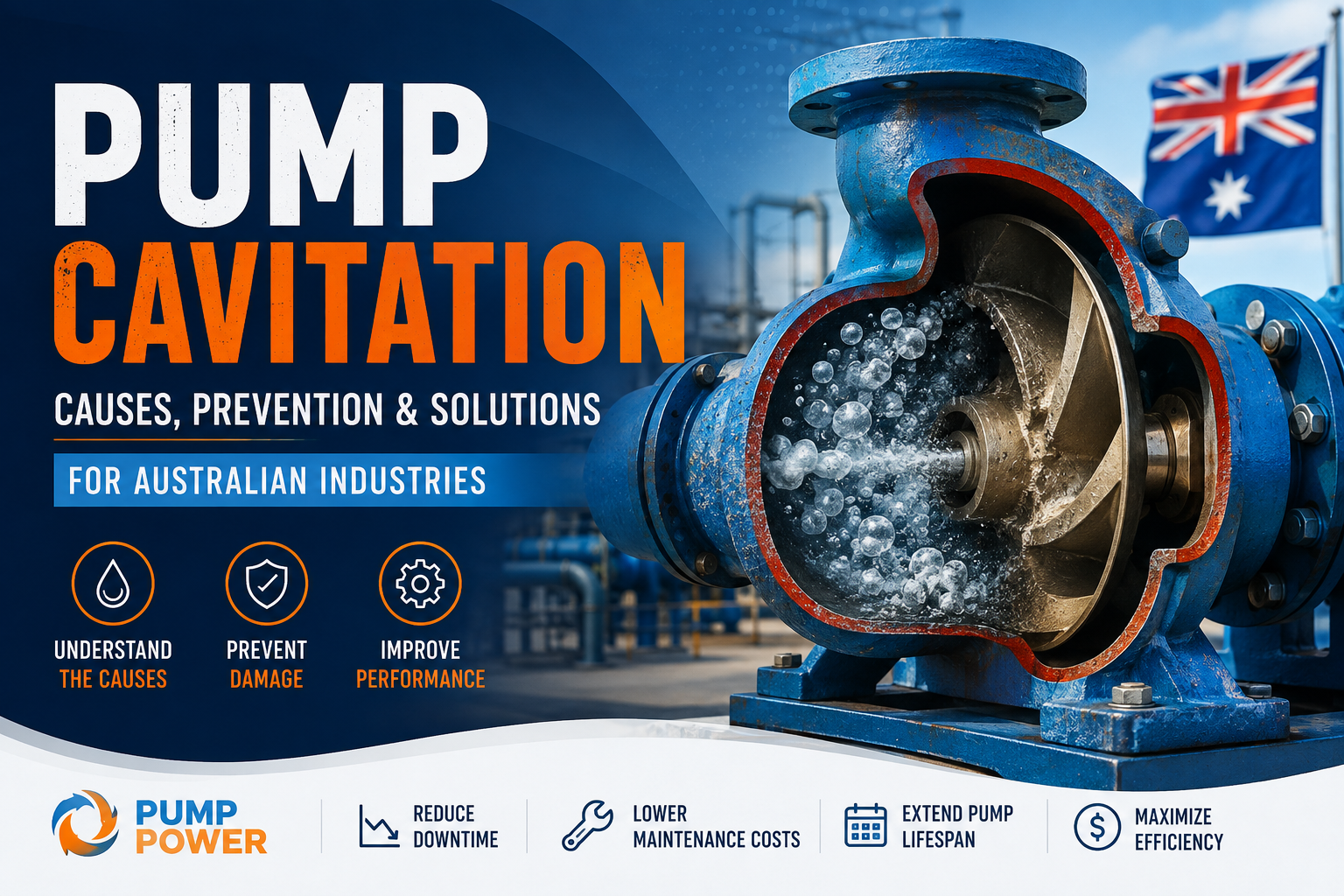
Pump cavitation is the formation and violent collapse of vapour bubbles inside a pump, caused when the local pressure within the pump drops below the vapour pressure of the liquid being pumped. As liquid accelerates into the impeller, pressure drops sharply at the impeller eye. If that pressure falls below the fluid’s vapour pressure at operating temperature, vapour bubbles form. When those bubbles are carried to higher-pressure zones in the pump, they collapse with enormous energy — generating microscopic shockwaves that erode metal, damage impellers, increase vibration, and reduce pump performance. It sounds like gravel in the pump. Left unchecked, it destroys the pump.
1. What Cavitation Actually Does to Your Pump — The Physics in Plain Language
Understanding the damage mechanism helps you understand why speed matters when diagnosing cavitation — and why “it’s still running” is not a safe indicator.
When a vapour bubble forms inside a pump and then collapses as it moves to a higher-pressure zone, it does not simply disappear. The collapse is violent and asymmetric. The surrounding liquid jets inward toward the collapsing bubble at speeds of up to 500 m/s — a process called microjet impact. Each microjet delivers a pressure impulse of up to 60,000 bar (6 GPa) to the metal surface it strikes. A single bubble collapse is insufficient to cause visible damage. But a cavitating pump produces millions of bubble collapses per second, all striking the same metal surfaces.
The result is progressive metal fatigue and surface erosion — first appearing as microscopic pitting, then as a rough, cratered honeycomb texture, then as wholesale loss of impeller material. A pump operating with severe cavitation can lose significant impeller vane material in a matter of weeks. With every microgram of metal removed, the impeller becomes more unbalanced — which increases vibration — which accelerates bearing wear — which leads to seal failure. The failure cascade accelerates once it starts.
What Cavitation Damages — In Order of Typical Progression
| Component | Damage type | Visible sign | Typical timeframe (severe cavitation) |
|---|---|---|---|
| Impeller vanes | Surface pitting, erosion, material loss | Cratered, honeycomb surface on vane face; rough texture; holes in thin vane sections | Days to weeks |
| Wear rings | Increased clearance from erosion + impeller imbalance vibration | Performance decline (flow loss) at constant speed; impeller-casing contact if severe | Weeks to months |
| Pump casing / volute | Pitting and erosion in high-velocity zones | Rough internal surfaces visible on inspection; reduced volute efficiency | Months |
| Pump bearings | Accelerated wear from impeller imbalance and increased radial force | Rising vibration and bearing temperature; premature bearing failure | Weeks to months |
| Mechanical seal | Shaft vibration from cavitation damages seal faces; misalignment | Seal leakage; fluid at shaft seal area | Weeks to months |
2. Warning Signs — How to Identify Pump Cavitation
Cavitation announces itself clearly. The challenge is recognising the pattern — particularly when you have not heard it before, or when multiple symptoms appear simultaneously and seem unrelated.
The most reliable indicator. A continuous rattling, crackling, or churning sound from within the pump casing — most maintenance engineers describe it as “pumping gravel” or “shaking a tin of marbles.” Mild cavitation: light hissing or ticking. Severe: sustained loud rattling. If your pump has always been quiet and has suddenly developed this sound — investigate immediately.
Vapour bubbles occupying space inside the pump reduce the effective volume available for liquid, causing a measurable drop in flow rate. If your centrifugal pump flow has dropped and speed has not changed — cavitation, impeller wear, or a suction problem are the likely causes. Check suction conditions first.
Discharge pressure gauge needle fluctuating or oscillating irregularly — not a smooth reading. Vapour bubble collapse events create pressure pulses that appear as erratic gauge movement. If your discharge pressure gauge is unstable and noise is present, cavitation is a strong candidate.
Bubble collapse events create random force impulses on the impeller. These impulses increase bearing housing vibration — measurable as elevated vibration velocity (mm/s RMS) at bearing locations. Cavitation vibration has a broad-spectrum signature different from imbalance (dominant at 1× running speed) or misalignment (dominant at 2×).
The energy from bubble collapse is absorbed as heat. A pump operating with sustained cavitation will run hotter than normal — detectable as elevated pump casing or bearing housing temperature. This is most pronounced when flow is very low (operation far from BEP) combined with cavitation.
The definitive confirmation of cavitation — visible during impeller inspection at next maintenance shutdown. Cratered, honeycomb-textured metal surfaces on impeller vane faces confirm sustained cavitation has occurred. Location of pitting (front vs rear vane face) distinguishes suction from discharge cavitation (see Section 3).
3. Suction Cavitation vs Discharge Cavitation — The Critical Difference
Correctly distinguishing between suction and discharge cavitation is essential — because the fix for one will not resolve the other, and misdiagnosis wastes time while the pump continues to be damaged.
| Factor | Suction Cavitation | Discharge Cavitation |
|---|---|---|
| What causes it | Suction pressure too LOW — pump is starved of fluid. NPSHa is insufficient. Suction restriction, excessive suction lift, blocked strainer, partially closed suction valve, high fluid temperature | Discharge pressure too HIGH — pump cannot push fluid out fast enough. Partially closed discharge valve, downstream blockage, system pressure higher than pump design, pump operating far left of BEP |
| Where bubbles form | At impeller eye (inlet) — where suction pressure is lowest | At impeller tip discharge side — where internal recirculation creates low-pressure zones |
| Impeller damage location | Front face of impeller vanes near the impeller eye — leading edge pitting | Rear face of impeller vanes — trailing edge and back-shroud pitting |
| Quick site diagnosis | Check suction pressure — is it lower than normal? Check strainer ΔP — is strainer blocked? Check suction valve — is it fully open? Measure actual suction lift | Check discharge valve — is it partially closed? Check downstream — is there a blockage? Check discharge pressure — is it higher than system design? Is pump operating at very low flow? |
| Proportion of cases | ~70% of cavitation cases | ~30% of cavitation cases |
| Fix direction | Increase NPSHa: clean strainer, open valve, widen suction pipe, lower pump, reduce fluid temperature | Reduce discharge resistance: open valve, remove blockage, reduce pump speed (VFD), trim impeller |
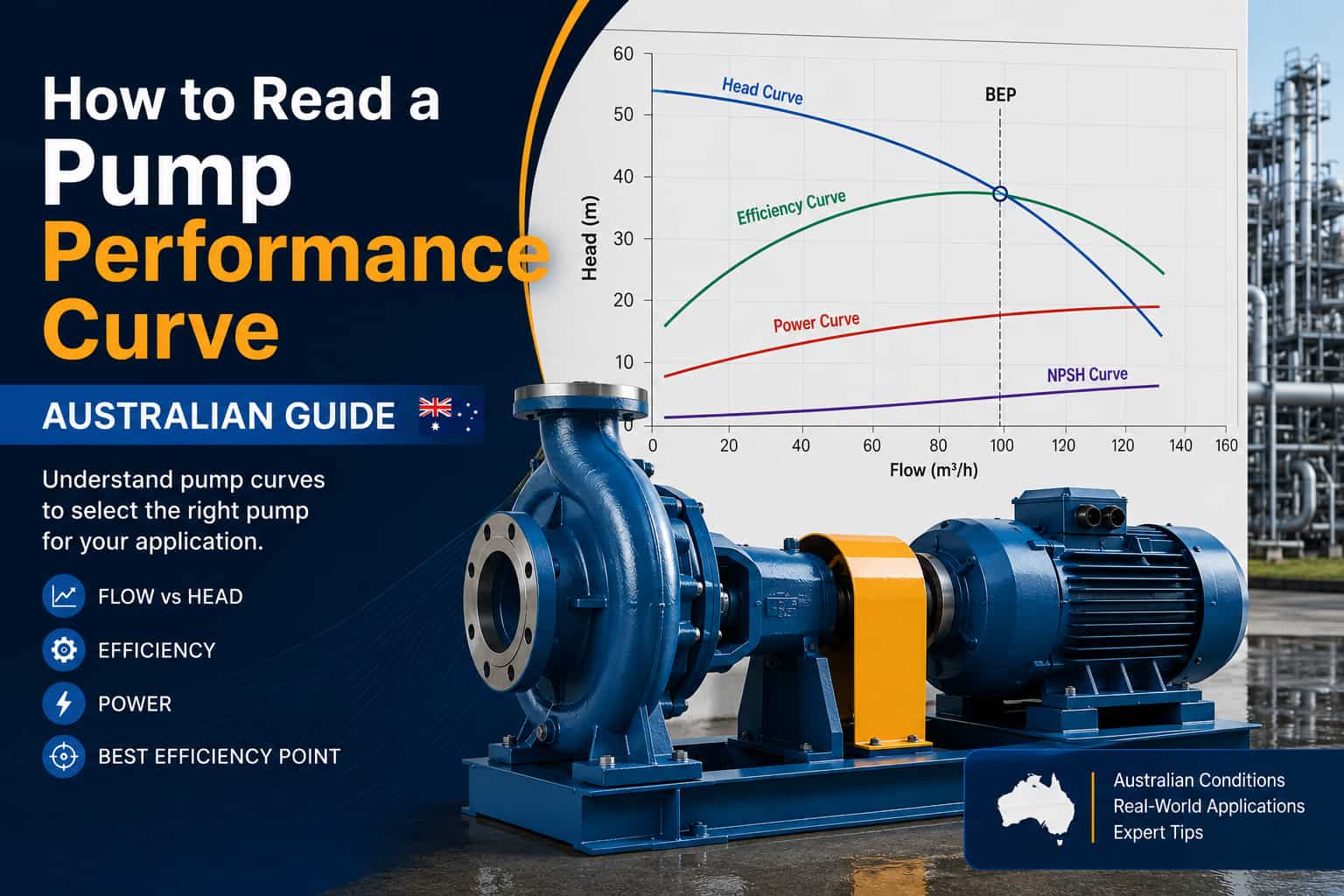
A third form — internal recirculation cavitation — occurs when a centrifugal pump operates far below its Best Efficiency Point (BEP). At very low flows, fluid recirculates at the impeller eye and discharge tips, creating low-pressure zones that generate cavitation even when inlet conditions appear acceptable. The fix: install a VFD and minimum flow bypass to prevent operation below 50–70% of BEP flow. See our VSD energy savings guide for implementation guidance.
4. The 8 Root Causes of Pump Cavitation — And How to Identify Yours
Cavitation is always a symptom of an underlying mismatch between the pump and the system. Here are the eight most common causes across Australian industrial installations — each with a quick site check to confirm or eliminate it as your root cause.
The most common single cause. A partially blocked suction strainer creates friction loss that reduces NPSHa below the pump’s NPSHr. Check: measure differential pressure across strainer — if ΔP is higher than normal, clean it. Even a strainer that appears “mostly clear” can be sufficiently restricted to cause cavitation at high flow rates. Fix: clean strainer immediately. Schedule weekly strainer ΔP checks on your maintenance plan — see our pump maintenance checklist.
The pump is installed too high above the suction source. Static suction lift directly reduces NPSHa — every additional metre of lift costs 1 metre of NPSHa. Check: measure actual pump installation height above minimum liquid level in suction tank or sump. Compare calculated NPSHa to pump’s NPSHr. Fix: lower pump installation, raise suction tank level, or select a pump with lower NPSHr for the application. For mine dewatering applications with variable sump levels, see our mine dewatering guide.
Small suction pipe diameter creates high fluid velocity, which generates friction losses that reduce NPSHa. A suction pipe with a velocity above 1.5 m/s is typically a problem. Suction pipe should generally be one pipe size larger than pump suction nozzle diameter for pumps drawing from elevated installations. Fix: upsize suction pipe to reduce velocity below 1.5 m/s. Minimise elbows and fittings on the suction side.
Vapour pressure rises sharply with temperature. Water at 60°C has a vapour pressure approximately 10× higher than at 20°C — meaning it needs far more suction pressure (NPSHa) to remain liquid as it accelerates into the impeller. Systems that pump hot water, hot oil, or process fluids at elevated temperatures are particularly vulnerable. Fix: reduce fluid temperature, insulate suction piping to prevent heat gain, or specify a pump with lower NPSHr for the hot fluid application. For boiler feed pump applications, correct NPSHa calculation at operating temperature is essential.
A suction isolation valve that has been partially closed — whether by accident, after maintenance, or deliberately to “control” flow — creates a restriction that reduces NPSHa and induces suction cavitation. The suction valve must always be fully open when the pump is running. Flow control on a centrifugal pump must only be done on the discharge side, never the suction. Check: physically confirm suction valve is 100% open. Even 10% closed is enough to cause cavitation at high flows.
Air leaking into the suction line — through a loose flange, cracked pipe, or leaking gasket — creates air bubbles that behave similarly to cavitation bubbles and produce similar noise and flow reduction. The suction side of a centrifugal pump operates below atmospheric pressure — any imperfection in the suction piping will draw air in. Check: inspect all suction flange joints, gaskets, and pipe connections. Air ingress often shows as a fluctuating rather than sustained noise. Fix: seal all suction piping. Consider this cause when noise is intermittent rather than constant.
NPSHr increases with the square of pump speed — double the speed and NPSHr increases fourfold. A pump operating above its design speed (wrong motor RPM, wrong pulley, VFD set too high) will cavitate even with adequate suction conditions for the design speed. Check: verify motor speed and compare to pump design speed. Confirm VFD maximum frequency setting is not above pump’s rated speed. Fix: correct motor speed or VFD setting to design speed.
Sometimes cavitation occurs because the pump was never correctly specified for the system. A pump with an NPSHr that is too high for the available suction conditions will always cavitate, regardless of how well it is installed and maintained. This is common after system changes — process expansion, piping modifications, or fluid temperature changes that were not reflected in a pump re-selection. Fix: re-evaluate pump selection against current system conditions. Contact Pump Power Australia’s engineering team for a pump selection review — we provide this as a free service to all customers.
5. NPSH — The Most Important Calculation in Pump Cavitation
Everything about pump cavitation comes down to one relationship: NPSHa must always exceed NPSHr. Understanding these two values — and how to calculate them — gives you the ability to diagnose cavitation quantitatively rather than guessing.
NPSHa vs NPSHr — What They Mean
A property of your system. The pressure available at the pump inlet above the vapour pressure of the fluid. You control NPSHa by changing tank level, suction pipe size, suction lift, fluid temperature, and strainer condition.
A property of the pump. The minimum inlet pressure the pump needs to avoid cavitation. Published by the manufacturer on the pump performance curve. NPSHr increases with flow rate and pump speed.
How to Calculate NPSHa — Step by Step
Worked Example — Australian Pump Installation
System: centrifugal pump drawing water from a sump 2.5m below pump centreline. Suction pipe friction losses: 1.2m. Water temperature: 25°C. Site at sea level.
(Patm – Pvapour) ÷ (ρ × g) = 98,155 ÷ (998 × 9.81) = 10.02 m
Hs = –2.5 m (suction lift — negative)
hf = 1.2 m
NPSHa = 10.02 – 2.5 – 1.2 = 6.32 metres
If strainer blocks and hf rises to 3.5m: NPSHa = 10.02 – 2.5 – 3.5 = 4.02m → NPSHa/NPSHr = 0.80 — cavitation guaranteed
NPSH Margin Ratio — 2026 Industry Standard
| Application | NPSH Margin Ratio (NPSHa ÷ NPSHr) | Standard |
|---|---|---|
| Standard water service, general industrial | ≥ 1.10 (minimum 10% margin) | HI standard |
| Chemical or hydrocarbon service | ≥ 1.30 | API 610 / HI |
| High-temperature process service (boiler feed, hot oil) | ≥ 1.50 recommended | Industry best practice 2026 |
| Mining slurry — variable suction conditions | ≥ 1.50 (design for worst-case sump level) | Mining industry best practice |
6. How to Fix Pump Cavitation — Step-by-Step Diagnosis and Action
Follow these steps in order. Steps 1–3 can be completed while the pump is running. Steps 4–6 require inspection during the next planned shutdown or emergency stoppage.
Listen carefully to noise character: cavitation produces a continuous, random gravel-like rattle. Bearing failure produces a more rhythmic grinding or growling at a specific frequency. Air entrainment produces an irregular gurgling that may vary with pump speed. Check all suction pipe joints for air leaks (soap solution on flanges reveals air ingress). Confirm flow and pressure are below normal. If uncertain — call our team on +61 3 9933 7400 for phone diagnosis support.
Confirm suction valve is 100% open. Measure strainer differential pressure — if elevated, clean strainer now. Check liquid level in suction tank or sump — if low, add fluid or wait for level to rise. Read suction pressure gauge — if lower than normal operating range, suction restriction is confirmed. These three checks resolve the majority of cavitation incidents in Australian industrial facilities.
Confirm discharge valve is fully open. Check downstream pipeline for blockages. Confirm discharge pressure is within normal operating range. If discharge pressure is significantly higher than normal, discharge cavitation or recirculation is the likely cause — partially open a recirculation bypass if fitted, or reduce pump speed using VFD.
Use the formula in Section 5. If NPSHa/NPSHr ratio is below 1.1 — cavitation risk is confirmed quantitatively. Identify which factor in the NPSHa calculation is the problem: suction lift? pipe friction? fluid temperature? This tells you exactly where the engineering fix must be applied. Contact our engineering team if you need help with the NPSHa calculation for your specific installation.
Based on your NPSHa calculation, implement the appropriate fix: widen suction pipe (reduces friction losses); lower pump installation (increases Hs); raise suction tank level; reduce fluid temperature; install VFD to reduce operating speed; trim impeller to shift BEP. Not all fixes require major work — suction pipe diameter increase and pump repositioning are often achievable cost-effectively.
At the next available shutdown — even if it means scheduling a brief planned stop — remove and inspect the impeller. A damaged impeller creates turbulence that makes cavitation self-reinforcing and harder to resolve even after the root cause is fixed. If pitting is significant, replace the impeller with a new one of the same specification. Pump Power Australia can supply replacement impellers for most pump makes and models — contact our Spares & Services team.
7. Cavitation Impeller Damage — Repair or Replace?
After identifying cavitation damage on an impeller during inspection, the decision is: repair (restore to near-original condition), continue running (if damage is mild), or replace. The correct answer depends on the extent of damage, the impeller material, and the cost context.
| Damage level | Visual appearance | Recommended action | Notes |
|---|---|---|---|
| Mild | Light surface roughening, small shallow pits, no material loss visible | Fix root cause. Continue running with close monitoring. Plan for impeller replacement at next scheduled overhaul | Cavitation must be eliminated — even mild damage accelerates if root cause is not fixed |
| Moderate | Defined pitting, cratered texture on vane faces, some material loss, impeller imbalance possible | Replace impeller. Do not continue running with moderate cavitation damage — imbalance accelerates bearing failure | Fix root cause before fitting new impeller — a new impeller will be damaged just as quickly if the system problem is not resolved |
| Severe | Deep craters, through-holes in thin vane sections, significant material loss, gross imbalance | Shut pump down. Do not continue operating. Replace impeller immediately. Assess casing and bearings for secondary damage | Severe imbalance at this stage causes rapid bearing failure and potential shaft failure — operating risk |
Pump Power Australia supplies replacement impellers, wear rings, mechanical seals, and complete pump assemblies for cavitation-damaged centrifugal pumps and slurry pumps from our Brooklyn, VIC warehouse — fast dispatch to all Australian states. We also provide pump refurbishment at our Brooklyn workshop — full inspection, re-machining, and rebuild to restore damaged pumps. Contact our Spares & Services team or call +61 3 9933 7400 for parts availability and lead time.
8. Prevention — 6 Permanent Fixes That Eliminate Cavitation Risk
Fixing an active cavitation problem is a short-term measure. Preventing it from returning — or from ever occurring in a newly installed pump — requires engineering the system correctly from the start. These six measures, applied correctly, eliminate the most common cavitation risks in Australian industrial pump installations.
| Prevention measure | How it prevents cavitation | Practical implementation |
|---|---|---|
| Size suction pipe correctly | Keeps suction pipe velocity below 1.5 m/s, minimising friction losses and preserving NPSHa | Size suction pipe one NPS larger than pump suction nozzle. Minimise elbows and fittings on suction side. Keep suction pipe as short and straight as possible |
| Install strainer ΔP monitoring | Provides early warning of strainer blockage before NPSHa drops below NPSHr | Fit differential pressure transmitter across suction strainer with high-ΔP alarm. Alarm setpoint: 2× clean strainer ΔP at duty flow. Connect to plant SCADA or local indicator |
| Install VFD for variable flow control | Prevents operation far from BEP (which causes recirculation cavitation); reduces operating speed when demand is low, reducing NPSHr | VFD minimum speed setting: do not allow operation below 50–70% of BEP flow. Install minimum flow bypass if low-demand periods are frequent. See our VSD guide |
| Design for minimum liquid level | Ensures NPSHa calculation uses worst-case (minimum) suction level, not average or maximum | Calculate NPSHa at minimum possible liquid level in suction tank/sump. Pump selection must achieve NPSHa ≥ 1.1× NPSHr even at minimum level. Install low-level shutoff to stop pump before level drops below minimum |
| Select pump with correct NPSHr for the system | Ensures the pump’s NPSHr requirement matches the NPSHa the system can reliably provide — eliminates the fundamental specification error | Include NPSHa calculation in pump specification at selection stage. Request pump curve with NPSHr plotted across full flow range. Compare NPSHr at maximum flow to worst-case NPSHa. Contact Pump Power Australia for free pump selection review |
| Monthly performance benchmarking | Detects developing suction problems (declining NPSHa from strainer blockage or pipe corrosion) before they cause cavitation | Record suction pressure, discharge pressure, flow rate, and motor current monthly at fixed conditions. A declining suction pressure trend at constant speed flags developing suction restriction. See our pump maintenance checklist guide |
9. Pump Cavitation vs Air Entrainment — How to Tell Them Apart
Cavitation and air entrainment are frequently confused — both produce noise, vibration, and flow reduction, and both are associated with suction-side problems. They are different phenomena with different fixes, and misdiagnosis is common.
| Factor | Cavitation | Air Entrainment |
|---|---|---|
| Cause | Vapour bubbles forming from the pumped liquid itself when pressure drops below vapour pressure — no external air | Air entering the pump from outside — leaking suction flange, cracked pipe, vortex at suction tank, loose fitting |
| Noise character | Sustained, consistent gravel-like rattling — relatively constant at constant operating conditions | Irregular gurgling, intermittent rattling — may vary with liquid level and time; often fluctuates |
| Suction pressure | Low but steady — below normal operating value | Fluctuating — erratic gauge movement as air pockets pass through pump |
| Discharge pressure | Reduced but relatively stable | Pulsating, highly erratic — large fluctuations as air pockets collapse |
| Quick test | Calculate NPSHa — if below 1.1× NPSHr, cavitation confirmed. Fix: improve suction conditions | Apply soap solution or shaving foam to all suction flange joints while pump runs — bubbling at any joint confirms air leak. Fix: tighten or replace flange joint |
| Impeller damage | Yes — pitting and erosion on impeller vanes | Less severe — air is more compressible than vapour; erosion is less aggressive but still damaging long-term |
10. Pump Cavitation Questions from Reddit, Quora, and Industry Forums — Answered
These are the most commonly asked pump cavitation questions across engineering forums, Reddit r/mechanical_engineering, Quora, and Australian industrial maintenance communities — with direct, practical answers.
Gravel-like rattling with flow present strongly suggests cavitation or air entrainment. Bearing failure typically produces a rhythmic grinding or growling at specific frequencies — not a continuous rattle. Loose impeller on the shaft produces a cyclical noise linked to speed. To confirm: check suction pressure (low = cavitation), check suction flanges for air leaks (soap test), and listen for whether the noise varies with pump speed (cavitation does; bearing noise shifts with speed but maintains its pattern). If in doubt, take the pump offline and inspect the impeller — pitting confirms cavitation.
The root cause was not fixed before the new impeller was fitted. A new impeller will cavitate just as fast as the old one if the system conditions remain unchanged — wrong suction conditions, blocked strainer, excessive speed, or wrong pump for the application. Replacing the impeller without fixing the root cause is expensive and ineffective. Always calculate NPSHa and compare to pump NPSHr before fitting a replacement impeller. If NPSHa/NPSHr is below 1.1, the root cause is still there and the new impeller will fail again.
Yes — reducing pump speed reduces NPSHr (which decreases with the square of speed). If your pump is cavitating because NPSHr is marginally too high for your NPSHa, a small speed reduction may bring you back into the safe zone. However, reducing speed also reduces flow and pressure — confirm that the reduced duty point still meets process requirements. A 10% speed reduction reduces NPSHr by approximately 19% and flow by 10%. This is a useful interim fix while a permanent engineering solution (pipe upsizing, pump relocation) is implemented.
Classic sign of a system that is marginal on NPSHa — just above the safe threshold in winter and dropping below it in summer. As fluid temperature increases, vapour pressure rises, which reduces NPSHa (less pressure available above vapour pressure). A system with just enough NPSHa at 15°C fluid temperature may cavitate at 30°C. The fix is to calculate NPSHa at your worst-case summer fluid temperature and compare to NPSHr — then implement a permanent fix (suction pipe upsizing, pump relocation, or pump replacement with lower NPSHr) rather than managing it seasonally.
Yes — the NPSH Margin Ratio gives you a quantitative measure of how far you are from the cavitation threshold. Calculate your NPSHa and divide by the pump’s NPSHr at your operating flow. A ratio of 1.5 means you have a comfortable 50% margin. A ratio of 1.1 means you are at the minimum acceptable margin. As strainer blocks, liquid level drops, or fluid temperature rises, this ratio falls. A real-time suction pressure transmitter and strainer ΔP transmitter, monitored against alarm setpoints, gives you early warning before noise begins.
Key Takeaways — Pump Cavitation
- Pump cavitation is the formation and collapse of vapour bubbles inside the pump — it sounds like gravel, reduces flow, increases vibration, and destroys impellers over time
- Suction cavitation (70% of cases): insufficient NPSHa — blocked strainer, suction lift too high, suction valve partially closed, fluid too hot
- Discharge cavitation (30% of cases): discharge pressure too high — partially closed discharge valve, downstream blockage, pump operating far left of BEP
- The fundamental test: calculate NPSHa and compare to pump’s NPSHr. If NPSHa ÷ NPSHr is below 1.1 — cavitation risk is confirmed
- The most common and fastest fix: clean the suction strainer and confirm suction valve is 100% open — these resolve the majority of Australian industrial cavitation incidents
- Never replace an impeller before fixing the root cause — the new impeller will cavitate just as fast
- A pump with moderate or severe impeller pitting should be taken offline for impeller replacement — damaged impeller surfaces self-reinforce cavitation
- Prevention: correctly sized suction pipe, suction strainer ΔP monitoring, VFD for variable duty, and monthly performance benchmarking
- Cavitation and air entrainment produce similar symptoms — test for air entrainment by applying soap solution to all suction flanges while running
- Pump Power Australia supplies replacement impellers, mechanical seals, and complete pumps for cavitation-damaged Australian industrial pumps — call +61 3 9933 7400 or contact our Spares & Services team
Frequently Asked Questions
Structured for Google People Also Ask, ChatGPT, Gemini, Claude, and Perplexity direct answer extraction.
Pump cavitation is the formation and violent collapse of vapour bubbles inside a pump, caused when local pressure within the pump drops below the vapour pressure of the liquid being pumped. As liquid accelerates into the impeller eye, pressure drops sharply. If it falls below the liquid’s vapour pressure at operating temperature, tiny vapour bubbles form. These bubbles collapse with enormous energy when they move to higher-pressure zones, generating shockwaves that erode metal surfaces, damage impellers, increase vibration, reduce flow, and ultimately destroy the pump if not addressed. It produces a characteristic sound described as “pumping gravel” or “shaking a tin of marbles.” For centrifugal pump operation basics, see our centrifugal pump guide.
Pump cavitation produces a distinctive rattling or crackling sound most commonly described as “pumping gravel” or “shaking a tin of marbles” — a continuous, irregular rattling noise coming from within the pump casing or suction area. Mild cavitation may sound like light hissing or ticking. Severe cavitation produces a loud, sustained rattling that is difficult to ignore. The sound is usually consistent at constant operating conditions — this distinguishes it from air entrainment noise, which tends to be more intermittent and gurgling. If your pump has suddenly developed this sound and flow or pressure has dropped, cavitation is the most likely diagnosis — check suction conditions immediately.
Suction cavitation occurs when suction pressure is too low — the pump is starved of fluid, vapour bubbles form at the impeller eye, and damage appears as pitting on the front face of impeller vanes near the impeller eye. It accounts for approximately 70% of cavitation cases and is typically caused by insufficient NPSHa: blocked strainer, excessive suction lift, high fluid temperature, partially closed suction valve. Discharge cavitation occurs when discharge pressure is too high — the pump cannot push fluid out fast enough, internal recirculation creates low-pressure zones, and damage appears on the rear face of impeller vanes. It is typically caused by a partially closed discharge valve, downstream blockage, or operating the pump far to the left of its Best Efficiency Point. Both types produce similar noise and vibration — the damage location on the impeller distinguishes them during inspection.
NPSHa (Net Positive Suction Head Available) is a property of your system — the pressure available at the pump inlet above the vapour pressure of the liquid. It depends on suction tank level, suction pipe friction losses, fluid temperature, and installation height. NPSHr (Net Positive Suction Head Required) is a property of the pump — the minimum inlet pressure needed to avoid cavitation, published by the manufacturer on the pump performance curve. NPSHa must always exceed NPSHr to prevent cavitation. The 2026 industry standard recommends a NPSH Margin Ratio of ≥ 1.1 for standard water service and ≥ 1.3 for chemical or hydrocarbon applications (API 610). Calculate NPSHa using: NPSHa = (Patm – Pvapour) ÷ (ρg) + Hs – hf.
Yes — a pump can continue to run while cavitating, but it is actively damaging itself every second. The fact that the pump is still running is not an indication that cavitation is harmless or can be ignored. Mild, low-energy cavitation causes slow progressive impeller pitting. Severe cavitation can destroy a stainless steel impeller in weeks. The cascading damage — impeller erosion → imbalance → bearing wear → seal failure — accelerates once it starts. If you can hear gravel-like noise and flow has reduced, address the root cause as urgently as possible and inspect the impeller at the next available maintenance window. Contact Pump Power Australia’s team on +61 3 9933 7400 for urgent support.
NPSHa formula: NPSHa = (Patm – Pvapour) ÷ (ρ × g) + Hs – hf. Where Patm = atmospheric pressure (Pa); Pvapour = vapour pressure of liquid at operating temperature (Pa); ρ = liquid density (kg/m³); g = 9.81 m/s²; Hs = static suction head in metres (positive if tank above pump, negative if pump above tank — suction lift); hf = total friction losses in suction piping in metres. Example: water at 20°C, pump 2.5m above sump, friction losses 1.2m, sea level: NPSHa = (101,325 – 2,337) ÷ (998 × 9.81) + (–2.5) – 1.2 = 10.08 – 2.5 – 1.2 = 6.38 metres. Compare to pump’s NPSHr at operating flow — if ratio ≥ 1.1, you are in the safe zone. Contact Pump Power Australia for NPSHa calculation support.
Cavitation damage on an impeller appears as surface pitting — a rough, cratered, or honeycomb-like texture on the metal surface where vapour bubble collapse has eroded material. Suction cavitation damage appears on the leading edge and front face of impeller vanes near the impeller eye. Discharge cavitation damage appears on the trailing edge and rear face of vanes. Mild damage: light roughening, small shallow pits — pump may continue to run with close monitoring. Moderate damage: defined craters, some material loss — impeller must be replaced. Severe damage: deep craters, through-holes in thin vane sections, visible imbalance — shut down immediately. Pump Power Australia can inspect and assess cavitation-damaged pumps at our Brooklyn, VIC workshop — contact our service team.
In most cases, yes — cavitation is a system design problem, not always a pump quality problem, and the pump itself is usually salvageable. Common system fixes that resolve cavitation: increasing suction pipe diameter to reduce friction losses; lowering pump installation height; removing suction restrictions (clean strainer, fully open suction valve); reducing fluid temperature; installing a VFD to reduce pump speed and NPSHr; trimming the impeller to shift the operating point toward BEP. Replace the pump itself only if it was fundamentally wrong for the application — incorrect NPSH characteristics, wrong impeller design for the fluid type, or incorrect pump curve for the system. Contact Pump Power Australia for a free pump and system suitability review.
No — they are different phenomena with different causes and different fixes, though they produce similar symptoms. Cavitation: vapour bubbles form from the liquid itself when pressure drops below vapour pressure — no external air is involved. Fix: improve NPSHa margin (reduce suction friction, lower pump height, reduce fluid temperature). Air entrainment: air enters the pump from outside through a leaking suction flange, cracked pipe, or vortex forming at suction tank surface. Fix: find and seal the air leak. Quick distinction test: apply soap solution or shaving foam to all suction flanges and pipe joints while the pump runs — bubbling at any joint confirms air entrainment. Calculate NPSHa and compare to NPSHr to confirm or eliminate cavitation as a simultaneous cause. Both can occur together.
Yes. Pump Power Australia supplies replacement impellers, wear rings, mechanical seals, and complete pump assemblies for cavitation-damaged centrifugal pumps and slurry pumps from our Brooklyn, VIC warehouse — with fast dispatch to all Australian states. We stock a large range of Ritz pump parts and can source impellers and pump components for most major pump brands. Our workshop also provides full pump refurbishment — strip-down, inspection, impeller replacement, bearing replacement, and rebuild to as-new specification. Contact our Spares & Services team or call +61 3 9933 7400 — we respond to all parts enquiries within one business day.
Conclusion — What to Do Next If Your Pump Is Cavitating
Pump cavitation is not a pump design flaw, a materials problem, or bad luck. In the overwhelming majority of cases, it is a mismatch between the pump and the system it is operating in — and that mismatch is correctable.
The fastest path to resolution: confirm suction valve is fully open, check strainer differential pressure and clean if elevated, calculate NPSHa and compare to pump’s NPSHr. In the majority of Australian industrial cavitation incidents, one of these three steps resolves the immediate problem. The longer-term solution — correctly sizing suction piping, designing for minimum liquid level, and selecting the right pump for the system — is what prevents recurrence.
If your pump has been cavitating for an extended period, inspect the impeller at the earliest opportunity. A damaged impeller makes cavitation self-reinforcing and harder to resolve even after the root cause is fixed. Replacing a cavitation-damaged impeller with a new one — in a system where the root cause has been correctly resolved — typically restores the pump to full design performance.
Pump Power Australia’s engineering team can help diagnose cavitation issues in your specific system, calculate NPSHa for your installation, review pump selection, and supply replacement impellers and pump components for fast return to service. We have been resolving Australian industrial pump problems for over 35 years — across mining, water treatment, food processing, chemical, and marine applications nationally.
References and Technical Sources
- EPCLand — “Centrifugal Pump Cavitation: Engineering Guide to NPSH and Reliability 2026”: epcland.com
- JM Industrial — “Pump Cavitation Causes, Symptoms and Long-Term Pump Damage” (Feb 2026): jmindustrial.com
- ISOHITECH — “Oil Pump Cavitation: Symptoms, Root Causes, and Prevention” (Apr 2026): isohitech.com
- Stream Pumps — “5 Common Causes of Centrifugal Pump Failure and How to Fix Them” (Jan 2026): streampumps.com
- ScienceInsights — “What is Pump Cavitation? Causes, Effects and Prevention” (Mar 2026): scienceinsights.org
- Pumps and Systems — “Cavitation: Causes, Prevention and More”: pumpsandsystems.com
- Hydraulic Institute (HI) — ANSI/HI Standards for Centrifugal Pump NPSH and Cavitation: pumps.org
- API Standard 610 — Centrifugal Pumps for Petroleum, Petrochemical and Natural Gas Industries (12th Edition)
- Wilo USA — “What is Pump Cavitation? Causes, Effects and Mitigation”: wilo.com
- Viking Pump — “Pump Cavitation: Symptoms, Cause, Diagnosis and Cure”: vikingpump.com
Pump Cavitation Problem? Talk to Our Engineering Team.
Tell us your pump make and model, the symptoms, and your site location — and we will diagnose your cavitation problem and recommend the correct fix. For urgent breakdown situations, we check impeller and parts availability immediately and can dispatch same business day from our Brooklyn, VIC warehouse.
Pump cavitation diagnosis and selection review is provided free to all customers.
📞 +61 3 9933 7400
✉ info@pumppower.com.au
9 Export Drive, Brooklyn VIC 3012 | Mon–Fri 8:00am–5:00pm AEST
This guide was prepared by the engineering team at Pump Power Australia, a specialist industrial pump supplier based in Brooklyn, Victoria, with over 35 years of experience diagnosing and resolving pump cavitation, impeller damage, and suction system problems across Australian mining, water treatment, food processing, chemical, and marine industries. Pump Power Australia supplies pump solutions to BHP, Rio Tinto, Shell, Woodside, and hundreds of Australian industrial facilities.
Related guides: Centrifugal vs Positive Displacement Pumps | Pump Maintenance Checklist | VSD Energy Savings Guide | Mine Dewatering Guide