Australian industrial electricity prices have risen by roughly 25% over the past five years (WhySolar / AER data, 2026). The Australian Energy Regulator approved further price hikes of up to 9.7% for 2025–26. For industrial sites running pumps 24 hours a day, seven days a week, this is not an abstraction — it is tens of thousands, sometimes hundreds of thousands, of dollars in avoidable annual cost.
The single most effective technology available to Australian industry for cutting pump energy costs is not a new pump design or a new motor technology. It is a Variable Speed Drive (VSD) — a device that has existed for decades, is proven across every industry, and still remains underdeployed on the majority of Australian industrial pump installations.
The mathematics are not ambiguous. Reduce a centrifugal pump’s operating speed by just 20% and, by the Affinity Laws (Cube Law), you cut its power consumption by approximately 49%. On a 75 kW pump running continuously, that is over AUD $50,000 per year in electricity savings at current Australian industrial electricity rates.
This guide — produced by the engineering team at Pump Power Australia, with over 35 years of experience supplying industrial pumps and pump systems to Australian industry — explains how VSD technology works, which pump applications benefit most, how to calculate your ROI, and what to watch out for when specifying a VSD for your pump system.
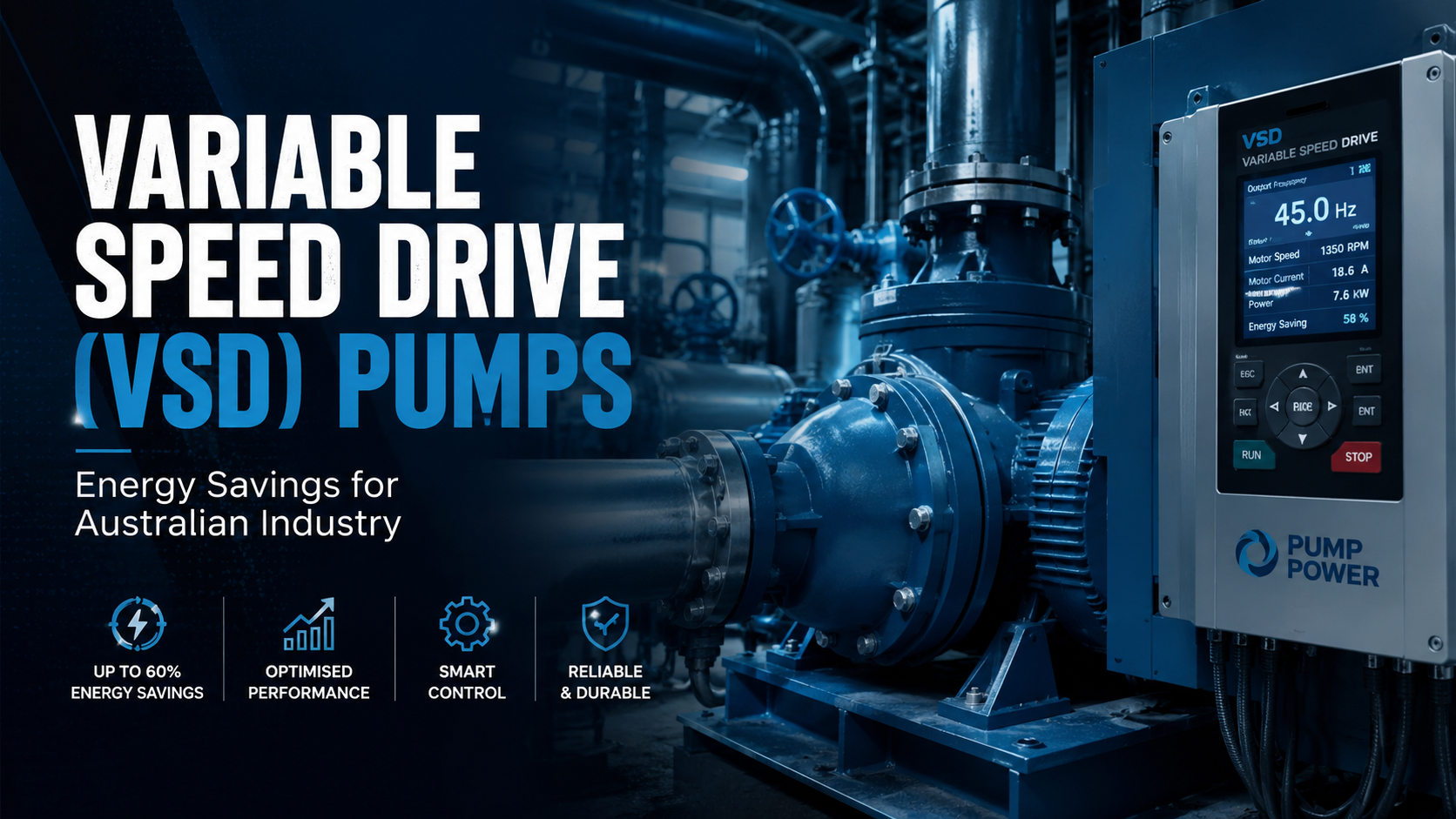
A Variable Speed Drive (VSD) — also called a Variable Frequency Drive (VFD) or Adjustable Speed Drive (ASD) — is an electronic device that controls the rotational speed of an electric motor by adjusting the frequency and voltage of the power supplied to it. When applied to a centrifugal pump, a VSD allows the pump to operate at precisely the speed needed to deliver the required flow, rather than running at constant full speed with flow controlled by throttling valves. This speed control exploits the Affinity Laws to achieve dramatic reductions in energy consumption whenever the required flow is less than the pump’s maximum capacity.
- Why Australian Industrial Electricity Costs Are Forcing Action in 2026
- The Affinity Laws Explained: The Physics Behind 50% Energy Savings
- How a VSD Works — Step by Step
- Which Pump Types Benefit Most from VSD Control?
- VSD vs Throttling Valve: Why Throttling Wastes Energy
- Real ROI Calculation — Australian Industrial Site Example
- Industry Applications: Where VSDs Deliver the Fastest Payback
- VSD Selection Criteria for Pump Applications
- Environmental and Sustainability Benefits
- Common Mistakes When Applying VSDs to Pumps
- Expert Tips from Pump Power Australia
- Key Statistics: VSD Energy Savings in Australian Industry 2026
- Comparison Tables
- Frequently Asked Questions (10 FAQs)
- Conclusion
1. Why Australian Industrial Electricity Costs Are Forcing Action in 2026
Pump Industry Magazine Australia’s 2026 State of the Industry survey is unambiguous: across Australia’s water pumping and fluid management sectors, energy has become one of the most significant operating costs. VSDs are no longer a discretionary upgrade — they are a strategic necessity.
The numbers behind this shift tell the story clearly:
For an industrial facility running centrifugal pumps continuously — water treatment plants, chemical plants, food processing facilities, mine sites, power stations, and HVAC installations — energy is the dominant life-cycle cost, not capital expenditure. A pump bought for $15,000 can consume $50,000 in electricity per year if run at full speed when partial flow would suffice.
The Australian Government’s Department of Energy confirms that electric motors account for a substantial share of industrial energy use, and that “speed control allows motors to be oversized to meet extreme requirements without wasting energy during low demand” — precisely the operating mode of most Australian industrial pump installations without VSD control.
2. The Affinity Laws Explained: The Physics Behind 50% Energy Savings
The energy savings delivered by VSD-controlled centrifugal pumps are not a marketing claim — they are a direct consequence of fundamental fluid mechanics, described by the Affinity Laws (also known as the Pump Laws or Cube Law).
The three Affinity Laws for centrifugal pumps state:
| Parameter | Relationship to Speed | Example: Speed reduced to 80% |
|---|---|---|
| Flow rate (Q) | Proportional to speed (Q ∝ N) | Flow = 80% of original |
| Head / pressure (H) | Proportional to speed² (H ∝ N²) | Head = 64% of original (0.8² = 0.64) |
| Power (P) | Proportional to speed³ (P ∝ N³) | Power = 51.2% of original (0.8³ = 0.512) |
The critical insight is in that third row. Reducing pump speed by just 20% cuts power consumption by approximately 49% — almost half. This is not an approximation that degrades significantly in practice; it is a well-established engineering relationship confirmed in thousands of real-world installations globally.
The Cube Law in Plain English
Think of it this way: at full speed, a pump is working extremely hard to push fluid against resistance. Even a modest reduction in speed means the pump is working against much less resistance — and because power scales with the cube of speed, the savings are disproportionately large compared to the speed reduction.
The Affinity Laws and cube law apply specifically to centrifugal pumps operating against variable system resistance (friction-dominant systems). They do not apply — or apply to a much lesser degree — to positive displacement pumps (gear pumps, progressive cavity pumps, piston pumps), which have a constant-torque relationship between speed and power. For positive displacement pumps, a 20% speed reduction delivers approximately 20% power saving, not 49%. Always confirm the pump type before projecting VSD energy savings.
3. How a VSD Works — Step by Step
A VSD operates by converting the fixed-frequency mains power supply (50 Hz in Australia) into a variable-frequency output matched to the required motor speed. The process involves three stages:
- Rectification — the incoming AC mains supply (415V 3-phase in most Australian industrial installations) is converted to DC power by a rectifier bridge.
- DC Bus filtering — the DC voltage is smoothed and stored in capacitors, providing a stable DC bus voltage.
- Inversion — an inverter uses pulse-width modulation (PWM) to reconstruct an AC output at the desired frequency and voltage. Lowering the output frequency reduces the motor’s synchronous speed and therefore the pump’s rotational speed.
The result: the pump motor runs at precisely the speed needed to deliver the required flow, continuously adjusting to match system demand. In a water treatment plant, for example, the VSD receives a 4–20mA signal from a flow meter or pressure transducer and automatically adjusts pump speed to maintain the setpoint — without any manual intervention and without any energy wasted on throttling.
- Soft start / soft stop — eliminates the high inrush current and mechanical shock of direct-on-line (DOL) starting, significantly extending motor and pump bearing life
- Process control integration — 4–20mA, Modbus, Profibus, EtherNet/IP inputs for direct integration with SCADA, DCS, and PLC systems
- Motor protection — built-in overtemperature, overcurrent, phase loss, and earth fault protection reduces the need for separate motor protection relays
- Energy monitoring — modern VSDs display real-time kW, kWh, and CO₂ savings — essential for sustainability reporting
- Harmonic filtering — essential for sites with multiple drives; ensure your VSD specification addresses harmonic distortion per AS/NZS 61000 requirements
4. Which Pump Types Benefit Most from VSD Control?
Not every pump application delivers equal VSD savings. The key question is: does the pump’s required flow rate vary over time? If the answer is yes, VSD control will save energy. The greater the variation, the greater the saving.
Pump Types With Excellent VSD Energy Savings (Cube Law Applies)
- Centrifugal pumps — the most common pump type in Australian industry and the primary beneficiary of VSD control. End-suction, in-line, back pull-out, and close-coupled centrifugal pumps all respond to the cube law when operating in friction-dominated systems.
- Multistage centrifugal pumps — VSD control on multistage pumps for boiler feed, RO systems, and mine dewatering delivers substantial savings, particularly where demand varies with process conditions or seasonal factors.
- Submersible dewatering pumps — VFD-controlled submersible pumps in wet wells and pit sumps maintain setpoint water levels with minimal energy consumption during low-inflow periods.
- Horizontal split case pumps — widely used in water supply, HVAC, and fire systems, these large pumps consume substantial energy and benefit significantly from speed-matched control.
- Bore hole pumps — VFD-controlled bore field dewatering arrays (5–30 pumps per field) deliver automated load balancing and significant energy savings on continuously running mine site bore fields.
Pump Types With Moderate VSD Benefits (Linear, Not Cubic)
- Progressive cavity pumps — positive displacement technology; speed reduction delivers proportional (not cubic) power savings, but VSD control is still valuable for flow rate control and gentle product handling in food and beverage and wastewater applications.
- Gear pumps — positive displacement; VSD control provides precise flow metering and speed matching to process requirements, with proportional energy savings.
- Lobe pumps — VSD control enables gentle product handling at lower speeds in sanitary food and beverage applications, with proportional energy savings.
5. VSD vs Throttling Valve: Why Throttling Wastes Energy
The traditional method of controlling flow from a centrifugal pump is simple: run the pump at full speed and partially close a throttling valve on the discharge to restrict flow to the required rate. This approach is intuitive, cheap to install, and enormously wasteful.
| Control Method | How It Works | Energy Consumption at 80% Flow | Energy Waste | Other Effects |
|---|---|---|---|---|
| Throttling valve | Pump runs at full speed; valve restricts discharge | ~90–95% of full-speed power (minimal saving) | Very high — full motor speed means near-full power draw | Increased pressure across valve; accelerated valve wear; vibration; noise; increased risk of cavitation |
| VSD speed control | Pump speed reduced to match required flow | ~51% of full-speed power (0.8³ = 0.512) | Minimal — pump only works as hard as required | Reduced mechanical stress; extended bearing and seal life; quieter operation; no throttling pressure drop |
A throttling valve on a centrifugal pump is analogous to driving a car with the accelerator flat to the floor and controlling speed with the brakes — you achieve the target speed, but at enormous fuel cost and accelerated brake wear. A VSD, by contrast, simply lifts the accelerator to match the required speed.
When a throttling valve is used to reduce flow significantly below the pump’s design point, the pump may operate in a low-flow recirculation zone, causing cavitation — implosion of vapour bubbles within the pump that damages impellers, casings, and mechanical seals. VSD control, by reducing pump speed to match demand, keeps the pump operating near its Best Efficiency Point (BEP) and dramatically reduces cavitation risk.
6. Real ROI Calculation — Australian Industrial Site Example
Abstract physics is convincing. Real numbers are more convincing. The following worked example uses a typical Australian industrial pump application and current Australian electricity pricing to demonstrate the VSD ROI case.
| Pump type | End-suction centrifugal pump |
| Motor rating | 75 kW |
| Operating hours | 8,000 hours per year (continuous operation) |
| Current flow control method | Throttling valve — pump runs at full speed |
| Average required flow | 80% of pump’s maximum capacity |
| Electricity rate | AUD $0.30/kWh (mid-range industrial rate, Victoria 2026) |
| Current annual energy cost (full speed + throttling) | 75 kW × 8,000 hrs × $0.30 = AUD $180,000/year |
| VSD-controlled power at 80% speed | 75 kW × 0.8³ = 75 × 0.512 = 38.4 kW |
| Annual energy cost with VSD | 38.4 kW × 8,000 hrs × $0.30 = AUD $92,160/year |
| Annual energy saving | AUD $87,840 per year (48.8% saving) |
| VSD and installation cost (estimate) | AUD $25,000–$40,000 |
| Simple payback period | Less than 6 months |
This is not an extreme example — it reflects a standard centrifugal pump application at a flow rate typical of hundreds of Australian water treatment plants, chemical facilities, mining sites, and industrial plants. At higher electricity rates (South Australia averages over AUD $0.40/kWh), the savings and payback are even more compelling.
Sensitivity Analysis: Savings by Motor Size and Speed Reduction
| Motor Size | Speed Reduction | Power Saving (%) | Annual kWh Saved (8,000 hrs) | Annual AUD Saved (at $0.30/kWh) |
|---|---|---|---|---|
| 22 kW | 20% (to 80% speed) | 49% | 86,240 | $25,872 |
| 37 kW | 20% (to 80% speed) | 49% | 145,040 | $43,512 |
| 75 kW | 20% (to 80% speed) | 49% | 291,840 | $87,552 |
| 110 kW | 20% (to 80% speed) | 49% | 431,200 | $129,360 |
| 75 kW | 10% (to 90% speed) | 27% | 164,160 | $49,248 |
| 75 kW | 30% (to 70% speed) | 66% | 422,400 | $126,720 |
Calculations based on Affinity Laws (Cube Law). Real-world savings may vary due to system curve characteristics, VSD efficiency losses (~2–3%), and motor efficiency at partial load. Consult Pump Power Australia’s engineering team for site-specific analysis.
7. Industry Applications: Where VSDs Deliver the Fastest Payback
Water and Wastewater Treatment
Municipal and industrial water and wastewater treatment plants run pumps continuously, with flow demands that vary significantly across the day, week, and season. VSD-controlled centrifugal and submersible pumps matched to SCADA-controlled level and flow setpoints deliver some of the fastest payback periods of any industrial VSD application — often under 12 months at current electricity prices.
Mine Dewatering
Mine dewatering bore field arrays running VFD-controlled bore hole pumps and submersible dewatering pumps deliver automated load balancing and substantial energy savings. On a site running 20 bore pumps of 15 kW each at an average 75% of full speed, the annual energy saving versus fixed-speed operation exceeds AUD $500,000 at current Victorian electricity rates.
Chemical Processing and Dosing
Chemical transfer and dosing applications using VSD-controlled centrifugal or positive displacement pumps achieve precise flow control without the need for throttling valves or bypass lines — reducing both energy consumption and maintenance requirements. See our magnetic drive pump range for sealless chemical transfer options compatible with VSD control.
Food and Beverage Manufacturing
In food and beverage processing, VSD-controlled lobe pumps and progressive cavity pumps allow precise product transfer speeds matched to process requirements — protecting product quality while reducing energy consumption and mechanical wear on pump components.
HVAC and Building Services
Chilled water and heating water circulating pumps in large commercial and industrial buildings are one of the highest-value VSD retrofit applications. Demand for heating and cooling varies constantly with occupancy and ambient temperature; VSD-controlled centrifugal circulating pumps matched to building management systems (BMS) routinely achieve 40–60% energy savings versus fixed-speed operation.
Oil and Gas
In oil and gas applications, VSD-controlled pumps for produced water handling, pipeline pressure boosting, and chemical injection provide precise flow matching to process conditions, reducing energy waste and improving process control. API-compliant centrifugal pumps in refinery and upstream applications are increasingly specified with VSD control.
Power Generation
Power generation facilities operate multiple large pumps in cooling water, condensate, and boiler feed service. VSD control on cooling water pumps — which typically run at partial load for the majority of operating hours — can deliver annual savings of hundreds of thousands of dollars on a single large power station unit.
8. VSD Selection Criteria for Pump Applications
Selecting a VSD for a pump application involves more than matching the kW rating. The following criteria must be assessed to ensure the VSD performs reliably in your specific site environment and application:
8.1 Power Rating and Motor Compatibility
- VSD output kW rating must match or exceed the motor’s nameplate kW rating
- Confirm motor insulation class is suitable for VSD operation — older motors may require insulation upgrades to withstand PWM voltage peaks
- Use of sine wave filters or dV/dt filters on long motor cables (>30m) reduces voltage stress on motor windings
8.2 Enclosure Rating and Site Environment
- IP55 minimum for most Australian industrial and mine site environments — dust, moisture, and washdown exposure are common
- IP66 for outdoor installations or areas subject to direct water spray
- Consider ATEX/IECEx hazardous area classification for pumps in flammable or explosive environments — see our AOD pump range for inherently safe alternatives where VSD use in hazardous areas is not appropriate
- High ambient temperatures on Australian mine sites and in process plants may require derating or forced cooling of the VSD enclosure
8.3 Input Power and Harmonics
- Confirm VSD input voltage matches site supply — 415V 3-phase is standard in most Australian industrial applications; some remote sites use non-standard voltages
- Multiple VSDs on the same supply bus can generate harmonic distortion — ensure compliance with AS/NZS 61000 harmonic limits. Active front-end (AFE) drives or passive harmonic filters may be required
- Input current at full load is typically 10–15% higher than motor nameplate current — check supply cable and switchboard ratings
8.4 Control Interface and Integration
- Confirm the VSD supports the control signal type required by your SCADA or PLC system — 4–20mA, 0–10V, Modbus RTU, Modbus TCP, Profibus, EtherNet/IP, or DeviceNet
- Remote monitoring and energy metering outputs are essential for facilities with energy reporting obligations or sustainability targets
- Pump-specific VSD firmware (available from leading manufacturers including Danfoss, ABB, Siemens, Schneider Electric, and Rockwell) provides built-in pump protection functions including dry run detection, minimum speed, sleep mode, and cavitation detection
8.5 Minimum Speed Limits
Centrifugal pumps must not be operated below their minimum continuous stable flow (MCSF). Most pump-specific VSDs allow a minimum speed setpoint to prevent operation in the low-flow recirculation zone. Consult your pump manufacturer’s data sheet for the minimum recommended operating speed — typically 30–50% of rated speed for most centrifugal pump designs.
Pump Power Australia’s engineering team can advise on VSD selection for all pump types in our range, including compatibility confirmation, enclosure selection, and control integration requirements. We recommend discussing VSD specifications with our technical team at the same time as selecting the pump — the combination of pump curve and VSD control range must be optimised together for the best energy and performance outcome. Contact our team or call +61 3 9933 7400.
9. Environmental and Sustainability Benefits
Energy savings from VSD-controlled pumps are directly equivalent to carbon emission reductions — a factor of increasing importance for Australian industrial operators subject to sustainability reporting, emissions targets, and ESG (Environmental, Social, Governance) obligations.
- Australia’s electricity grid average emissions intensity is approximately 0.5 kg CO₂ per kWh (varying by state and time of day)
- A 75 kW centrifugal pump saving 290,000 kWh per year via VSD control eliminates approximately 145 tonnes of CO₂ per year
- Multiple pumps across an industrial facility can represent a material contribution to Scope 2 emissions reduction targets
- Energy savings from VSDs are quantifiable, verifiable, and directly reportable under the National Greenhouse and Energy Reporting (NGER) scheme
- Some Australian state governments offer energy efficiency incentive programs that include financial support for VSD retrofits — check with your state energy authority for current programs
As Australia transitions its electricity grid to higher renewable energy penetration, the carbon benefit per kWh saved will increase — making VSD energy savings even more environmentally significant over the coming decade.
10. Common Mistakes When Applying VSDs to Pumps
Mistake 1: Applying the Cube Law to Positive Displacement Pumps
The Affinity Laws and their dramatic cubic power savings apply only to centrifugal pumps in variable-resistance systems. Applying a VSD to a gear pump, progressive cavity pump, or piston pump and expecting 50% energy savings at 80% speed will lead to disappointment — savings are proportional, not cubic, in positive displacement applications.
Mistake 2: Ignoring the System Curve
The Affinity Laws strictly apply in systems where resistance is dominated by friction losses (pipes, fittings, equipment). In systems with a significant static head component (pumping to elevated storage tanks, against a pressure vessel, or in mine dewatering against a fixed water table depth), the cube law savings are reduced. Always analyse the complete system curve before projecting VSD energy savings.
Mistake 3: Running the Pump Below Minimum Continuous Stable Flow
Reducing pump speed below the minimum recommended level causes the pump to operate in internal recirculation — a damaging condition that causes vibration, noise, heat generation, and impeller erosion. Always confirm the pump’s minimum operating speed with the manufacturer and set a minimum speed limit in the VSD programming.
Mistake 4: Neglecting Motor Compatibility
Standard motors installed before VSD retrofits may have winding insulation that is not rated for the voltage peaks (dV/dt) produced by modern PWM drives. This can cause premature winding insulation failure. Confirm motor insulation class (IE3 inverter-rated motors are recommended) and install dV/dt or sine wave filters on cables longer than 30m.
Mistake 5: Incorrect Enclosure Selection for Australian Site Conditions
Installing an IP54-rated VSD in a location exposed to water spray, washdown, or high dust levels leads to drive failures. Australian mine sites, food processing plants, and outdoor pump installations frequently require IP55 or IP66 enclosures. Confirm enclosure rating before installation.
Mistake 6: Specifying a VSD for a Hazardous Area Without Proper Classification
VSDs contain electronic switching components that can produce arcs — a potential ignition source in ATEX/IECEx classified areas. In hazardous area applications, either install the VSD in a safe area and run cables to the motor, or use a specifically certified hazardous area VSD. For applications where electrical operation is inherently problematic, Air Operated Diaphragm (AOD) pumps require no electricity and are the preferred solution.
Mistake 7: Overlooking Harmonic Distortion
Installing multiple VSDs on the same electrical supply bus without harmonic analysis can cause voltage distortion that damages other equipment on the same supply. Commission a harmonic analysis study when installing multiple large VSDs, and specify active front-end drives or passive harmonic filters where required.
11. Expert Tips from Pump Power Australia’s Engineering Team
- Before specifying a VSD, always analyse the full system curve — not just the pump curve. In systems with significant static head, the energy savings from speed reduction are lower than the cube law suggests. A proper system analysis prevents over-promising and under-delivering on the VSD business case.
- Specify the pump and VSD together, not separately. The optimal pump selection for VSD operation may differ from the optimal fixed-speed pump — the combination of pump curve shape and VSD speed range must be matched to the system for best efficiency.
- On large motors (110 kW and above), the cost of harmonics analysis and filtering is almost always justified. Harmonic distortion issues on large industrial supplies are expensive to remediate after installation.
- Set a minimum speed limit in the VSD at commissioning — typically 30–40% of rated speed for most centrifugal pumps. Operating below this can damage the pump and provides minimal additional flow control benefit.
- Use the VSD’s built-in energy monitoring to benchmark savings against your pre-VSD baseline. This data is invaluable for NGER reporting, sustainability commitments, and justifying further energy efficiency investment.
- For mine dewatering bore field arrays, SCADA-integrated VFD control with automated level setpoints eliminates manual pump switching and delivers 24/7 energy-optimised operation without operator intervention.
- When retrofitting a VSD to an existing pump installation, check the mechanical seal type. At reduced speeds, some seal designs may not generate sufficient hydrodynamic lift, leading to premature seal wear. Our mechanical seals team can advise on seal compatibility with VSD operation.
12. Key Statistics: VSD Energy Savings in Australian Industry 2026
| Statistic | Source |
|---|---|
| Average Australian industrial electricity rate: AUD $0.30–$0.35/kWh (2026) | Canstar / AER data, 2026 |
| Australian residential & industrial electricity prices rose ~25% over five years | WhySolar / AER analysis, 2026 |
| AER approved electricity price increases of up to 9.7% for 2025–26 | Australian Energy Regulator, 2025 |
| 20% pump speed reduction = 49% power reduction (Affinity Law / Cube Law) | Affinity Laws — established fluid mechanics; RS Components energy guide, 2026 |
| VSDs are “no longer a discretionary upgrade — they’re a strategic necessity” | Pump Industry Magazine Australia, April 2026 |
| Motor systems lose over half their input energy before delivering end-use service without optimisation | Australian Government Department of Energy, energy.gov.au |
| 50% flow requires only 12.5% of full power in centrifugal pump applications (0.5³ = 0.125) | BPX Engineering / Affinity Laws |
| VSD payback period on continuously running industrial pumps: typically 6–18 months at current Australian electricity prices | Pump Power Australia engineering analysis, 2026 |
| Australian industrial pump market CAGR: 6.9% (2025–2033) — energy efficiency is primary growth driver | IMARC Group Market Research |
| Danfoss VSD launches for hydraulic applications citing energy savings of up to 60% | Danfoss press release, March 2026 |
13. Comparison Tables
Table 1: VSD Control vs Fixed Speed vs Throttling Valve — Full Comparison
| Factor | Fixed Speed (DOL) | Throttling Valve | VSD Speed Control |
|---|---|---|---|
| Flow control method | No control (fixed flow) | Restrict discharge | Adjust motor speed |
| Energy at 80% flow demand | ~100% (over-delivers, wasteful) | ~90–95% (minimal saving) | ~51% (cube law) |
| Cavitation risk | Low (if sized correctly) | High at low flows | Low (near-BEP operation) |
| Mechanical wear | Moderate | High (valve wear + vibration) | Low (soft start/stop, reduced speed) |
| Motor and pump life | Standard | Reduced | Extended |
| Capital cost | Low | Low | Medium–High (VSD purchase) |
| Payback period | N/A | N/A | 6–18 months (typical) |
| SCADA/automation compatible | Limited (on/off) | Limited | Excellent (4–20mA, Modbus, etc.) |
| Process control precision | Poor | Moderate | Excellent |
Table 2: VSD Applicability by Pump Type and Application
| Pump Type | VSD Energy Saving | VSD Control Benefit | Key Application |
|---|---|---|---|
| Centrifugal pumps | Excellent (cube law) | Flow matching, pressure control | Water treatment, HVAC, general industrial |
| Multistage centrifugal | Excellent (cube law) | Pressure setpoint control | Boiler feed, RO, mine dewatering, pressure boosting |
| Submersible pumps | Excellent (cube law) | Level control, flow matching | Wet wells, dewatering, sewage pump stations |
| Horizontal split case | Excellent (cube law) | High-flow system control | Water supply, fire systems, power station cooling |
| Bore hole pumps | Very good | Drawdown level control | Mine dewatering bore fields, water supply bores |
| Progressive cavity pumps | Moderate (linear) | Precise flow metering, gentle handling | Food, wastewater sludge, chemical dosing |
| Gear pumps | Moderate (linear) | Precise metering control | Lubrication oil, fuel, bitumen, chemical dosing |
| Lobe pumps | Moderate (linear) | Speed-matched gentle handling | Food & beverage, pharmaceutical, dairy |
Key Takeaways
- Australian industrial electricity prices have risen 25% over five years — and energy is now the dominant life-cycle cost for most continuously running pump systems
- The Affinity Laws (Cube Law) mean a 20% reduction in centrifugal pump speed delivers approximately 49% reduction in power consumption — this is physics, not marketing
- Throttling valves waste energy by running the pump at full speed against artificial restriction — VSDs eliminate this waste by matching pump speed to demand
- For a 75 kW centrifugal pump running 8,000 hours per year at 80% average flow demand, VSD control saves approximately AUD $87,000 per year in electricity at current Victorian rates
- Typical simple payback on a VSD retrofit for a continuously running industrial pump is 6–18 months at current Australian electricity prices
- The cube law applies to centrifugal pumps — positive displacement pumps (gear, PC, piston) achieve proportional, not cubic, savings
- VSD selection must address: motor kW rating, enclosure rating (IP55/IP66 for Australian industrial sites), harmonic compliance (AS/NZS 61000), control interface, and minimum speed limits
- Specifying pump and VSD together — not separately — delivers the best efficiency outcome
- VSD energy savings are directly reportable as Scope 2 carbon emission reductions under the NGER scheme
- Contact Pump Power Australia for expert VSD and pump selection advice tailored to your specific application
Frequently Asked Questions
A VSD (also called VFD — Variable Frequency Drive) controls the rotational speed of a pump motor by adjusting the frequency of the power supply. For centrifugal pumps, the Affinity Laws mean power consumption scales with the cube of speed — so reducing speed by 20% cuts power by approximately 49%. A VSD matches pump speed to actual demand, eliminating the energy waste of running at full speed against a partially closed throttling valve. Centrifugal pumps are the primary beneficiary of VSD energy savings.
Savings depend on motor size, operating hours, average flow demand versus pump capacity, and electricity rate. As a practical example: a 75 kW centrifugal pump running 8,000 hours per year at an average 80% of maximum flow demand, with VSD control replacing throttling valve control, saves approximately AUD $87,000 per year in electricity at current Victorian industrial rates of AUD $0.30/kWh. Payback on VSD installation is typically under 6 months in this scenario. Contact Pump Power Australia for a site-specific calculation.
The Affinity Laws describe the mathematical relationships between a centrifugal pump’s speed, flow rate, head, and power consumption. The Cube Law states that power consumption is proportional to speed cubed (P ∝ N³). This means reducing speed to 80% of full speed reduces power to 0.8³ = 0.512, i.e. 51.2% of full power — a 48.8% saving. This cubic relationship is why modest speed reductions produce dramatically disproportionate energy savings in centrifugal pump applications.
No. The Cube Law applies specifically to centrifugal pumps in systems where resistance is dominated by friction (pipes, fittings, equipment). It does not apply to positive displacement pumps — gear pumps, progressive cavity pumps, piston pumps, and lobe pumps — where power scales proportionally with speed, not with the cube of speed. VSDs still provide flow control benefits for positive displacement pumps, but energy savings are proportional rather than cubic.
VSD (Variable Speed Drive) and VFD (Variable Frequency Drive) are terms used interchangeably in Australian industry and refer to the same class of device. Both describe an electronic controller that adjusts the frequency and voltage of the power supply to an AC induction motor to control its rotational speed. Other terms you may encounter include ASD (Adjustable Speed Drive), AFD (Adjustable Frequency Drive), and inverter drive — all refer to the same fundamental technology.
In most cases, yes — VSD retrofits are one of the most cost-effective energy efficiency investments available to Australian industrial operators. Key checks before retrofitting include: confirming motor insulation class is suitable for VSD operation (IE3 inverter-rated motors are recommended; older motors may require insulation testing); checking cable length between drive and motor (install dV/dt or sine wave filters on cables over 30m); and verifying the mechanical seal type is compatible with VSD operation at reduced speeds. Contact Pump Power Australia’s engineering team for a retrofit assessment.
IP55 is the minimum recommended enclosure rating for most Australian industrial and mine site environments, where dust, moisture, and occasional water spray are commonplace. IP66 is recommended for outdoor installations or areas subject to direct water spray or washdown. In ATEX/IECEx classified hazardous areas, the VSD must either be installed in a safe area outside the classified zone, or a specifically certified Ex-rated drive must be used. Australian mine sites in particular require careful consideration of both IP rating and ambient temperature derating.
Some Australian state governments offer energy efficiency incentive programs that may include VSD retrofits as eligible activities. Programs vary by state and change over time — check with your state energy authority or the Australian Government’s energy.gov.au for current programs. The energy savings from VSDs are also reportable under the National Greenhouse and Energy Reporting (NGER) scheme, which may have value for facilities with carbon reporting obligations or sustainability targets.
Most centrifugal pumps should not be operated below 30–50% of their rated speed under VSD control. Operating at very low speeds risks the pump entering internal recirculation — a condition that causes vibration, elevated temperatures, impeller erosion, and mechanical seal damage. Always check the pump manufacturer’s data sheet for the minimum recommended operating speed and set a minimum speed limit in the VSD programming. Our mechanical seals team can advise on seal compatibility at reduced operating speeds.
Yes. Pump Power Australia’s engineering team can assist with VSD selection, pump performance assessment, energy audit calculations, and complete pump-plus-drive system specification. We serve customers across Victoria, Western Australia, Queensland, New South Wales, South Australia, and the Northern Territory from our Brooklyn, VIC base. Contact us online or call +61 3 9933 7400 to discuss your application.
Conclusion: The Most Effective Energy Investment Available to Australian Industry
Variable Speed Drives are not new technology. They are not experimental. They are not expensive relative to the savings they deliver. Yet the majority of centrifugal pumps running continuously on Australian industrial sites today are still operating at fixed speed against throttling valves — wasting up to half their energy consumption every hour they run.
At current Australian industrial electricity rates, the business case for VSD control on any continuously running centrifugal pump larger than 15 kW is almost always compelling — typically delivering a simple payback period of 6 to 18 months and an annualised return on investment exceeding 100%. On large pumps in continuous duty, payback can be measured in weeks.
The combination of Australian electricity prices at multi-decade highs, the Affinity Laws delivering disproportionate savings from modest speed reductions, and increasingly capable VSD technology with built-in pump protection, SCADA integration, and energy monitoring means there has never been a better time to act.
Pump Power Australia supplies a comprehensive range of industrial pumps — centrifugal, multistage, submersible, horizontal split case, bore hole, and progressive cavity — all compatible with VSD control. Our engineering team can assess your existing pump system, calculate potential energy savings, and recommend the optimal pump-plus-drive solution for your application.
Ready to Cut Your Pump Energy Costs by Up to 50%?
Talk to Pump Power Australia’s engineering team. We’ll review your pump application, calculate your potential VSD energy savings, and recommend the right pump and drive solution for your site.
📞 +61 3 9933 7400
✉ info@pumppower.com.au
9 Export Drive, Brooklyn VIC 3012 | pumppower.com.au/contact-us
Serving industrial customers across Victoria, Western Australia, Queensland, New South Wales, South Australia, and the Northern Territory.