Most industrial pump failures are not sudden. They are slow, predictable, and entirely preventable — if the right checks are done at the right frequency.
The numbers from 2026 industry data are unambiguous: pumps maintained on a structured preventive schedule achieve 12 years of average service life. Pumps run to failure average 5–8 years. Emergency repairs cost 3–5 times more than planned maintenance. And modern AI-assisted vibration monitoring systems are now achieving 94% fault prediction accuracy before failure occurs (Oxmaint, June 2026).
The gap between a pump that lasts 12 years and one that fails at 5 is almost never design quality or brand choice. It is maintenance discipline. This guide — produced by the engineering team at Pump Power Australia, with over 35 years of experience supporting pump maintenance across Australian mining, water treatment, food processing, and industrial operations — gives you a complete, practical maintenance framework covering every frequency from daily to annual, every major pump type, and the condition monitoring approach that separates reactive firefighting from proactive asset management.
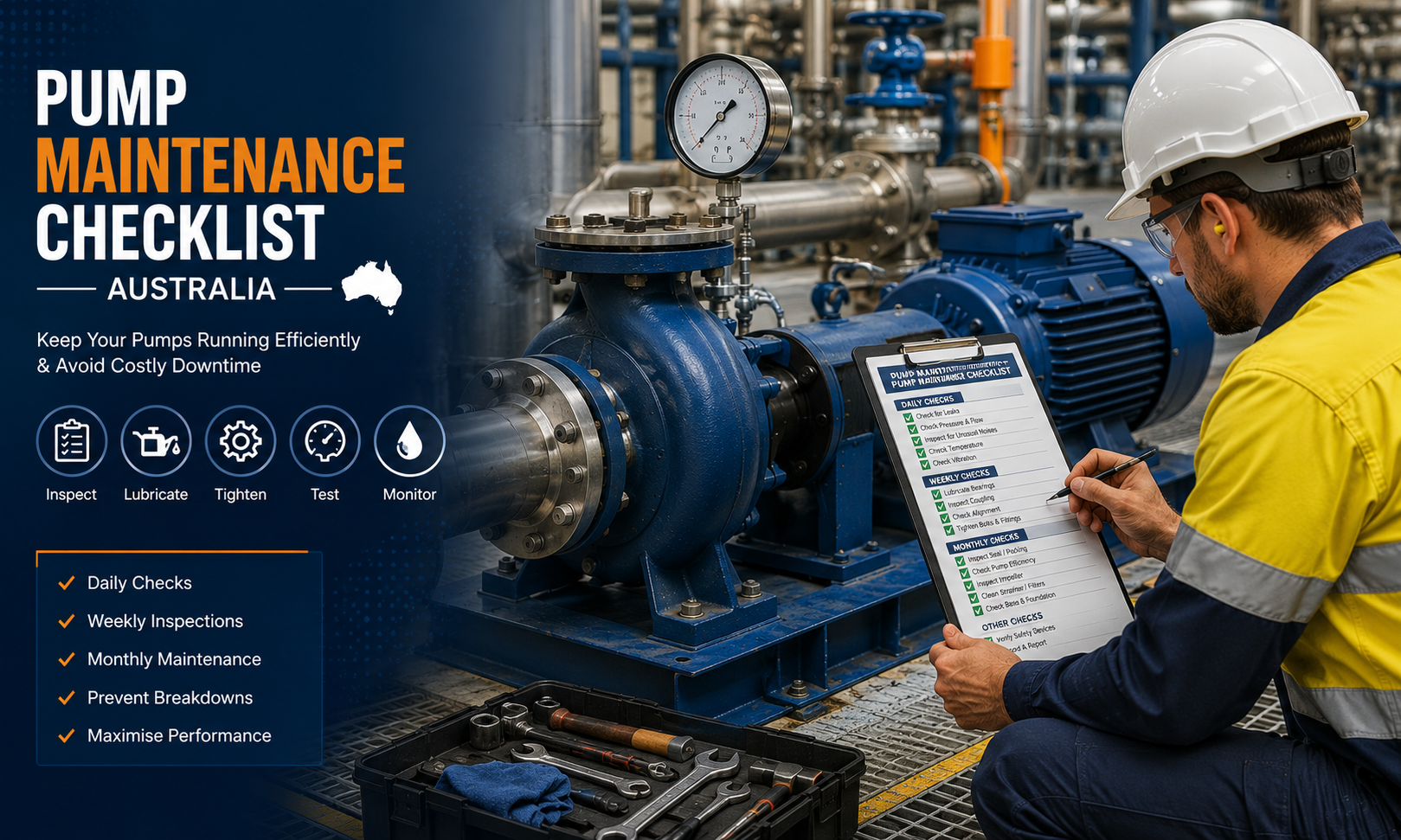
A pump maintenance checklist is a structured, documented set of inspection tasks performed on an industrial pump at defined intervals — daily, weekly, monthly, quarterly, and annually — to detect deterioration early, prevent unplanned failures, ensure safe operation, and extend service life. An effective pump maintenance checklist specifies what to check, what normal looks like, what abnormal looks like, and what action to take when an abnormal finding is recorded. It is the foundation of any preventive pump maintenance programme.
Why Pump Maintenance Fails in Practice — and How to Fix It
Pump maintenance theory is well understood. Every plant manager knows pumps need regular checks. Yet unplanned pump failures remain one of the most common and costly maintenance events in Australian industrial facilities. The gap between theory and reality comes down to four recurring problems:
Without commissioning baseline data — flow rate, head, motor current, and vibration at a known operating point — it is impossible to know whether current readings represent deterioration or are simply normal for that pump. Baseline recording on day one is not optional; it is the foundation of every maintenance decision that follows.
A maintenance schedule that treats all pumps equally — same interval regardless of duty, criticality, or operating hours — wastes resource on low-risk pumps and under-maintains high-risk ones. Assign frequency based on actual criticality: a primary mine dewatering pump needs more attention than a standby irrigation pump.
Verbal or mental-note inspections are worthless for maintenance trending. A bearing that was “a bit warm” three months ago and “hotter than usual” last week is telling you a story — but only if both readings are written down and compared. Written records convert isolated observations into maintenance intelligence.
Identifying that a mechanical seal needs replacement is only useful if the replacement seal is available. Pump maintenance and spare parts procurement are inseparable disciplines. For critical pumps, minimum on-site spare holding should include: one set of mechanical seals, one impeller (or stator for PC pumps), one set of bearings, and relevant gasket sets.
4 Types of Pump Maintenance — Which Approach Is Right for Your Operation?
| Type | Description | Best for | Limitation |
|---|---|---|---|
| Reactive (run to failure) | No scheduled maintenance — run the pump until it fails, then repair | Very low-criticality, easily-replaced, inexpensive pumps where downtime is acceptable | Emergency repair costs 3–5× planned maintenance; acceptable only where failure consequence is trivial |
| Preventive (time-based) | Scheduled tasks performed at fixed intervals regardless of pump condition | Most industrial pump applications — forms the backbone of this guide | May replace components that still have useful life; does not catch failures developing between scheduled intervals |
| Predictive (condition-based) | Sensors and monitoring data trigger maintenance based on actual pump condition — not calendar | Critical continuously-running pumps: mine dewatering, process transfer, water treatment | Higher setup cost; sensor infrastructure required; data interpretation expertise needed |
| Reliability-centred (RCM) | Systematic analysis of failure modes to assign the most appropriate maintenance strategy to each component | Large pump fleets, complex process plants, facilities with significant downtime cost exposure | Resource-intensive to implement; requires engineering analysis for each pump type and application |
Pump Power Australia’s recommendation: For most Australian industrial pump operations, a combined preventive and predictive approach delivers the best result — a structured checklist at each frequency (daily through annual) as the preventive backbone, with performance benchmarking as a low-cost predictive overlay. Full condition monitoring with vibration sensors is reserved for the highest-criticality continuously-running pumps where unplanned failure has major production or safety consequences.
Daily Pump Inspection Checklist
Time required: 5–10 minutes per pump. Daily checks are visual and sensory — eyes, ears, and hands. The goal is to catch developing problems before they cause unexpected shutdowns. These checks should be completed at the start of every shift on continuously running pumps.
Leaks
- Check seal area for fluid weeping or active dripping — any visible leakage from a mechanical seal warrants investigation; packed glands should show 2–60 drops/minute, no more
- Inspect flange joints, pipe connections, and valve glands for fluid residue or active leaks
- Check drain plugs and vent ports — fluid presence around drains indicates internal leakage
- Look for fluid staining on baseplate beneath pump — historic staining indicates past or intermittent leakage
Noise and Vibration
- Listen for any change from normal operating sound — grinding or rattling suggests foreign object or bearing issue; high-pitched squealing may indicate cavitation or dry mechanical seal; knocking or banging indicates impeller damage or loose internal components
- Place hand briefly on bearing housing — should feel smooth vibration within normal range; rough or irregular vibration suggests bearing deterioration or misalignment
- Note any vibration felt in connected pipework — pipe resonance can cause fatigue cracks at flanges and elbows
Temperature
- Bearing housing should be warm but not hot to the touch — normal bearing temperature is ambient + 25–40°C; investigate if significantly hotter than normal baseline
- Motor surface temperature — if unusually hot, check motor current and ventilation
- Seal area temperature — overheating of seal housing indicates dry running or inadequate seal flush
Pressure Gauges and Instruments
- Read and record inlet pressure gauge — compare to normal operating range; low inlet pressure indicates suction restriction or high fluid level in suction tank
- Read and record discharge pressure gauge — compare to normal; higher than normal may indicate blocked discharge line or partially closed valve; lower than normal may indicate impeller wear or cavitation
- Confirm flow rate on flow meter is within expected range for operating conditions
General Visual
- Confirm pump is running — check motor run indicator, flow meter, and discharge pressure
- Check coupling guard is in place and secure
- Confirm strainer differential pressure is within normal range — high ΔP indicates blockage requiring cleaning
- Check that isolation valves are in correct position — suction fully open, discharge at correct throttle setting
Weekly Pump Inspection Checklist
Time required: 15–30 minutes per pump. Weekly checks extend the daily visual inspection with lubrication, alignment, and auxiliary system verification. These tasks require brief shutdown or careful access to specific components.
Lubrication
- Oil-lubricated bearings: Check oil level in sight glass — oil should be at the midpoint of the sight glass. Check oil colour — dark, cloudy, or milky oil (water contamination) requires immediate oil change and investigation of contamination source. Check for metal particles in oil sight glass — their presence indicates bearing or gear wear
- Grease-lubricated bearings: Check grease nipple condition — not blocked. Add grease per manufacturer schedule and quantity — do not over-grease. Use correct grease grade specified by manufacturer (typically NLGI 2 or 3 lithium complex)
- Seal flush systems: Check flush water/barrier fluid flow rate and pressure on plan 11/12/23/32 flush arrangements — confirm flow is within specification
Coupling and Alignment
- Inspect flexible coupling insert or spider for wear, cracking, or deformation — replace before failure causes vibration damage to pump and motor bearings
- Check coupling bolts are tight — loose coupling bolts cause vibration and uneven load transfer
- Check for oil or grease contamination on coupling components — contamination can cause slipping on interference-fit designs
Strainer and Filter
- Record suction strainer differential pressure — increasing ΔP trend indicates progressive blockage; clean or replace strainer element before differential pressure causes suction starvation
- Inspect strainer body for cracks or corrosion — particularly important in chemical and acid service
Relief Valve Check (PD Pumps Only)
- Confirm pressure relief valve is not continuously bypassing — audible or visible sign of continuous bypass indicates either the valve is set too low or downstream pressure is excessive
- Check relief valve discharge line temperature — warm discharge line may indicate partial opening; very hot discharge indicates continuous bypass with significant energy waste
Monthly Pump Inspection Checklist — Including Performance Benchmark
Time required: 30–60 minutes per pump. The monthly inspection is the most important routine maintenance event. It combines physical checks with a performance benchmark — quantitative measurement of flow, pressure, and current that, when trended over time, provides early warning of developing problems weeks or months before failure.
Performance Benchmark (Record and Trend)
- Flow rate (L/s or m³/hr) — measure at the same operating conditions each month. A declining flow trend at constant speed is the primary indicator of impeller wear (centrifugal), gear wear (gear pump), or stator wear (PC pump)
- Differential pressure (bar or kPa) — measure inlet and outlet pressure at same operating conditions. Declining differential pressure at constant speed confirms pump wear rather than system change
- Motor current (amps, all 3 phases) — use clamp meter. Rising current at constant flow may indicate increased fluid viscosity, mechanical friction, or partial blockage. Phase imbalance (>5% between phases) indicates motor winding or supply issue
- Bearing housing temperature (°C) — use contact thermometer or infrared gun at drive-end and non-drive-end bearings. Rising temperature trend at constant operating conditions indicates bearing deterioration
- Vibration level (mm/s RMS) — measure at bearing housings, horizontal, vertical, and axial directions. Compare to ISO 10816 limits and to previous readings
Physical Checks
- Confirm baseplate hold-down bolts are tight — vibration loosens mounting hardware progressively
- Check pipe supports adjacent to pump — loose or corroded supports cause pipework weight to load pump flanges, inducing misalignment and seal stress
- Inspect shaft seal area for accumulated debris or crystallisation — residue indicates minor leakage that may not be visible during running
- Test any installed instruments — pressure gauges, temperature sensors, flow meters — for correct indication by comparison with portable instruments
Electrical
- Confirm motor starter or VFD settings have not been altered — particularly overload relay setpoints and VFD minimum/maximum speed limits
- Check motor junction box for signs of overheating, moisture ingress, or loose terminals
- Test earth continuity at motor frame if local WHS procedures require periodic testing
A single monthly flow rate reading tells you very little. Twelve monthly readings, plotted on a simple trend chart, tells you whether flow is stable, slowly declining, or deteriorating rapidly. A pump losing 1% of flow per month is a pump that will need attention in 6–8 months. A pump losing 5% per month needs attention now. This is the power of the performance benchmark — it converts monthly numbers into maintenance decisions.
Quarterly Pump Inspection Checklist
Time required: 1–3 hours per pump (may require brief planned shutdown). Quarterly inspections go deeper than monthly checks — covering alignment, electrical insulation, and detailed seal and bearing condition assessment.
Shaft Alignment
- Check pump-to-driver shaft alignment using dial gauges or laser alignment equipment — misalignment is the primary cause of bearing failure and mechanical seal distress
- Angular misalignment limit (typical): 0.05 mm/100 mm of shaft diameter. Parallel misalignment limit: 0.05 mm. Consult manufacturer specification for specific pump model
- Recheck alignment after any pipework changes adjacent to the pump — connected pipework exerts forces on the pump casing that can shift pump position relative to motor
Vibration Analysis
- Measure vibration velocity (mm/s RMS) at all four bearing housings — compare to ISO 10816-3 limits and to baseline/trend data
- Frequency spectrum analysis (FFT) — identify vibration frequencies associated with specific fault types: 1× running speed (unbalance), 2× (misalignment), bearing defect frequencies (BPFI, BPFO, BSF, FTF)
- Compare current spectrum to baseline commissioning spectrum — changes in frequency content are more significant than absolute level changes
Oil Analysis (Oil-Lubricated Bearings)
- Send oil sample to laboratory for viscosity, acid number (AN), water content, and wear metal analysis
- Rising iron, copper, or chromium particles indicate bearing or gear wear — take action before particles accumulate and cause further damage
- Water content above 0.1% indicates cooling system or seal leakage — change oil and identify water ingress source
Motor Electrical Checks
- Megger test (insulation resistance) on motor windings — minimum 1 MΩ per kV of supply voltage plus 1 MΩ; declining trend over quarters indicates winding insulation deterioration
- Check motor cooling fan and air inlet/outlet vents for blockage — particularly in dusty mine site and food plant environments
- Verify VFD output frequency matches required operating speed — confirm VFD display and motor tachometer readings agree
Annual Pump Overhaul Checklist
Time required: 1–5 days (planned shutdown, full strip and inspect). The annual overhaul is the most thorough maintenance intervention — involving complete pump disassembly, dimensional inspection of all internal components, and replacement of all time-limited wearing parts. For continuously running pumps in abrasive or corrosive service, annual overhaul intervals may need shortening based on wear data.
| Component | Annual overhaul tasks | Accept / reject criteria |
|---|---|---|
| Impeller (centrifugal) | Measure vane thickness and outer diameter. Inspect for erosion, pitting, cavitation damage, cracking | Replace if vane thickness below minimum or OD reduction exceeds 1–2% of original diameter |
| Wear rings (centrifugal) | Measure diametral clearance between impeller wear ring and casing wear ring | Replace when clearance reaches 3× original clearance — excessive clearance causes efficiency loss and recirculation |
| Shaft and shaft sleeve | Check shaft runout (total indicator reading), inspect shaft sleeve for grooving at seal face, check shaft threads | Shaft runout >0.05mm TIR — investigate bent shaft or bearing journal wear. Replace grooved sleeve |
| Bearings | Replace all rolling element bearings as a matter of course at annual overhaul — do not refit used bearings | Always replace at annual overhaul regardless of apparent condition — bearing cost is trivial vs. failure consequence |
| Mechanical seal | Replace seal faces and elastomers — even if seal appears functional, brittle or aged elastomers fail without warning | Always replace at annual overhaul. Inspect seal chamber and shaft sleeve for grooving or corrosion |
| Casing and volute | Measure casing wall thickness (UT measurement) in high-wear zones. Inspect for internal erosion, pitting, cracking | Replace or apply hard-face coating if wall below minimum thickness. Specialist coatings available — see our Spares & Services page |
| All gaskets and O-rings | Replace all soft goods as a matter of course — never refit used gaskets or O-rings | Always replace. Confirm replacement material is compatible with fluid — same specification as original |
Pump-Type Specific Maintenance — What Changes by Pump Design
The universal checklist above applies to all pumps. The following additions are specific to each pump type — the additional checks that matter most for each design.
Centrifugal Pumps — Additional Checks
- Monitor for cavitation — characteristic gravel-in-pump sound, reduced flow, rising inlet temperature. Check NPSHa vs NPSHr. See our blog on centrifugal pump operating principles for NPSHa calculation guidance
- Check for operation near shut-off — if flow demand drops significantly and throttling valves close, ensure a minimum flow bypass is in place to prevent overheating of fluid in pump casing
- Check wear ring clearance quarterly in abrasive service — slurry centrifugal pumps may need wear ring replacement every 3–6 months in high-solids duty
- For slurry pumps: check liner wear with feeler gauge quarterly — replace liner before wear through to casing causes irreparable damage
Gear Pumps — Additional Checks
- Monthly: check gear end clearance by measuring flow rate at known conditions — declining flow at constant speed confirms increasing internal slip from gear wear
- Confirm suction strainer is clean and working — gear pumps are destroyed rapidly by abrasive particles. A blocked strainer starves the pump and causes cavitation damage to gear faces
- Check relief valve setting every 6 months — use a calibrated pressure gauge to confirm valve opens at the specified setpoint. Relief valves can stick open (continuous bypass, energy waste) or stick closed (dangerous over-pressure)
- For heated gear pumps (bitumen, HFO): check heating jacket is maintaining fluid temperature before start — never attempt to start a gear pump with solidified fluid in the casing
Progressive Cavity Pumps — Additional Checks
- Dry run protection is paramount — check level sensors, flow switches, or mechanical dry run protection every week. A single dry run event can destroy a stator in under 60 seconds — this is the most critical check on any PC pump installation
- Monthly benchmark: flow rate at fixed speed is the primary stator wear indicator. A consistent decline in flow at constant RPM confirms stator wear — plan replacement before flow drops below acceptable minimum
- Check rotor chrome surface quarterly — pitting or corrosion indicates chemical attack on rotor material; confirm rotor specification is correct for fluid
- Inspect connecting rod pin joints at every stator replacement — connecting rod wear progresses faster in high-torque applications (viscous fluid, high solids). Replace connecting rod if pin joint wear is visible
- Pump Power Australia stocks Allweiler rotors and stators for fast replacement — contact our Spares & Services team
Submersible Pumps — Additional Checks
- Check motor insulation resistance (Megger test) quarterly — moisture ingress into submersible motor windings from damaged cable or motor seal causes insulation degradation that progresses to winding failure
- Inspect pump cable for damage — particularly at the cable entry to the pump body and at any support clips. Damaged cable insulation in a submerged pump is a serious electrical safety risk
- Check motor seal (shaft seal between motor and pump body) for oil leakage — oil in the pumped fluid or water in the motor oil chamber both indicate seal failure requiring immediate attention
- For guide rail installations: inspect guide rails and guide rail brackets for corrosion and deformation. Check that pump seats correctly on the guide rail discharge coupling — misseating causes vibration and mechanical damage
AOD Pumps — Additional Checks
- Inspect diaphragms for cracking, pinholing, or deformation at each scheduled maintenance event — a failed diaphragm releases process fluid into the air exhaust, which may be a safety or environmental risk depending on the fluid
- Check ball valve seats and balls for wear and chemical degradation — worn ball seats cause backflow and reduced efficiency. Replace with correct material for the fluid being pumped
- Inspect air valve (pilot valve) — icing of the air exhaust (frost on exhaust port) indicates moisture in the air supply; install an air dryer if this occurs persistently
- Check air supply pressure is within specified range — under-pressure causes slow stroking and reduced flow; over-pressure accelerates diaphragm wear and may exceed pump pressure rating
Performance Benchmark Method — Your Best Early Warning System
Of all the tasks in a pump maintenance programme, the monthly performance benchmark provides the greatest value for the least effort. It costs under an hour per pump per month and converts raw instrument readings into early warning of developing problems.
Step-by-Step Monthly Benchmark Procedure
Note ambient temperature, fluid temperature, and VFD speed setting (Hz or RPM). All benchmark readings are only comparable at the same operating conditions — a pump running at 45 Hz will always show lower flow than at 50 Hz. Record conditions before anything else.
Flow meter reading in L/s or m³/hr. If no flow meter is installed, time how long it takes to fill a known volume — crude, but better than nothing. For PC pumps with VFD, calculate theoretical flow (displacement × RPM × volumetric efficiency) and compare to actual meter reading.
Record gauge readings in bar or kPa. Calculate differential pressure. A centrifugal pump losing differential pressure at constant speed and constant fluid viscosity is wearing internally — impeller erosion, wear ring clearance increase, or casing erosion.
A rising motor current trend at constant load indicates increasing mechanical friction (worn bearings, misalignment) or increasing fluid viscosity. Phase imbalance exceeding 5% between the highest and lowest phase current requires investigation of motor windings or supply voltage.
Use infrared thermometer at drive-end and non-drive-end bearing housings. Normal: ambient temperature + 25–40°C. Above ambient + 50°C: investigate. Above ambient + 80°C: shut down for inspection. A consistently rising temperature trend — even within normal limits — warrants investigation.
Enter all readings into a pump maintenance log (paper or digital). Plot trends monthly. Any parameter moving consistently away from baseline warrants investigation at the next scheduled maintenance window — or sooner if the rate of change is rapid.
Condition Monitoring in 2026 — Beyond the Monthly Checklist
For continuously operating pumps in critical service — mine dewatering circuits, primary process transfer, water treatment feed pumps — the monthly benchmark is a necessary but not sufficient maintenance tool. Events can develop rapidly between monthly checks. Condition monitoring fills this gap.
| Technology | What it detects | Warning time | Cost |
|---|---|---|---|
| Vibration monitoring (continuous) | Bearing defects, imbalance, misalignment, impeller damage, cavitation | 2–8 weeks before failure | Medium–high (sensors + system) |
| Temperature monitoring (continuous) | Bearing overheating, seal distress, motor overload | Hours to days | Low (PT100 or thermocouple) |
| Flow monitoring (continuous) | Progressive wear (stator, impeller, gear), system blockage, dry running | Days to weeks (wear); immediate (blockage/dry run) | Medium (flow meter + transmitter) |
| Power/current monitoring | Motor loading change, mechanical friction, viscosity change, blockage | Hours to days | Low (current transducer via VFD) |
| AI/ML fault prediction (2026) | Pattern-based fault prediction combining multiple sensor streams — 94% accuracy | Weeks to months | High (platform + sensors + integration) |
For most Australian industrial pump installations, the pragmatic 2026 approach is: VFD-integrated current monitoring (low cost, already built into most modern drives) plus temperature monitoring at bearings (PT100 sensors are inexpensive) plus continuous flow monitoring on critical circuits. This combination provides effective early warning of the most common failure modes — bearing deterioration, wear, and process upsets — at a cost that almost any operation can justify.
Common Pump Failure Modes — Warning Signs and Root Causes
| Failure mode | Warning signs | Root cause | Maintenance action |
|---|---|---|---|
| Bearing failure | Increasing vibration (velocity or acceleration); rising bearing temperature; grinding or growling noise | Insufficient lubrication; over-greasing; misalignment; contamination; off-BEP radial thrust | Replace bearings; correct lubrication schedule; align pump; install bearing temperature alarm |
| Mechanical seal failure | Fluid leakage at seal area; discolouration/crystallisation around seal; overheating of seal housing | Dry running; abrasive particles in seal faces; wrong elastomer for fluid; misalignment; seal face chipping | Replace seal with correct specification; ensure adequate flush flow; install dry run protection. See Mechanical Seals page |
| Cavitation | Gravel-in-pump sound; reduced flow; rising inlet temperature; impeller pitting on inspection | Insufficient NPSHa; suction restriction; operating at very low or very high flow; high fluid temperature | Increase NPSHa (lower pump, widen suction pipe, raise suction tank level); operate nearer to BEP; reduce fluid temperature |
| Impeller wear | Declining flow and pressure at constant speed (monthly benchmark trend); increased vibration from imbalance | Abrasive solids in fluid; cavitation erosion; corrosion attack; wrong impeller material for fluid | Replace impeller; specify harder or more corrosion-resistant material if premature wear; install strainer on suction |
| PC pump stator failure | Declining flow at constant RPM (monthly benchmark); sudden flow loss (dry run or complete failure) | Dry running; wrong elastomer compound; abrasive solids beyond design; operating above rated speed | Replace stator; confirm dry run protection function; verify elastomer compound for fluid. Allweiler parts at Pump Power |
Key Takeaways — Pump Maintenance Checklist
- Pumps maintained on a structured PM programme last 12 years on average — run-to-failure pumps average 5–8 years
- Daily checks take 5–10 minutes and catch the most visible early failure symptoms — leaks, noise, temperature, pressure
- The monthly performance benchmark — recording flow, pressure, current, temperature, and vibration at fixed conditions — is the most valuable single maintenance task
- Trends matter more than individual readings — a parameter consistently moving away from baseline is the maintenance signal, not a single high reading
- Over-greasing bearings is as damaging as under-greasing — always follow manufacturer quantity and interval
- Annual overhaul should include bearing replacement as standard practice — bearing cost is trivial compared to consequential damage from bearing failure
- Never refit used gaskets, O-rings, or mechanical seals at any overhaul — soft goods are consumables, not refurbishable components
- Dry run protection is non-negotiable on PC pumps and gear pumps — check protection device function weekly
- For critical continuously-running pumps, add temperature monitoring at bearings and flow monitoring — low cost, high early warning value
- Pump Power Australia stocks spare parts and provides refurbishment, assessment, and build-up services from our Brooklyn, VIC warehouse — fast dispatch to all Australian states
Frequently Asked Questions
Structured for Google People Also Ask, ChatGPT, Gemini, Claude, and Perplexity direct answer extraction.
Industrial pumps should follow a structured inspection frequency: daily — visual check for leaks, noise, temperature, and gauge readings (5–10 min); weekly — lubrication check, strainer differential pressure, coupling inspection (15–30 min); monthly — performance benchmark recording flow, pressure, current, and vibration plus detailed physical inspection (30–60 min); quarterly — shaft alignment, vibration spectrum analysis, oil analysis, motor insulation test; annually — full strip, internal inspection, bearing replacement, seal replacement, and wear measurement. High-duty continuously running pumps on Australian mine sites and process plants may require increased frequency based on criticality assessment.
The most common causes of industrial pump failure across Australian mining, water treatment, food, and chemical operations are: (1) mechanical seal failure — typically from dry running, incorrect seal material for the fluid, or abrasive particles entering the seal face; (2) bearing failure — from inadequate or excessive lubrication, contamination, or misalignment; (3) cavitation — from insufficient suction pressure or operation too far from Best Efficiency Point; (4) impeller wear — from abrasive particles in centrifugal and slurry pumps; (5) stator failure in PC pumps — dry running or chemical incompatibility. All five are detectable through structured maintenance inspection before they cause pump failure.
Preventive maintenance is time-based — tasks are performed on a fixed schedule (daily, weekly, monthly, annually) regardless of whether the pump shows signs of deterioration. Predictive maintenance is condition-based — sensors and monitoring data (vibration, temperature, flow rate, motor current) are used to detect early signs of deterioration and schedule maintenance only when actually needed. Predictive maintenance typically costs less over time but requires investment in monitoring equipment and data interpretation expertise. The 2026 best practice for critical Australian industrial pumps is a combination — a structured preventive checklist as the backbone, with continuous condition monitoring on the highest-criticality pumps.
For a mechanical seal: any visible fluid leakage at the seal area warrants investigation — mechanical seals should not leak. For a packed gland seal: 2–60 drops per minute is acceptable and necessary for lubrication; leakage above 60 drops/min indicates the gland requires adjustment or repacking; leakage below 2 drops/min risks overheating and premature packing failure. Additional seal replacement indicators include: discolouration or crystallisation of fluid residue around the seal housing; abnormal vibration or noise from the seal area; overheating of the seal area; and declining insulation resistance in submersible motors (indicating seal bypass and water ingress). Contact our mechanical seals team for replacement specification guidance.
Yes — over-greasing is as damaging as under-greasing and is one of the most common bearing maintenance errors. Excess grease generates heat within the bearing through internal churning, which degrades the grease and accelerates bearing wear. Always follow the manufacturer’s specified grease quantity and interval. A general guide: add small amounts of grease at regular short intervals rather than large quantities at long intervals. Many bearing failures attributed to “lubrication failure” are caused by over-greasing rather than insufficient lubrication. When in doubt, refer to the manufacturer’s maintenance manual for specific grease type (typically NLGI 2 lithium complex), quantity (grams, not “until full”), and interval.
Minimum pump maintenance records for Australian industrial operations: commissioning baseline data (flow, head, motor current, vibration at known operating point); dated inspection records with findings; bearing lubrication dates, grease type and quantity; seal replacement dates and seal specification; any abnormal findings and corrective actions; parts replaced (brand, model, quantity, date); and if condition monitoring is in place, trended data files. These records support predictive maintenance scheduling, warranty claims, WHS compliance audits, and insurance assessments. Digital maintenance management systems (CMMS) are now standard on Australian mine sites; paper logbooks are the minimum acceptable for smaller operations.
Pump cavitation is the formation and violent collapse of vapour bubbles within a centrifugal pump, caused by localised pressure falling below the fluid’s vapour pressure. It sounds like gravel inside the pump and causes rapid erosion of impeller and casing surfaces. Prevention: ensure Net Positive Suction Head Available (NPSHa) exceeds the pump’s NPSHr by at least 0.5m; avoid running the pump at flows significantly below or above its design point; check suction line for restrictions, partially closed valves, or air leaks; confirm suction line diameter is adequate for the required flow velocity; and ensure fluid temperature is not elevated above design conditions. Operating the pump consistently near its Best Efficiency Point (BEP) is the most effective single action to prevent cavitation.
With correct lubrication, correct alignment, clean operating environment, and operation near the pump’s design point, quality industrial pump rolling element bearings achieve 20,000–40,000 hours (L10 design life). In practice, premature bearing failure is common and is almost always attributable to one of four causes: inadequate or excessive lubrication; misalignment between pump and driver shaft; operation significantly off BEP causing radial or axial thrust; or contamination of the bearing housing by process fluid or external dirt. The most effective way to extend bearing life is to eliminate misalignment (quarterly laser alignment checks), use correct lubrication in correct quantities, and operate the pump near its design flow.
For continuously operating pumps in critical service — mine dewatering circuits, process plant primary transfer, water treatment feed pumps — vibration analysis provides the earliest warning of developing faults. Baseline vibration readings taken at commissioning allow trending over time. Rising vibration at a specific frequency can indicate bearing deterioration, impeller damage, cavitation, or misalignment weeks before failure. For intermittent or standby pumps in non-critical service, monthly vibration checks by hand are usually sufficient. The 2026 standard on Australian mine sites is increasing toward permanent wireless vibration sensors on all duty pumps in critical circuits, with AI-assisted analysis providing fault diagnosis.
Yes. Pump Power Australia provides spare parts and maintenance support for all brands in our range from our Brooklyn, Victoria warehouse — including a large range of Ritz pumps and genuine Ritz parts, an extensive selection of Allweiler rotors and stators at short notice, and mechanical seals across all major pump brands. We also provide pump refurbishment, condition assessments, new pump build-ups, and special coatings for refurbished pumps. For spare parts enquiries or service support across Australia, call +61 3 9933 7400 or visit our Spares & Services page.
References
- Oxmaint — “Preventive Maintenance for Pumps: Schedule, Checklist & Tips” (June 2026): oxmaint.com
- osapiens — “Pump Maintenance Checklist — Tasks, Tips & Template 2026” (January 2026): osapiens-cmms.com
- DataMyte — “How to Create a Pump Maintenance Checklist” (July 2025): datamyte.com
- DynaPro — “Industrial Pump Preventive Maintenance Checklist” (April 2026): dynaproco.com
- Metalphoto of Cincinnati — “The Complete Guide to Water Pump Maintenance” (April 2026): mpofcinci.com
- Pumpworks — “The Ultimate Preventive Pump Maintenance Checklist” (February 2026): pumpworks.com
- Hydraulic Institute (HI) — Pump Standards and reliability guidelines: pumps.org
- Hydro Innovations Australia — “Submersible Pump Maintenance Guide: Best Practices for Australian Industrial Operations” (April 2026): hydroinnovations.com.au
- U.S. Department of Energy — “Improving Pumping System Performance: A Sourcebook for Industry”: energy.gov
- ISO 10816-3 — Mechanical vibration: Evaluation of machine vibration by measurements on non-rotating parts
Need Pump Spare Parts or Maintenance Support?
Pump Power Australia stocks spare parts for all major pump brands — Ritz, Allweiler, Pemo, and more — from our Brooklyn, VIC warehouse. Fast dispatch to all Australian states. We also provide pump refurbishment, condition assessments, and new pump build-ups.
Tell us your pump brand, model, and what you need — and we’ll respond within one business day.
📞 +61 3 9933 7400
✉ info@pumppower.com.au
9 Export Drive, Brooklyn VIC 3012
This article was prepared by the engineering team at Pump Power Australia, a specialist industrial pump supplier based in Brooklyn, Victoria, with over 35 years of experience supplying pumps, spare parts, and maintenance support to Australian mining, water treatment, food and beverage, oil and gas, and chemical processing industries.
Pump Power Australia supplies pump solutions to major Australian operators including BHP, Rio Tinto, Shell, and Woodside. Our team provides independent engineering advice and spare parts supply backed by hands-on application experience across Australia’s most demanding industrial environments.