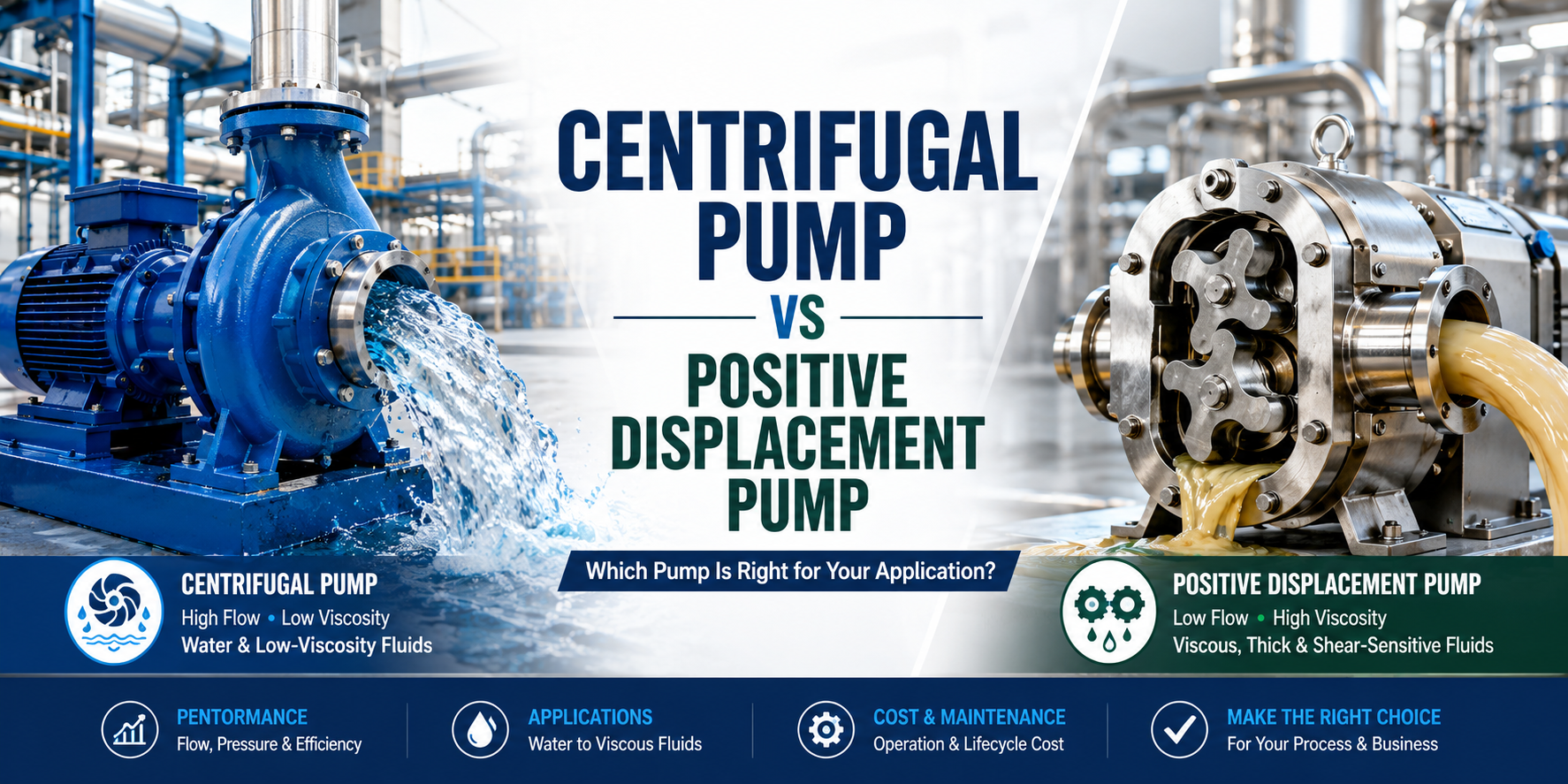
Every pump enquiry received by Pump Power Australia’s engineering team starts the same way — with a description of what needs to be pumped, where it needs to go, and how fast. And in the majority of cases, the most fundamental decision that needs to be made before anything else is this: centrifugal pump or positive displacement pump?
Get this decision right and your pump installation will deliver years of reliable, efficient service. Get it wrong — and it happens more often than it should — and you are looking at premature pump failure, poor performance, excessive maintenance, and in some cases, the complete destruction of the product being pumped.
These two pump families are not interchangeable. They operate on fundamentally different principles, they behave differently as system conditions change, and they each excel in completely different applications. Centrifugal pumps are the most widely deployed pump type across global industry — but they are also the most frequently misapplied. Positive displacement pumps handle duties that centrifugal pumps simply cannot perform — yet they are often overlooked by engineers and procurement teams more familiar with the centrifugal world.
This guide — produced by the engineering team at Pump Power Australia, with over 35 years of experience supplying industrial pumps across mining, oil and gas, food and beverage, water treatment, chemical processing, and power generation — gives you a definitive, engineering-based framework for choosing between these two pump families for your specific application.
Choose a centrifugal pump when your fluid is low viscosity (water-like), your flow rate is high, your pressure requirement is moderate, and you need simple, low-maintenance operation.
Choose a positive displacement pump when your fluid is viscous, shear-sensitive, abrasive, or requires precise metered delivery; when you need consistent flow regardless of pressure; or when you need to pump against very high pressures.
- How a Centrifugal Pump Works — The Fundamentals
- How a Positive Displacement Pump Works — The Fundamentals
- The 8 Key Differences: Centrifugal vs Positive Displacement
- Decision Guide by Fluid Type
- Decision Guide by Industry and Application
- Types of Centrifugal Pumps — Pump Power Australia’s Range
- Types of Positive Displacement Pumps — Pump Power Australia’s Range
- Performance Curves: How Each Pump Type Responds to System Changes
- Viscosity: The Most Important Factor in Pump Type Selection
- When to Use Both Pump Types in the Same System
- Common Mistakes — Using the Wrong Pump Type
- Expert Tips from Pump Power Australia
- Comparison Tables
- Frequently Asked Questions (10 FAQs)
- Conclusion
How a Centrifugal Pump Works — The Fundamentals
A centrifugal pump converts rotational (kinetic) energy into fluid velocity and pressure. The operating principle is elegantly simple:
- Fluid enters the pump at the centre (eye) of a rotating impeller.
- The impeller’s vanes fling the fluid outward at high velocity using centrifugal force.
- The high-velocity fluid enters the volute casing, where the expanding cross-section converts velocity into pressure.
- The pressurised fluid exits through the discharge nozzle into the system pipework.
This continuous, smooth, non-pulsating flow is one of the centrifugal pump’s greatest advantages. There are no valves, no reciprocating parts, no intermittent discharge. Fluid moves continuously as long as the impeller rotates.
What Makes Centrifugal Pumps Special
- High flow rate capability — centrifugal pumps can move very large volumes of fluid per unit time; no other pump technology matches them on raw throughput
- Smooth, non-pulsating flow — the continuous impeller action delivers consistent, pulsation-free discharge
- Simple construction — few moving parts; typically only the impeller and shaft rotate, making them inherently low-maintenance
- Wide material options — cast iron, stainless steel, duplex, bronze, and plastic-lined variants for different fluid chemistries
- VFD / VSD compatible — centrifugal pumps respond to the Affinity Laws, delivering dramatic energy savings under VFD speed control (see our VSD energy savings guide)
Centrifugal Pump Limitations
- Must be primed — centrifugal pumps cannot self-prime in most configurations; they must be flooded with liquid before starting
- Cannot run dry — dry operation damages mechanical seals and can destroy the pump rapidly
- Poor with viscous fluids — efficiency drops steeply as fluid viscosity increases above approximately 50–100 cSt
- Flow varies with pressure — as system back pressure increases, a centrifugal pump’s flow rate decreases. This is a fundamental characteristic, not a fault — but it means centrifugal pumps cannot provide constant flow against variable system pressures
- Cannot handle high-solids fluids in standard configurations — abrasive solids rapidly erode standard impeller and casing materials (specialist slurry pump designs address this)
How a Positive Displacement Pump Works — The Fundamentals
A positive displacement (PD) pump moves fluid by mechanically trapping a fixed volume and forcing it through the discharge. Unlike a centrifugal pump — which uses kinetic energy and continuous impeller action — a PD pump physically pushes a defined parcel of fluid with each cycle of operation.
The operating principle, regardless of the specific pump design, is always the same:
- A cavity on the suction side of the pump expands, drawing fluid in.
- The cavity is sealed from the suction port and moves to the discharge side.
- The cavity contracts, forcing the trapped fluid out through the discharge.
- The cycle repeats continuously (rotary designs) or reciprocally (piston/diaphragm designs).
A positive displacement pump delivers a constant flow rate regardless of system pressure. If the discharge valve is open, a fixed volume passes through with every rotation or stroke. This is the defining characteristic that makes PD pumps essential for metering, dosing, and high-pressure applications — and it is also why PD pumps must never be operated against a closed valve without a pressure relief device fitted.
What Makes Positive Displacement Pumps Special
- Constant flow regardless of pressure — flow rate does not change as discharge pressure rises, making them ideal for metering and dosing applications
- Handles viscous fluids efficiently — unlike centrifugal pumps, PD pump efficiency actually increases with viscosity up to a point, because viscous fluid fills the pump cavity more completely
- Self-priming — most PD pump designs can draw fluid up from below the pump without pre-filling
- Can run dry briefly (design-dependent) — some designs tolerate short periods of dry operation
- High-pressure capability — PD pumps can generate very high discharge pressures; centrifugal pumps cannot achieve the same pressure range without very large, expensive multistage designs
- Gentle, low-shear handling (rotary PD designs) — suits shear-sensitive, fragile, or living products that would be damaged by centrifugal impeller action
Positive Displacement Pump Limitations
- Lower maximum flow rates than centrifugal pumps of comparable size and cost
- Pulsating flow (reciprocating designs) — piston and diaphragm pumps produce intermittent discharge that may require pulse dampeners in sensitive applications
- Must have pressure relief — because a PD pump delivers constant flow regardless of pressure, operating against a closed valve will build pressure until something fails. A pressure relief valve is non-negotiable
- More complex maintenance (reciprocating types) — piston pumps, diaphragm pumps, and plunger pumps have more moving parts and wearing components than a simple centrifugal pump
- Higher purchase cost for equivalent flow rate versus centrifugal pumps in simple, clean-fluid applications
The 8 Key Differences: Centrifugal vs Positive Displacement
| Factor | Centrifugal Pump | Positive Displacement Pump |
|---|---|---|
| Operating principle | Kinetic energy via rotating impeller converts to pressure | Mechanical trapping and forcing of fixed fluid volume |
| Flow vs pressure relationship | Flow decreases as discharge pressure increases | Flow remains constant regardless of discharge pressure |
| Viscosity performance | Efficiency drops steeply above ~50–100 cSt | Efficiency maintained or improved at higher viscosity |
| Priming | Requires priming (must be flooded) in most configurations | Self-priming in most designs |
| Flow characteristics | Smooth, continuous, non-pulsating | Continuous (rotary) or pulsating (reciprocating) |
| Maximum flow rate | Very high — handles the largest flow duties | Moderate — lower maximum flow than centrifugal |
| Maximum pressure | Moderate (high for multistage designs) | Very high — no theoretical upper pressure limit with correct design |
| Metering / dosing | Poor — flow rate varies with system pressure | Excellent — constant volume per cycle enables accurate metering |
| Shear sensitivity | High shear from impeller — unsuitable for fragile media | Low shear (rotary PD) — preferred for shear-sensitive products |
| Dry run tolerance | None — damages seals rapidly | Variable by type — some tolerate brief dry operation |
| Pressure relief requirement | Not required — pump stalls at shutoff head | Mandatory — closed valve causes dangerous pressure build-up |
| Maintenance complexity | Low — few moving parts | Moderate to high (more components in reciprocating designs) |
| Energy efficiency | High in design-point operation; VFD delivers cubic savings | Good; VFD provides proportional savings only |
| Typical purchase cost | Lower for simple, clean-fluid, high-flow applications | Higher for equivalent flow; lower for high-pressure duties |
Decision Guide by Fluid Type
The nature of the fluid being pumped is the most important starting point for pump type selection. Use this guide to identify which pump family suits your fluid — then refine the selection using the industry-specific guidance in Section 5.
Clean Water and Water-Like Fluids (Viscosity <5 cSt)
Centrifugal Centrifugal pump is almost always the correct choice.
Municipal water supply, irrigation, HVAC chilled water and heating water, cooling tower circuits, clean process water, rainwater, stormwater — these are the natural domain of the centrifugal pump. High flow rates, smooth continuous delivery, simple maintenance, and very long service life are achievable with correctly specified centrifugal pumps in clean-water service. Explore our centrifugal pump range and horizontal split case pumps for large-volume water duties.
Low-Viscosity Chemicals (Viscosity <50 cSt, Non-Aggressive)
Centrifugal Centrifugal pump with appropriate materials of construction.
Dilute acids, alkalis, solvents, and other low-viscosity process chemicals are well served by centrifugal pumps in corrosion-resistant materials — stainless steel, duplex alloys, PVDF-lined, or rubber-lined designs. For toxic, volatile, or environmentally hazardous chemicals where any leakage is unacceptable, consider magnetic drive (sealless) centrifugal pumps. See our chemical transfer application page.
Viscous Fluids (Viscosity 100–10,000 cSt — Oils, Syrups, Resins)
PD Pump Positive displacement pump — centrifugal pump efficiency degrades rapidly above 100 cSt.
Lubrication oils, hydraulic fluids, edible oils, syrups, glycols, molasses, resins, and adhesives — once viscosity exceeds approximately 100 cSt, centrifugal pump efficiency drops to the point where energy consumption becomes impractical. Gear pumps are the industry standard for viscous fluid transfer, delivering consistent flow regardless of viscosity variation. Triple screw pumps and two screw pumps handle high-viscosity marine and industrial lubrication duties.
Very High Viscosity Fluids (Viscosity >10,000 cSt — Bitumen, Heavy Crude, Thick Pastes)
PD Pump Positive displacement pump essential — centrifugal pump cannot function.
Bitumen, asphalt, heavy crude oil, polymer melts, thick pastes, and similar materials require positive displacement pump technology. Heated gear pumps, progressive cavity pumps, and screw pumps with heating jackets are the correct choices for these duties. See our asphalt and emulsions application page.
Shear-Sensitive Fluids (Fruit Pulp, Emulsions, Polymers, Creams, Living Cultures)
PD Pump Positive displacement pump — centrifugal impeller destroys shear-sensitive products.
The high-speed impeller of a centrifugal pump imparts significant shear forces to the fluid passing through it. For products where shear causes degradation — fruit pulp with intact cells, polymer emulsions, cosmetic creams, dairy cultures, and fragile biological media — a low-shear positive displacement pump is mandatory. Lobe pumps, progressive cavity pumps, and eccentric/hollow disk pumps are the preferred technologies for shear-sensitive product transfer.
Abrasive Slurries (Mine Tailings, Mill Discharge, Dredge Spoil)
Centrifugal Specialist slurry centrifugal pump — but with heavy-duty wear-resistant materials.
Standard centrifugal pumps are destroyed rapidly by abrasive slurries. However, specialist slurry pumps — which are centrifugal in operating principle but feature thick high-chrome or rubber liners and wide impeller clearances — are the industry standard for tailings transfer, mill discharge, and dredging. The open impeller design and generous clearances allow solids to pass without blockage while the hardened liner materials resist abrasion. See our mine dewatering application page.
Metered Chemical Dosing (Precise Volume per Cycle Required)
PD Pump Positive displacement pump — centrifugal pumps cannot meter accurately.
Chemical dosing, polymer addition, reagent injection, and water treatment chemical addition all require precise, repeatable delivery of a defined volume of chemical per unit time. Because centrifugal pump flow rate varies with system pressure, it cannot deliver accurate metering. Dosing applications use gear pumps, progressive cavity pumps, or piston/plunger pumps depending on the required accuracy, pressure, and chemical compatibility.
Hazardous, Toxic, or Volatile Fluids (Zero Leakage Required)
Either Type — Sealless Sealless pump design regardless of pump type.
Where fluid leakage is unacceptable — toxic chemicals, volatile solvents, environmentally hazardous materials — the pump shaft seal is the critical design element. Magnetic drive centrifugal pumps eliminate the shaft seal entirely using a magnetic coupling through the pump casing. Air Operated Diaphragm (AOD) pumps use a double-diaphragm design that contains the fluid completely without any shaft penetration.
Decision Guide by Industry and Application
Mining and Minerals Processing
Mining operations use both pump families extensively — often simultaneously within the same facility.
- Centrifugal Submersible dewatering pumps and slurry pumps for pit dewatering, tailings transfer, mill discharge, and cyclone feed
- Centrifugal Multistage centrifugal pumps and bore hole pumps for high-head mine dewatering
- PD Pump Progressive cavity pumps for thickened tailings, high-solids sludge transfer, and reagent dosing
- PD Pump Piston/plunger pumps for high-pressure chemical injection into ore processing circuits
For a complete guide to mine dewatering pump selection, see our mine dewatering pump selection guide.
Food and Beverage Manufacturing
The food and beverage industry presents one of the clearest cases for careful pump type discrimination — the wrong pump can physically destroy the product.
- Centrifugal Centrifugal pumps for clean water, CIP chemical circulation, and low-viscosity aqueous product transfer
- PD Pump Lobe pumps for dairy cream, yoghurt, sauces, fruit-containing products, and brewery transfers — CIP/SIP compatible
- PD Pump Progressive cavity pumps for fruit pulp, tomato paste, meat, fish, and other high-viscosity or particulate food products
- PD Pump Eccentric/hollow disk pumps for ultra-gentle transfer of the most fragile food products — whole fruit, delicate emulsions, and living cultures
- PD Pump Food-grade gear pumps for edible oils, chocolate, syrups, and confectionery products
See our complete sanitary food and beverage pump application page.
Chemical Processing
- Centrifugal Centrifugal pumps (corrosion-resistant materials) for high-flow, low-viscosity chemical transfer
- Centrifugal Magnetic drive pumps for toxic or volatile chemical transfer where zero leakage is required
- PD Pump Gear pumps for viscous chemical metering, resin transfer, and adhesive dosing
- PD Pump AOD pumps for safe chemical transfer in hazardous area environments without electrical supply
- PD Pump Piston/plunger pumps for high-pressure chemical injection into reactors or process vessels
See our chemical transfer application page and dosing application page.
Oil and Gas
- Centrifugal API 610 centrifugal pumps for high-flow crude transfer, produced water, and refinery process duties
- PD Pump Two screw pumps for crude oil, produced water with entrained gas, and ship unloading
- PD Pump Piston/plunger pumps for high-pressure chemical injection, hydraulic fracturing, and well stimulation
- PD Pump Progressive cavity pumps for heavy crude, high-solids produced water, and chemical injection in remote locations
See our oil and gas application page.
Water and Wastewater Treatment
- Centrifugal Centrifugal pumps for raw water intake, clear water transfer, and pressure boosting
- Centrifugal Submersible pumps for sewage pump stations, wet wells, and stormwater
- Centrifugal Archimedean screw pumps for large-volume low-head wastewater lifting at treatment plants
- PD Pump Progressive cavity pumps for thickened sludge, biosolids, and dewatered cake transfer
- PD Pump Chemical dosing using gear pumps or piston pumps for coagulants, pH adjustment, and disinfection chemicals
- PD Pump Grinders and macerators to protect downstream pumps from rag, wipe, and solids damage
See our water and wastewater application page.
Marine
- Centrifugal Centrifugal pumps for ballast water, cooling water, and general bilge duties
- PD Pump Triple screw pumps for lube oil and fuel oil service — ultra-quiet, pulse-free for machinery room operation
- PD Pump Two screw pumps for cargo transfer and ship unloading
- PD Pump Gear pumps for fuel oil booster and lube oil transfer
See our marine application page.
Power Generation
- Centrifugal Multistage centrifugal pumps for boiler feed and condensate extraction
- Centrifugal Horizontal split case pumps for large-volume cooling water
- PD Pump Triple screw pumps for turbine lube oil and control oil circulation
- PD Pump Gear pumps for fuel oil transfer and lube oil service
See our power and energy application page.
Types of Centrifugal Pumps — Pump Power Australia’s Range
Centrifugal pumps are not a monolithic category. Within the centrifugal family there are numerous configurations, each optimised for different flow rates, head requirements, fluid types, and installation constraints. Pump Power Australia supplies the full spectrum:
| Centrifugal Pump Type | Key Characteristic | Best Application |
|---|---|---|
| End-suction centrifugal | Most common configuration; compact, low cost, wide range of sizes | General industrial water transfer, HVAC, irrigation, chemical processing |
| In-line centrifugal | Suction and discharge inline; fits directly in pipework, space-saving | Building services, HVAC circulation, booster duties |
| Multistage centrifugal | Multiple impeller stages in series for high head | Boiler feed, RO systems, mine dewatering, high-pressure water supply |
| Horizontal split case | Split casing for easy maintenance without pipe disconnection | Large water supply, fire fighting, HVAC, power generation cooling |
| Submersible centrifugal | Fully submerged; no priming required; quiet operation | Sewage pump stations, dewatering, wet wells, bore hole extraction |
| Slurry centrifugal | Heavy-duty wear-resistant liners and impellers for abrasive duty | Mine tailings, mill discharge, dredging, abrasive slurry transfer |
| Magnetic drive centrifugal | Sealless design; zero leakage through magnetic coupling | Toxic, volatile, or high-value chemical transfer |
| Bore hole submersible | Designed to fit inside drilled boreholes; multistage for high head | Mine dewatering bore fields, groundwater extraction, water supply bores |
| Propeller / axial flow | Very high flow, very low head; open impeller handles debris | Irrigation, flood control, stormwater drainage, large water transfer |
Types of Positive Displacement Pumps — Pump Power Australia’s Range
The positive displacement family is even more diverse than the centrifugal family — spanning gentle, low-shear rotary designs through to extremely high-pressure reciprocating pumps. Understanding which PD pump sub-type suits your application is a separate decision layer within the PD family. Pump Power Australia supplies the complete range:
| PD Pump Type | Sub-category | Key Characteristic | Best Application |
|---|---|---|---|
| Gear pumps | Rotary | Internal/external gear meshing; consistent flow at high viscosity; compact | Lubrication oil, hydraulic fluid, fuel, bitumen, food-grade oils, chemical metering |
| Progressive cavity (PC) pumps | Rotary | Helical rotor-stator design; gentle low-shear flow; handles high solids content | Wastewater sludge, food products, mining slurries, oil and gas produced fluids |
| Lobe pumps | Rotary | Non-contacting rotors; hygienic design; CIP/SIP compatible | Dairy, food and beverage, pharmaceutical, personal care — shear-sensitive products |
| AOD pumps | Reciprocating (diaphragm) | No electricity; self-priming; run-dry safe; handles highly corrosive fluids | Chemical transfer, hazardous area applications, mining, food, paint, coatings |
| Piston / plunger pumps | Reciprocating | Very high discharge pressure; accurate metering; robust heavy-duty construction | High-pressure water jetting, chemical injection, hydraulic fracturing, descaling |
| Triple screw pumps | Rotary (screw) | Ultra-quiet; pulse-free; high efficiency at viscous fluid duties | Marine lube oil and fuel oil, power station turbine lube oil, hydraulic systems |
| Two screw pumps | Rotary (screw) | Handles entrained gas, solids, and variable viscosity; heating jacket options | Crude oil transfer, produced water, ship unloading, bitumen, multiphase duties |
| Rotary vane pumps | Rotary | Self-compensating vanes; consistent flow; compact; self-priming | Fuel transfer, tanker unloading, lubrication oil, vacuum applications |
| Eccentric / hollow disk pumps | Rotary | Minimal shear; ultra-gentle; smooth low-pulsation flow | Cosmetics, gels, creams, fragile food products, fish, pharmaceutical |
Performance Curves: How Each Pump Type Responds to System Changes
Understanding how each pump type responds to changes in system conditions is critical for engineers designing pump systems — and for operators trying to diagnose pump performance problems in the field.
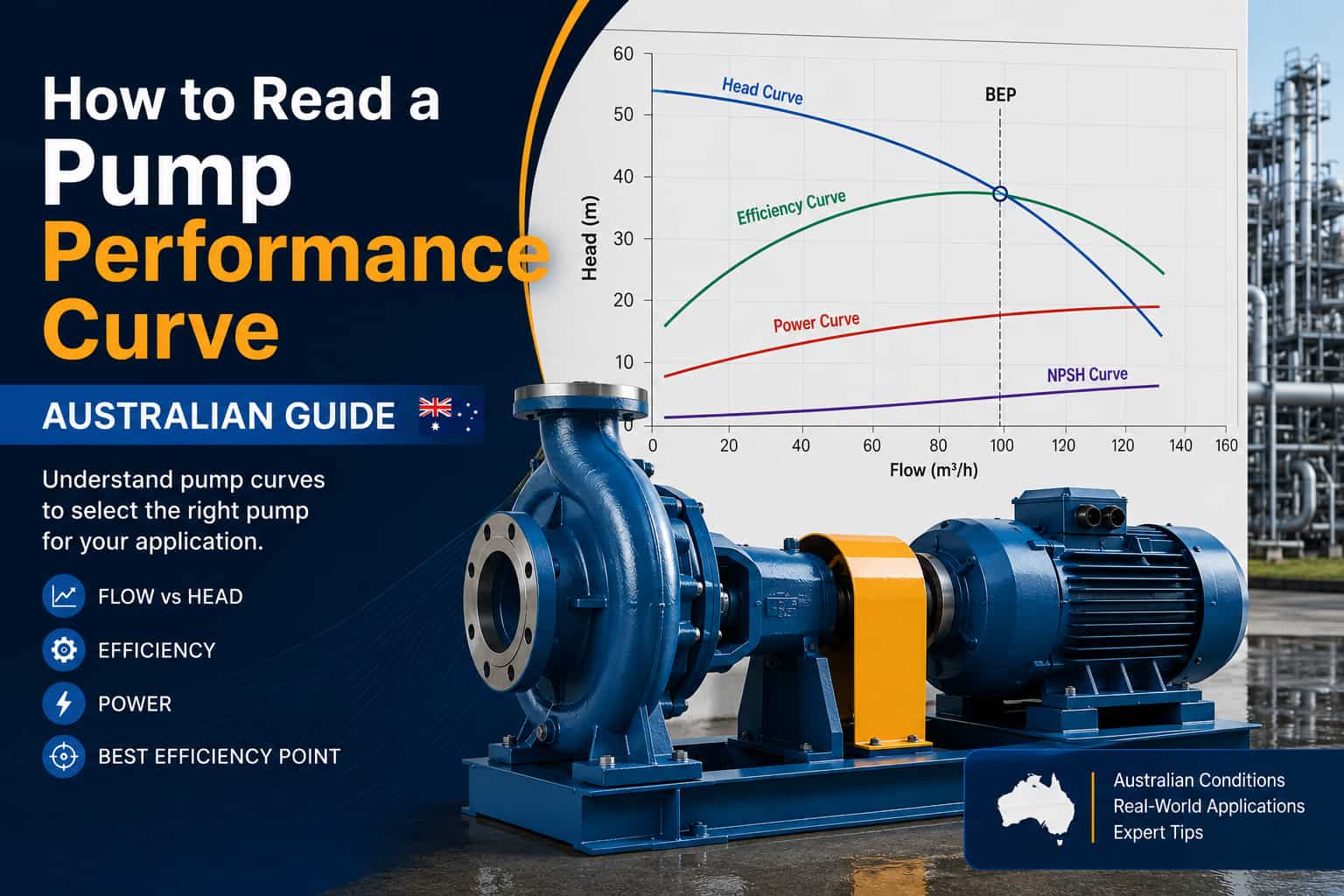
Centrifugal Pump Performance Curve
A centrifugal pump’s performance is described by its Head-Flow (H-Q) curve — a curve that shows how the pump’s discharge head (pressure) decreases as flow rate increases. Key characteristics:
- At zero flow (shutoff head), the pump generates maximum pressure and zero flow. This is safe for brief periods but causes heat build-up if sustained
- At maximum flow (runout), the pump generates maximum flow at minimum head. Running continuously at runout can overload the motor
- The Best Efficiency Point (BEP) is the flow rate at which the pump operates most efficiently. Specifying a pump to operate near its BEP minimises energy consumption and mechanical wear
- As system resistance increases (e.g. a partially closed valve), the pump’s operating point moves left on the H-Q curve — delivering less flow at higher head
Positive Displacement Pump Performance Curve
A PD pump’s performance is described by a near-vertical flow-pressure curve — because flow rate is essentially constant regardless of pressure (within the pump’s pressure rating). Key characteristics:
- Flow rate is determined primarily by pump speed (RPM), not by system pressure. Change the speed, change the flow. Open or close a valve, and flow barely changes — pressure changes instead
- As discharge pressure increases, a small amount of slippage occurs in rotary PD pumps — viscous fluids slip less than thin fluids, which is why PD pump efficiency improves with viscosity
- Pressure builds without limit if the discharge is blocked — this is why a pressure relief valve is non-negotiable on every PD pump installation
Every positive displacement pump installation must have a pressure relief valve fitted between the pump discharge and any valve that could isolate the discharge line. A PD pump will continue to build pressure against a closed valve until either the pump drive fails, a pipe or fitting ruptures, or the pump is mechanically destroyed. This is not a recommendation — it is a fundamental safety requirement. Never commission a PD pump system without a correctly sized and set pressure relief valve.
Viscosity: The Most Important Factor in Pump Type Selection
Viscosity — the resistance of a fluid to flow — is the single most important fluid property in pump type selection. More centrifugal pump misapplication cases come down to incorrect viscosity assessment than any other factor.
| Viscosity Range | Example Fluids | Centrifugal Pump | PD Pump Recommendation |
|---|---|---|---|
| <5 cSt | Water, solvents, light acids | ✅ Excellent — optimal range | Not required; centrifugal preferred |
| 5–50 cSt | Light oils, milk, dilute syrups | ✅ Good — some efficiency reduction | Either type acceptable; application-specific |
| 50–500 cSt | Vegetable oil, gear oil, glycol | ⚠ Marginal — efficiency drops significantly; consider PD | Gear pump or PC pump preferred |
| 500–5,000 cSt | Heavy gear oil, molasses, resins | ❌ Poor — centrifugal pump unsuitable | Gear pump, two screw pump, or PC pump required |
| 5,000–50,000 cSt | Heavy crude, bitumen, polymer melts | ❌ Cannot function | Heated gear pump or heated screw pump with heating jacket |
| >50,000 cSt | Very heavy bitumen, polymer pastes | ❌ Cannot function | Specialist heated PD pump — contact Pump Power Australia |
Viscosity changes significantly with temperature for most industrial fluids — particularly oils, bitumen, and food products. Always specify viscosity at the actual pumping temperature, not at ambient or storage temperature. A heavy fuel oil that is effectively solid at 15°C may have a pumpable viscosity of 200 cSt at 60°C with trace heating — requiring a different pump specification than its cold-temperature viscosity would suggest. Pump Power Australia’s engineering team can assist with viscosity correction across your operating temperature range — contact us for advice.
When to Use Both Pump Types in the Same System
Many Australian industrial processes require both centrifugal and positive displacement pumps within the same facility — performing different but complementary duties. Understanding where each type fits within a process prevents costly selection errors.
Water Treatment Plant Example
- Centrifugal Raw water intake and transfer — centrifugal pumps for high-volume, low-pressure water supply
- PD Pump Coagulant and flocculant dosing — gear pumps or piston pumps for precise chemical metering
- Centrifugal Filtered water transfer and distribution — centrifugal pumps for high-flow, moderate-pressure transfer
- PD Pump Sludge transfer from clarifiers — progressive cavity pumps for thickened sludge handling
Food Processing Plant Example
- Centrifugal CIP (clean-in-place) chemical circulation and rinse water supply — centrifugal pumps
- PD Pump Product transfer — lobe pumps or progressive cavity pumps for shear-sensitive food products
- PD Pump Flavour and additive dosing — gear pumps for precise metered addition
Mine Site Example
- Centrifugal Pit sump dewatering — submersible centrifugal pumps
- Centrifugal Tailings and slurry transfer — slurry pumps
- PD Pump Reagent dosing for ore processing — piston/plunger pumps
- PD Pump Thickened tailings disposal — progressive cavity pumps
Common Mistakes — Using the Wrong Pump Type
Mistake 1: Using a Centrifugal Pump for a Viscous Fluid
This is the most common and costly pump misapplication seen by Pump Power Australia’s engineering team. A centrifugal pump specified for water service and then re-deployed on a viscous fluid duty — oils, syrups, resins — will consume far more energy than expected, deliver significantly less flow, run hot, and wear rapidly. Whenever fluid viscosity exceeds 50–100 cSt, a gear pump or progressive cavity pump should be evaluated.
Mistake 2: Using a Centrifugal Pump for a Shear-Sensitive Product
Food manufacturers and pharmaceutical processors sometimes apply centrifugal pumps to shear-sensitive products because they are familiar, low-cost, and simple. The result is product degradation — broken emulsions, destroyed cell structures, damaged fruit pieces, and reduced product quality. For any product where shear causes quality issues, a lobe pump, PC pump, or eccentric disk pump is the correct specification.
Mistake 3: Using a PD Pump Without a Pressure Relief Valve
Commissioning a positive displacement pump without a correctly sized and set pressure relief valve between the pump and any downstream isolation valve is a serious safety and equipment risk. PD pumps will build pressure without limit against a closed valve. This is not a theoretical concern — it results in burst pipes, failed pump components, and in extreme cases, dangerous fluid releases. Every PD pump installation requires a pressure relief valve. No exceptions.
Mistake 4: Trying to Use a Centrifugal Pump for Accurate Chemical Dosing
Centrifugal pump flow rate varies with system pressure. A centrifugal pump specified for chemical dosing duty will under-dose when system pressure is high and over-dose when it is low — making accurate chemical addition impossible without continuous flow measurement and PLC feedback control. For accurate dosing, specify a positive displacement dosing pump — gear, piston, or progressive cavity depending on the chemical and required accuracy.
Mistake 5: Specifying a PD Pump for a High-Flow, Low-Pressure Clean Water Duty
Positive displacement pumps are not the answer to every pumping problem. For high-flow, low-pressure clean water duties — water supply, irrigation, HVAC, drainage — a centrifugal pump is simpler, cheaper, more reliable, and far more energy-efficient. Specifying a PD pump for a duty that a centrifugal pump handles better results in unnecessary complexity, higher capital cost, and more maintenance.
Mistake 6: Running a Centrifugal Pump Dry
Centrifugal pumps rely on the pumped fluid to lubricate and cool the mechanical seal and bearings. Running dry — even briefly — can destroy the mechanical seal, causing leakage, and can cause bearing damage. Specify dry-run protection devices (dry-run sensors, low-level switches, or pressure switches) on centrifugal pump installations where dry running is a risk. Our mechanical seals team can advise on seal specifications for your application.
Mistake 7: Applying the Cube Law (VSD Energy Savings) to a PD Pump
As covered in our VSD energy savings guide, the dramatic cubic energy savings from VSD speed control apply only to centrifugal pumps. Positive displacement pumps deliver proportional (linear) power savings with speed reduction — a 20% speed reduction gives approximately 20% power saving, not 49%. This is still valuable, but it must not be confused with the cubic savings achievable on centrifugal pump applications.
Expert Tips from Pump Power Australia’s Engineering Team
- Always confirm viscosity at operating temperature — not at ambient temperature. Many fluid selection errors stem from viscosity data taken at the wrong temperature. A heavy oil at 15°C may be effectively unpumpable by a centrifugal pump, but entirely appropriate at 60°C.
- If you are unsure whether your fluid is shear-sensitive, assume it is and specify a PD pump. The cost of degraded product quality or a batch loss is almost always greater than the cost difference between pump types.
- For applications that alternate between clean water (CIP) and viscous product duties, consider two separate pump circuits — one centrifugal for CIP, one PD for product. Trying to use a single pump for both duties typically results in a compromise that serves neither well.
- In chemical dosing applications, even a small centrifugal pump with a flow meter and PLC control is less accurate and more maintenance-intensive than a properly specified PD dosing pump. Get the pump type right from the start.
- When specifying a PD pump, always specify the pressure relief valve at the same time. The relief valve is not an optional accessory — it is an integral safety component of every PD pump installation.
- For new installations where the fluid characteristics may change over the asset life (new products, changed process), specify a PD pump with variable speed drive for maximum flexibility — flow rate can be matched to process requirements by adjusting speed, without changing pump internals.
- Pump Power Australia can supply complete pump solutions across both centrifugal and positive displacement families — browse our full product types page or contact our engineering team for application-specific selection advice.
Comparison Tables
Table 1: At-a-Glance Selection Guide — Centrifugal vs Positive Displacement
| Selection Factor | Choose Centrifugal Pump | Choose Positive Displacement Pump |
|---|---|---|
| Fluid viscosity | <100 cSt (water, dilute chemicals, light liquids) | >100 cSt (oils, syrups, resins, bitumen, pastes) |
| Flow rate requirement | High to very high — large volume transfer | Low to moderate — precise or metered delivery |
| Pressure requirement | Moderate (single stage); high (multistage) | Very high achievable in reciprocating designs |
| Shear sensitivity | Fluid is not shear-sensitive | Fluid degrades under impeller shear (food, pharma, polymers) |
| Metering / dosing accuracy | Not required — flow variation with pressure acceptable | Required — fixed volume per stroke/rotation essential |
| Solids content | Low solids (standard); high solids (slurry pump) | Very high solids (PC pump up to 70% w/w) |
| Self-priming required | No — can flood pump from gravity supply | Yes — pump located above fluid level |
| Hazardous area / ATEX | AOD: not applicable; Mag drive: suitable if area is safe | AOD pump: no electricity — inherently safe for hazardous areas |
| Zero leakage required | Magnetic drive centrifugal pump | AOD pump (double diaphragm) |
| Maintenance preference | Minimum — fewest moving parts | Acceptable — more components but designed for serviceability |
| VFD energy savings | Excellent — cubic law applies (up to 50% at 80% speed) | Good — proportional savings only (~20% at 80% speed) |
Table 2: Pump Type by Industry Quick Reference
| Industry | Centrifugal Pump Types Used | Positive Displacement Pump Types Used |
|---|---|---|
| Mining | Submersible, slurry, multistage, bore hole, split case | Progressive cavity, piston/plunger, AOD |
| Food & Beverage | Centrifugal (CIP and water), magnetic drive | Lobe, progressive cavity, gear, eccentric disk, AOD |
| Chemical Processing | Centrifugal (corrosion-resistant), magnetic drive | Gear, AOD, piston/plunger, progressive cavity |
| Oil & Gas | API 610 centrifugal, multistage | Two screw, progressive cavity, piston/plunger, gear |
| Water & Wastewater | End-suction, submersible, split case, screw, propeller | Progressive cavity (sludge), gear (dosing), piston (dosing) |
| Marine | Centrifugal (ballast, cooling, bilge) | Triple screw, two screw, gear (lube oil and fuel oil) |
| Power Generation | Multistage (boiler feed), split case (cooling water) | Triple screw (lube oil), gear (fuel oil, lube oil) |
| Asphalt & Bitumen | Not suitable | Heated gear pump, two screw (heated), progressive cavity |
Key Takeaways
- Centrifugal pumps and positive displacement pumps operate on fundamentally different principles and are suited to completely different applications — they are not interchangeable
- Choose a centrifugal pump for high-flow, low-viscosity, moderate-pressure duties with simple, low-maintenance requirements
- Choose a positive displacement pump for viscous fluids, shear-sensitive products, precise metering, very high pressures, or self-priming applications
- Viscosity is the single most important fluid property in pump type selection — centrifugal pump efficiency degrades rapidly above 50–100 cSt
- Positive displacement pumps deliver constant flow regardless of system pressure — making them essential for accurate dosing and metering
- Every positive displacement pump installation must have a pressure relief valve — no exceptions
- VSD cubic energy savings (cube law) apply only to centrifugal pumps — positive displacement pumps achieve proportional savings only
- Many industrial processes correctly use both pump types simultaneously — centrifugal for bulk fluid transfer, PD pumps for metering, dosing, and viscous product handling
- The most common and costly misapplication is using a centrifugal pump for a viscous or shear-sensitive fluid — match the pump type to the fluid, not the other way around
- Pump Power Australia supplies the complete range of both centrifugal and positive displacement pumps — contact our team for application-specific selection advice
Frequently Asked Questions
A centrifugal pump uses a rotating impeller to convert kinetic energy into fluid pressure and flow — it is best for high-flow, low-viscosity, moderate-pressure applications and delivers variable flow depending on system pressure. A positive displacement pump mechanically traps and forces a fixed volume of fluid per cycle — it delivers constant flow regardless of system pressure and excels at viscous fluids, accurate metering, and high-pressure duties. The two pump families operate on fundamentally different principles and are suited to completely different applications.
Positive displacement pumps are significantly better for high-viscosity fluids. Centrifugal pump efficiency degrades rapidly as viscosity increases above approximately 50–100 cSt — the impeller loses its ability to impart kinetic energy to the fluid effectively, resulting in very high energy consumption for little flow. For viscous fluids, gear pumps are the industry standard, with progressive cavity pumps and screw pumps for higher viscosities and solids-containing duties. Above approximately 10,000 cSt (heavy bitumen, polymer melts), heated pump designs are required.
No — not without a flow meter and PLC feedback control system, which adds cost and complexity. A centrifugal pump’s flow rate varies with system pressure, making it inherently unsuitable for accurate metering without instrumentation. For accurate chemical dosing, specify a positive displacement pump — gear pump, progressive cavity pump, or piston pump depending on the chemical, required accuracy, and operating pressure. PD pumps deliver a fixed volume per cycle, enabling accurate, repeatable dosing without flow measurement.
A positive displacement pump delivers a fixed volume per cycle regardless of system pressure. If the discharge line is blocked or a valve is closed, the pump continues to push fluid — building pressure without limit until either the pump drive fails, a pipe bursts, or a fitting is destroyed. A pressure relief valve protects the pump, pipework, and personnel by opening and bypassing fluid back to the suction side if discharge pressure exceeds the safe limit. A pressure relief valve is a mandatory safety component on every PD pump installation — not optional. Contact Pump Power Australia for advice on relief valve sizing and selection for your application.
It depends on the product. For clean water, CIP chemicals, and non-shear-sensitive liquid products, centrifugal pumps are appropriate and cost-effective. For shear-sensitive products — dairy products, fruit pulp, sauces, whole-fruit beverages, cultures, and emulsions — a positive displacement pump is required to protect product quality: lobe pumps (CIP/SIP compatible, gentle handling), progressive cavity pumps (high-viscosity and particulate products), or eccentric disk pumps (ultra-fragile products). See our sanitary food and beverage application page.
No — there is a significant difference. On centrifugal pumps, the Affinity Laws (Cube Law) mean a 20% speed reduction delivers approximately 49% power saving — a highly non-linear, very favourable relationship. On positive displacement pumps, power scales proportionally with speed — a 20% speed reduction gives approximately 20% power saving. VSDs still provide valuable flow control and energy benefits on PD pumps, but the energy savings are much less dramatic than on centrifugal pumps. See our detailed VSD pump energy savings guide for full calculations and worked examples.
Tailings transfer requires a specialist centrifugal slurry pump — not a standard centrifugal pump. Slurry pumps feature thick high-chrome white iron or rubber liners, wide impeller clearances, and low operating speeds to maximise wear life in highly abrasive duty. Standard centrifugal pumps fail rapidly in tailings service. For thickened or paste tailings at very high solids concentrations, progressive cavity pumps may be more appropriate. See our mining application page and mine dewatering guide.
Technically yes — but it is not the right tool for most clean water applications. PD pumps are more complex and more expensive than centrifugal pumps for equivalent flow rates in simple, clean-fluid, low-pressure duties. They also require pressure relief protection and are generally less energy-efficient at high flow rates. For clean water supply, irrigation, HVAC, and general water transfer, a centrifugal pump is the correct, lower-cost, lower-maintenance choice. PD pumps earn their place in high-pressure, high-viscosity, or metering applications.
Both are positive displacement pump types, but they suit different duties. A gear pump uses meshing internal or external gears to trap and move fluid — it excels at clean or mildly contaminated viscous fluids (lubrication oil, hydraulic fluid, edible oils, fuel), delivers precise flow with low pulsation, and achieves high pressures in a compact package. A progressive cavity pump uses a helical rotor inside a rubber stator — it excels at fluids containing significant solids, highly viscous or shear-sensitive media, and self-priming applications where the fluid may be inconsistent or intermittent. PC pumps handle solids up to 70% by weight; gear pumps are damaged by abrasive particles.
Yes — expert pump type selection is central to what Pump Power Australia does. With over 35 years of experience across mining, oil and gas, food and beverage, water treatment, chemical processing, and power generation, our engineering team can assess your fluid, duty point, and installation requirements and recommend the optimal pump type and model from our comprehensive range. We supply the full spectrum of both centrifugal and positive displacement pump types from leading global manufacturers. Contact our team or call +61 3 9933 7400.
Conclusion: Match the Pump to the Application — Every Time
The centrifugal pump vs positive displacement pump decision is one of the most consequential choices in industrial pump system design. Get it right and your installation delivers years of efficient, reliable service. Get it wrong and you face premature failure, poor performance, product quality problems, and the cost and disruption of replacing the wrong pump with the right one.
The framework in this guide — choosing by fluid viscosity, shear sensitivity, solids content, flow rate, pressure requirement, and metering accuracy — gives engineers, plant managers, and procurement teams across Australian industry a systematic, defensible basis for this decision. There are no shortcuts, but there are clear rules: centrifugal for high-flow, low-viscosity, bulk transfer duties; positive displacement for viscous, shear-sensitive, metered, or high-pressure applications.
Pump Power Australia supplies the complete range of both pump families — from centrifugal, multistage, slurry, submersible, and magnetic drive pumps through to gear, progressive cavity, lobe, AOD, piston/plunger, and screw pumps — all backed by local spare parts inventory and technical support from our Brooklyn, Victoria base. Browse our complete pump types range or explore our industry applications to find the right pump for your process.
Not Sure Which Pump Type Your Application Needs?
Talk to Pump Power Australia’s engineering team. Describe your fluid, your duty point, and your process — and we will recommend the right pump type and model from our comprehensive range of centrifugal and positive displacement pumps.
📞 +61 3 9933 7400
✉ info@pumppower.com.au
9 Export Drive, Brooklyn VIC 3012 | pumppower.com.au/contact-us
Serving industrial customers across Victoria, Western Australia, Queensland, New South Wales, South Australia, and the Northern Territory.